Posted in Advocacy, Mental Health

Over Pathologisation of Mental Health

We hear a lot nowadays about removing the stigma from mental illness, and that is incredibly important. After all, we all have mental health. But I also I think it’s essential while advocating in mental health spaces that we not only call for destigmatisation, but we also question the systems; call out the injustices of the systems meant to care for us. We must question whether medicalisation of mental health really helps us. Would it be necessary if our society wasn’t structured the way it is in the west? Does it further the link between mental illness and criminalisation? Because destigmatising mental distress isn’t only recognising that it exists, it’s asking why it exists, is the language we use to describe mental illness helpful, what does healing really mean, and how are we failing to learn the lessons from our madness? So here are some of my musings on the over pathologisation of mental health:

It individualises our pain without individualising our care – that is to say it tells us we are broken, it is our individual chemistry that is flawed, and we are to blame, yet also not putting us at the forefront of understanding our pain and choosing how we heal. It tells us we are too sick to know what’s really good for us, or that we don’t know ourselves well enough. It doesn’t allow us to learn who we are and what’s really at the root of our pain; doesn’t encourage us to put it into a sociopolitical context, and the context of what has informed our life. Doesn’t allow us to heal with others.

There is no community. No value given to peer support, to healing with others who are experiencing the same things or similar things or completely different things, but feel safe to heal with. Doesn’t encourage the connections that are vital to long term healing and alternative methods of care. If you want proof that peer support methods of healing work, look at AA – it revolutionised care for alcoholics. What was a death sentence became an opportunity for hope and healing.

Our pain is shunned and labelled, pathologised. Instead of learning to embrace the madness as part of who we are, we learn shame which in turn births more pain. Instead of learning to see mental distress as a natural human reaction, however difficult, we learn to be afraid of it. Language that could be used to free us is instead weaponised against us to strip us of our wholeness and our identity through clinical rotes.

But it doesn’t have to be that way. I don’t have all the answers. I listen to psychiatric abolitionists and I think, yeah, they have the answer. I listen to amazing healers in other cultures outside of the west and am filled with inspiration and hope. Then I look back at the world as it is and wonder if we don’t need to adapt our goals to be a little more realistic within the current frame of society here in the UK. I don’t have the answer nor a clear label for my ideology surrounding this all. But I do have hope. And I do know things are already changing. 

We don’t have to wait to build communities. We don’t have to wait to create new ways of healing. We don’t have to wait to find hope. 

You can also find a version of this post on my Instagram @our.happy.notes
Posted in Managing Mental Health, Mental Health, positivity

Identity in Mental Illness

As an autistic person with mental illnesses sometimes it can be hard to figure out who I am.

If you have diagnoses you might feel like you have to split up parts of yourself and your actions into boxes, like this part of you is autism and that part of you is anxiety, for example.

Or you might feel like your whole identity is your diagnoses.

Even without a diagnosis you might feel like parts of you are defined by the way you feel, split up and separate.

This can make us feel like we have to be ashamed of these parts of ourselves or like we are not really whole. It can be confusing to know who we are and find our identity in the midst of it all.

Then you add in other identity factors like sexuality, gender, and race which in many cases can complicate our mental health and understanding of ourselves even further – especially because it impacts how others see us, and this is even more prevalent for minority identities.

Rather than trying to see ourselves as a selection of different parts and separate ourselves into these parts, maybe we can start to think of it more like colours blended together and filters on the image of who we are.

Like my anxiety is red and it bleeds into my passion for theatre which is blue. They mix to create a purple in the middle, and that’s where stage fright lives. But all the colours are a part of me, blending together to make me who I am.

And my autism is a filter with a yellow tinge and that does affect how I view and interact with the whole world, but it isn’t my whole identity, nor is it separate to every other part of me. They all work together in different ways to make me who I am.

At the end of the day, you don’t have to have everything figured out about your life and who you are. No one does. It’s a journey and an ongoing process which can be really scary to think about. But it’s actually pretty amazing, all these colours that make up the rainbow of you, changing and growing each day. Remember – no one but you gets to define who you are; your identity is personal and you don’t owe it to anyone else, nor do you need to define who you are! 

But you are wonderfully unique, allowed to take up space, and your rainbow is so much more than you could ever imagine.

Posted in Advocacy, autism, Mental Health

Diagnosis – Good, Bad, or Dependant on the System?

Validation:

It can be very hard to access treatments and be validated by ‘professionals‘ within this system without a diagnosis. Budget issues and a mental health system based in oppression that seeks to produce productivity rather than healing and often doesn’t recognise its intrinsic links to all other aspects of capitalist society doesn’t help this. However, more importantly, without a diagnosis it can be hard to validate ourselves – to give ourselves permission to display certain symptoms, feel what we feel, and believe that it’s real.

Getting a diagnosis can be a validating and liberating experience for many people – my autism diagnosis certainly was for me. It helped me understand myself, put my entire life into context, and connect with other people going through similar experiences. That was incredibly useful with all my diagnoses – finding people going through the same thing and learning how they were managing in a world often not built for us which helped me find ways to define and facilitate my own healing. Community truly is a powerful force. It teaches us that we are not alone, and is one of the most invigorating tools in supporting mental health; my diagnoses are helping me find mine.

But we must ask the question – why do we lack validation without a diagnosis? Why have we not been taught validation and community by the systems surrounding us? If human experience was universally understood as fluid and acceptable, would we need diagnoses at all?

Stigma and Stereotyping:

However, diagnoses have also been used as oppressive tools throughout history, and being given a diagnosis can be a terrifying experience. For example women could be put into mental institutions if their husbands thought they weren’t living up to their duties and this was justified under the label of hysteria. Nowadays Black women are significantly more likely to be diagnosed with BPD – this may be a misdiagnosis of a neurodivergency (chronically under recognised in Black people) or due to how their traits and emotions are perceived so different within the system. Black people are also four times more likely to be detained under the Mental Health Act in the Uk – a hugely oppressive tool that twins criminal incarceration.

It may feel like a condemnation to receive a diagnosis due to preconceived notions of stigmatised mental illnesses, and lack of care options. Sometimes it can seem like a lifetime of suffering and inevitable failures lie ahead. It may even be harder to be taken seriously within the system – especially in psychiatry wards where any legitimate complaints can be brushed off as ‘symptoms’. Telling family and friends may elicit negative reactions due to their preconceived ideas, regardless of how positive the experience was for the individual

Stuck in a Box:

Although it can be liberating to understand your behaviour through the lens of a diagnoses, it can also be challenging when dealing with others and interpreting your own experience. It can be difficult to know where you start and where the illness ends, or to what extent you should view yourself as your illness. It can be difficult to know whether an emotional reaction is ‘natural’ or a symptom or a potential warning for future issues. It can be difficult to be heard and seen as anything but your diagnosis and your experiences as anything separate or unrelated to it by others.

Diagnosing a mental illness is not straight forward. No one person presents the same, and often two psychiatrists will have completely different opinions leading to misdiagnosis/ confusion for the individual trying to grapple with many opinions and find understanding.

And yet once given a diagnosis we are often stuck in a box or a more rigid understanding of who we are and how me must think and will behave. Does that seem logical? It doesn’t to me. But it’s understandable within a system that looks for easy processing, and profit – both achieved through the over medicalisation of human distress. 

When the DSM was first released in 1952 there were 102 diagnoses in it. By 2000 there were 365. This has since reduced again – but you can see how inexact and dramatic the medicalisation has been.

Nonetheless, getting a diagnosis, finding community and comfort it in, can be a very positive experience. My autism diagnosis certainly was for me, and being able to say I’m bipolar helps me feel whole and proud of everything I’ve been through. But getting those diagnoses, navigating conversations, therapy, and life with them has been challenging and complicated. And I am privileged in many ways. Bottom line – receiving a diagnosis is not something to be afraid of, and if your experience was good then that is amazing, and valid! But negative experiences are just as valid too. Perhaps even more so because they often fall on the more marginalised. And everyone’s emotions, pain, and trauma are valid with or without a label. We deserve a society that teaches us that.

Sources

  • Sedated: How modern capitalism created our mental health crisis by James Davies
  • verywellmind.com 
  • mind.org.uk
  • Phenomenology of Borderline Personality Disorder, The Role of Race and Socioeconomic Status, Natacha M. De Genna, PhD and Ulrike Feske, PhD
  • My brain
Posted in Happy Notes, Managing Mental Health, Mental Health, Personal Growth

An Anxious Experience

Today’s post is a guest post written by Eya, a follower of Our Happy Notes on Instagram (their username: @the_dangerous_me). It was edited by Millie Bevan, founder of Our Happy Notes. If you would like to collaborate please email ourhappynotes@gmail.com or fill out the contact form on the website.

Anxiety can be a very physical experience where you can’t understand what’s happening to your body.  It’s hard to rationalise; it feels like your hormones have gone into overdrive. And really they have – being afraid or nervous is your body and brain’s way of telling you that there is danger nearby, so you may think at first that the feeling will pass, but anxiety means your brain sees danger everywhere. It doesn’t pass so easily. 

Anxiety is a silent killer. It kills your soul, it cuts you to pieces. Consider yourself as a game to anxiety because it makes you feel like a doll which it plays with. You can’t sleep at night and you constantly question what the people around you might be thinking, getting stuck in a loop with these thoughts going round and round in your head, replaying everything you’ve said and done. I have experienced anxiety since I was 13 years old when I started to lose sleep andi cried at night and i suffered. I felt so alone and it was a dark time in my life. I lost friends, became isolated, and soon started to experience depression as well. But there is  hope. I went to a therapist and day by day I felt better. Anxiety is not a topic to be taken lightly. It can make life so difficult. But you are not alone and you can look after your mental health. Eventually, with patience, it gets better.

There’s a lot of love out there and people that care. You can learn to love yourself again; know that there’s nothing that could stop you from your dreams and achievements. Nowadays I feel so much better, so I want to pass that hope onto you so you can enjoy everyday for yourself. 

Posted in Managing Mental Health, Mental Health

How to Support Someone With Mental Health Issues

It can be extremely hard to watch someone you love and care about going through a tough time regarding their mental health. It can also be painful if someone close to you discloses their mental illness or mental health struggles and you had no idea about it. You may feel like a failure yourself, like there’s nothing you can do, like you are useless. Essentially it may start to impact your mental health as well. That’s why the most important thing to remember when supporting someone with mental health issues is that you need to look after yourself as well. You have to.

1. Look after yourself

Sometimes we want to rush in and save the whole world – fix everything – but this simply isn’t possible. Perhaps at first it may seem like a good idea to try and take on the other person’s issues entirely as your own, without giving yourself the space needed to process your own emotions. In fact for a short while this may actually help the other person – but that’s not sustainable; long term it will lead to you burning out, struggling yourself or becoming resentful, likely making the entire situation worse. That’s why it’s so important to look after yourself, even if this is just journaling at the end of the day to help you sort out the feelings of the day, or doing a hobby once a week, the possibilities are limitless and you have to find what works for you. The important thing is that you do find it. And putting in boundaries with the person you are supporting can also help this, and most likely will help them in the long run too.

2. Listen to them

Many people with mental health issues, especially when they are first opening up about them, doubt themselves, feel ashamed or invalidated. By listening to them with an open mind you can help lessen these feelings. And by listening, I mean just that. Not everyone wants (nor even needs) advice or solutions all the time, sometimes they just need to be heard so they feel a little less alone. When having a conversation about their emotions/ experience it can be really helpful to ask the question ‘would you like me to offer advice or just listen to you?’. Validating their experience through listening to them can have a huge impact for someone struggling and give them confidence and reassurance. Remember that they are the one that lives in their brain, and they know what they are going through better than anyone else; it’s not your job to dictate to them what they are undergoing. However, linking to my last point, it is important that you don’t take on all of their feelings for yourself, so placing boundaries can be really helpful – for example requesting that before they talk to you, they ask you if you are in a place to have that conversation.

3. Involve them

Going through a tough time mentally can feel very isolating, and our brains can make us feel very lonely and rejected. That’s why it’s important to continue to involve someone who is struggling mentally. This could mean continuing to invite them to social events while making clear there is no pressure or expectations placed upon them to attend. If they accept and invitation, it might then mean making some accommodations for them, like helping them order food if that’s a point of anxiety for them or giving them some space if they need it for example. It might also mean offering to meet them one on one for a while if that’s easier for them, or talking with them about plans to keep them safe and checking in with them regularly. To relate to my last point, if you’re unsure of what to do, you can always ask them if they have any ideas or if there’s a way you can accommodate them better. This is a huge sign that you care for and accept them still.

4. Research their experience

If the person you are supporting has a diagnosis or has disclosed to you specific symptoms, it can be helpful for your own knowledge to research this. A quick google search will bring up symptoms lists and examples of how these might affect them, but I would also encourage you to look beyond this and read up on the personal experience of different people from different walks of life to get a clearer picture. This can help you understand the person you are supporting better without the worry that you are prying to much, and it can help them to feel seen as this informs how you support them.

5. Make them a happy kit

I’ve made a previous post on this, which you can read here. A happy kit is essentially a little collection of things that can help someone process their emotions, get through a crisis moment, or just generally cheer them up. It can include some things that they find calming or cheering, and maybe a list of distractions and mini coping exercises to try. Distractions are also a really great way to help someone with a mental health issue – it’s not a long term fix but it can help them escape their brain for a minute and feel more ready to face the day. If a distraction is creative it could also be a way of helping them to express themselves, and feel less alone if you’re doing it together.

6. Help with small tasks

Small tasks such as cleaning, ordering food, or remembering deadlines can become seemingly impossible for someone experiencing a mental health struggle. If you feel up to it you can offer to help them with these small tasks, even if that’s just by doing it with them (for example cleaning together one afternoon, or going food shopping together). As always, asking them how best to help is always a good idea, and if they’re not sure offering something specific – such as sending them a reminder text – might appeal to them.

7. Show them you care

It’s simple, but one of the most helpful and meaningful things anyone has ever done for me during my own struggles has been showing me they cared. This could mean writing someone a supportive letter, or making them a playlist. Just something simple that lets them know you care.

7. Be patient

We all have mental health and it can be a long term challenge to face for many. Someone in the midsts of a struggle isn’t going to overcome it overnight, but with amazing people like you willing to support them, they can find their way through. Keep in mind that you need to be patient – one of the reasons why looking after yourself is so important – and that their struggles are not a comment on you, ever. Eventually the sun will come shining through!

Posted in Advocacy, Mental Health

Overview on Eating Disorder Awareness

As someone who spent a long time struggling with disordered eating – and still continues to grapple with it – I know first hand that eating disorders, diet culture, body image and our relationship with food is so much more complicated than a few statistics. However I also know that de-stigmatisation of mental health starts with awareness, and that de-stigmatising mental illness saves lives and has the power to change communities. So for eating disorder awareness week here’s a short overview I put together on eating disorder awareness. Follow this blog for more in depth posts to come on this topic:

Eating Disorder Misconceptions:

Not everyone with an eating disorder;

… is skinny

… is underweight

… goes to hospital

… knows they have one

… gets diagnosed

… recovers

… is white

… is female

… has anorexia or bulimia

… is a teenager

… looks like they have one

… restricts or purges

… survives

… has body dysmorphia

Eating Disorder Facts:

⁃ Around 25% of those affected by an eating disorder are male

⁃ Only around 10% of people suffering with an eating disorder are anorexic

⁃ Eating disorders are not a choice or for attention – they are a mental illness

⁃ Research suggests that people that have a family member with an eating disorder are more likely to develop one

⁃ Black teenagers are 50% more likely to exhibit symptoms of bulimia than white teenagers

⁃ LGBTQ people are more likely to develop an eating disorder

⁃ Research suggests that up to 20% of autistic people exhibit traits of eating disorders, and while anorexia is the second least common eating disorder among non-autistic people it is the most common among autistic people

⁃ Approximately 1.25 million people in the U.K. have an eating disorder

⁃ Anorexia has the highest mentality rate of any psychiatric disorder

Types of Eating Disorders:

⁃ Anorexia Nervosa

Anorexia (or anorexia nervosa) is a serious mental illness where people lose a lot of weight due to restricting how much they eat and drink. They may develop “rules” around what they feel they can and cannot eat, as well as things like when and where they’ll eat, and around exercise. Anorexia can affect anyone not matter their age, gender, ethnicity or background.

⁃ ARFID

Avoidant restrictive food intake disorder, more commonly known as ARFID, is a condition characterised by someone avoiding certain foods or types of food. They may restrict overall intake of intake of certain foods, and have foods that they deal as “safe”.

⁃ Binge Eating Disorder

Binge eating disorder (BED) is a serious mental illness where people eat very large quantities of food while feeling like they are not in control or what they are doing. Evidence suggests it is more common than other eating disorders, and is often misunderstood.

⁃ Bulimia

People with bulimia feel caught in a cycle of eating large quantities of food (called bingeing), and then trying to compensate for that overeating by purging in some way. That may be vomiting, taking laxatives or diuretics, fasting, or exercising excessively.

⁃ OSFED

Anorexia, bulimia, and binge eating disorder are diagnosed using a list of expected behavioural, psychological, and physical symptoms, however sometimes a person’s symptoms don’t exactly fit the expected criteria for any of these three specific eating disorders. In that case, they might be diagnosed with an “other specified feeding or eating disorder” (OSFED).

Things not to say to someone with an eating disorder (or literally anyone for that matter)

⁃ Are you really going to eat all that?

⁃ That’s a meal not a snack!

⁃ You’re just attention seeking

⁃ You’re weak

⁃ Just eat more/less

⁃ Get over it

⁃ But you’re eating well, how can you have an eating disorder?

⁃ I could never starve myself, I wish I was as devoted as you

⁃ Why don’t you just stop throwing up?

⁃ What diet are you on?

⁃ You should just go on a diet

⁃ Pointing out their weight gain, weight loss, anything about their body or anyone else’s body; try to compliment people through things unrelated to appearance

Eating Disorder help

⁃ Recovery is completely possible; the worst day in recovery is better than a single day being ill

⁃ No one with an eating disorder has anything to be ashamed of; there are so many loving and supporting people out there ready to help

⁃ Asking for help is not weak; it is brave

⁃ If you are a family member or friend supporting someone with an eating disorder you deserve to be supported as well

⁃ You deserve to have a healthy, sustainable and accepting relationship with your body and food

-You are not alone

Goeree, Sovinsky, & Iorio, 2011; Beateatingdisorders.co.uk; Autism.org.uk; Health.com

Posted in Mental Health, Personal Growth

Letter to Anyone With Disordered Eating

Dear you,

I’ll start by saying hello and that I care, in case no one has said that to you today. Where you are right now, I’ve been there. Maybe not physically, but in some way mentally, and certainly in empathy with you. Some days you’ve probably told yourself you’re not struggling, it’s not hard, it’s worth it – I know I did. And deep down I also know that you know it’s not. It never will be. So here’s my letter to you. Not to say stop or that the pain goes away overnight, just to speak to you as someone who cares, and let you be.

You may think this is all about ‘skinny’; that this is all about achieving the version of yourself that you ‘should’ be. You might think you’re in control. It feels good to be in control right? To know your goals, your focus for the day or the month. I get that. The problem is that in the end, you’re not. And, wow, that is painful to realise. It crushed me when I did. It brought back the struggle of every step I’d been through. But it was necessary. In the end it controls you – whether that is your thoughts or this system telling you that you will never be enough until you fit into that dress, it controls you. And all of a sudden what you were fighting for becomes the thing you are fighting to get away from. In a way, if you really look, you can see this all along. I don’t want you to feel that terror or that hurt, but I want you to know you are not alone in that and the sooner you can get away from it the better.

The good news is that you can. I’m not forcing you to – I’m not another voice telling you to eat more or eat less or do this or that because they can be annoying right? And they can fuel us, I know they did for me. I lived for the finger on my spine telling me how skinny I’d gotten; I lived for the voice telling me how healthy I looked, thinking I’d failed. You’ve never failed. There’s never anything you should be. All I want to do is remind you of your power and your strength because my goodness have you got a lot of it. Think I’m wrong? Well let’s have a look at it, logically – maybe you’ve been restricting for months, purging for years, feeling unworthy for what seems like a lifetime, binging every night? That takes effort. That is blood and sweat and tears, often literally. But the effort it took just to put into that system shows you just how much power you have in you to reverse it. That strength can be turned around to go the other way and to learn, or relearn perhaps, that you are enough just the way you are. What makes you who you are is not your body.

Words like that seem futile though sometimes, don’t they? Well, I’ll let you in on a secret, I don’t love my body. Most people don’t love their bodies, at least not everyday. But what I do have now is a deep appreciation for how incredible the inner workings of my body are. They’re insane! And most days – I have acceptance. That’s all I need. Acceptance that this food fuels my brain, and that I am enough in this moment. Just enough. Not to say I don’t still struggle, because I do, I really do, but I look back on the pain I was in and I wonder how I ever survived. I didn’t even realise it at the time. It took someone reaching out and telling me they’d been there too for me to even comprehend the idea that this wasn’t healthy for me to be under such mental stress, let alone physical. You are not alone.

Most likely you know all the issues that await if you head down this road further, so I’m not here to preach that to you, but to give you hope of a life outside of this. Of an acceptance and tolerance I for one could not even dream of at one point. My dear you are doing alright – whatever has brought you to this point does not deserve your magnificence or your power. I want to remind you that help is a brave word and there are so many people out there ready and willing to help you in so many different capacities no matter what your struggle may be. I love you, and you are worthy of a life outside of a fixation on your looks. We all are.

Your friend,

Millie

Posted in Advocacy, Mental Health

Reducing Mental Health Stigma

I have been fortunate that I have not personally come up against too much explicit stigma throughout my mental health journey so far – and when I have, there has been an incredible amount of supportive people surrounding me. However just a quick trip online reveals how much stigma still exists around mental health, and backhanded comments such as ‘just snap out of it’ or ‘you don’t look mentally ill’ are far too common. Sometimes I am afraid that I will be left out from job opportunities or educational experiences in the future because of my struggles. And so it is important to me, for my benefit and the benefit others, that I do what I can to reduce stigma in my advocacy. For me that means sharing my story, educating myself (especially on the intersectionality of mental health in society), and being open in conversation. Here is my quick guide on what anyone can do to reduce mental health stigma.

  1. Change your language

It might insignificant, but language holds power. What I mean by this is avoiding calling someone who is mentally ill ‘crazy’, and instead validating their experience. Another way to adapt our language is to avoiding using conditions as adjectives. For example instead of saying ‘I’m a bit OCD’ say ‘I like things to be tidy’, and instead of saying ‘She’s so bipolar’ say ‘she’s a bit moody today’. Changing our language can signify a shift in how we approach topics, and encourages us to be more mindful of how what we say can impact someone.

2. Educate yourself

Education is a powerful tool. Educate yourself on the warning signs of mental health issues, different conditions, and the reality of the lived experience of those struggling with their mental health (they’re not the dangerous, horrible people that some media may lead us to believe they are). And educate yourself on the fact that everyone has mental health, and everyone deserves to look after it. Furthermore, educate yourself on how mental health is intersectional with identity and social issues. Here is a post from my instagram that has some basic statistics on this.

3. Listen

When someone speaks up about their mental health, listen. Actively listen. Do not try to shut them down or tell them to toughen up. Listen to what they need and what they are experiencing.

4. Speak up

If someone says something ignorant in a conversation about mental health, try to gently educate them. If you are able to, speak up in your workplace or school to ask for better training for employees on mental health, and policies to support employees/ students.

5. Speak to power

Sign petitions that lobby for better and more inclusive mental health support nationwide and in our communities. Write an email to your MP (or other political representative) about improving mental health systems.

8. Support mental health charities

Whether this is by donating, sharing their campaigns, or engaging with their programmes, their work is so important.

7. Carry openness in your life

Include people in your workplace; continue to invite friends with mental health issues even if they don’t always come along. Treat everyone with dignity and respect, and offer them encouragement in their day to day life and when seeking professional support. Never blame anyone for their struggles. Be kind.

Thank you for taking the time to read this post. All of my love and support to you today,

Millie xx

Posted in Advocacy, Happy Notes, Mental Health, Notes, Personal Growth

What is positivity?

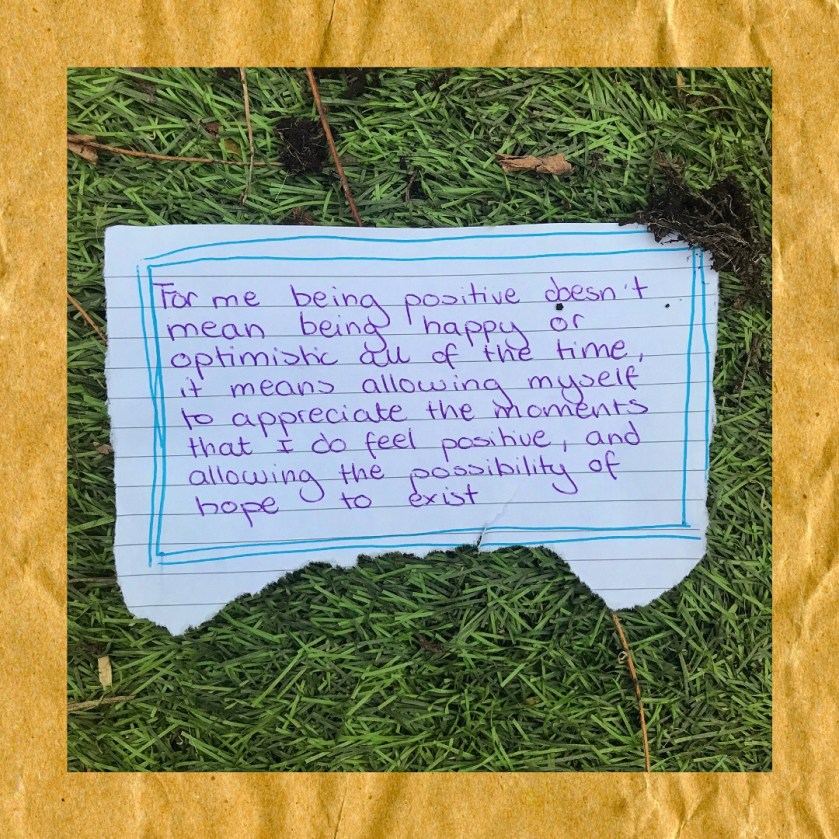
This post is inspired by I note I made for my Instagram – @our.happy.notes – which read: ‘For me being positive doesn’t mean being happy or positive all the time, it means allowing myself to appreciate the moments that I do feel positive, and allowing the possibility of hope to exist’. I wrote it because being the inquisitive person I am and being active on social media brought the thought into my mind – what is positivity? What does positivity mean to me?

I’m a person that tends to find myself living in extremes. There either is or there isn’t. I am all or nothing. So with positivity and a mood disorder, I found that I either lived in a state of overwhelming optimist or complete lack of any positive thought at all. What I have found interesting, and beneficial to my mental health, is exploring the space in between. The idea that even in positive moments I can accept that it won’t last forever, and in the times where I lack such I can acknowledge that it doesn’t mean that positivity has disappeared.

I think sometimes even in well meaning spaces, there can be such a pressure to be positive and see the good in life. Unfortunately this simply isn’t possible all of the time, and when we put pressure on ourselves to feel one way or the other it can lead to us feeling even worse. The reality of the situation is that all emotions on the spectrum are valid. Yet the lack of positivity or hope in one moment does not mean it will never return; that it has ceased to exist. Nowadays this is something I like to remind myself – writing it out helps me to absorb it.

So, what is positivity to me? Positivity is not the blind belief in a bright future, but the acceptance of the fact that a bright future could exist. It is allowing the possibility of a good day for someone else happening, even if it isn’t for me. It is embracing the small, joyful things in life – the most minute parts of the world that make me a little less down, even if only for a moment. It is an intangible thing, an emotion, an idea – a beautiful prospect.

However I recognise that in moments we really can want to increase our positive thoughts and feelings in life. I am no expert on this, though I do have some tools that have helped me. In the morning I write down affirmations for the day – ‘Today can be a good day’, ‘I am enough’, etc. In the evening I write a gratitude list – ‘I have a roof over my head’, ‘someone smiled at me in the street’. I list the small things in life that bring me joy. I allow myself to dream wildly, but remind myself that whether or not these dreams materialise, I will be ok. I smile; sometimes I simply sit there and I smile. And when I feel that positivity is disappearing, that hope is waning, I repeat aloud and write on paper that they are not gone forever. These might seem a little silly, but they are some of the most healing things toward my mental health.

Sending love and support to anyone who needs it today!

Love, Millie x

Posted in Mental Health, Personal Growth

Small Steps

Hey there! 

I’ve been thinking recently on how I can help myself to maintain a better state of mental health, when I’m already feeling a bit better in myself, but also how I can make it easier to lift out of those darker moments. Through some conversations, therapy, and self reflection I have come to appreciate how important the small steps we take to support our mental health are.

However, when you’re feeling particularly blue it can be difficult to even begin to do the smallest things; people can often get annoyed at us for this as well. For me one way of overcoming this is by breaking them down into even smaller steps. For example if my aim is to take my meds, then I’ll start by walking to the drawer, then opening the draw, taking them out, laying them out etc etc. It may seem silly at first – I know for me it almost felt like I was patronising myself – but it might just be of use to try this, and it is a huge thing to take any of these steps so you deserve congratulating for that! 

So what are some of the small steps I’ve come up with to help maintain my mental health? Writing my diary; gratitude and affirmation lists; meds and vits; drinking enough water; walking; allowing myself downtime; using planners to keep on top of work; reading (to make learning fun); making my happy notes; doodling and using fiddle toys; playing piano; meditating and more…

I hope you can find some small steps that will help you maintain your mental health! We all have it and we all need to look after it 

See ya later 🙂