Posted in autism, Managing Mental Health, Mental Health, Personal Growth

How to Make a Happy Kit

I still struggle greatly everyday with my mental health, and that can be enormously frustrating. It can also make it feel like the smaller things I can do to help myself are useless in the long run. However, I know this isn’t true. I know that when I add up all these little bits and pieces (like writing and walking for example) they do make an impact. And, yes, sometimes it’s a very small impact – but I know how much more hopeless and desperate it would make me feel if it wasn’t there. One of my favourite things I ever did to help myself manage my mental health was to make a ‘Happy Kit’ (as I call it). The great thing is that it’s totally unique to me and my needs, so I thought I’d share a little guide on how to make your own Happy Kit to suit you. I really love mine and I would recommend that everyone make something like this, because we all have mental health and challenging days – or simply just bored days. In my case it has loads of stuff in it to help me manage my anxiety, depressive episodes, sensory overload, and boredom; I keep it in my school bag at all times. So here’s how I made it:

My ‘Happy Kit’ is almost like a summary of all the tools I’ve gathered over the years to help myself. However, before you decide on the specifics of what will be in your kit, decide how you want to use it. Do you want it to be a box full of stuff that will keep you entertained when you’re bored at home? Or something you can always keep in your bag? Or maybe it’s something you use to help you wind down in the evenings? Once you’ve decided this, you can then choose what container you’re going to keep it in. I keep mine in a black makeup bag with sparkles sewn into it – I like the texture and the way it catches the light. You might choose to keep yours in a box or on a shelf in your bathroom cupboard for example.

Before I go further, here’s an overview of the contents in my own Happy Kit to give you an idea of what to keep in mind when making yours:

Me and My Happy Kit
  1. Fiddle toys – they help me focus in lessons, ease anxiety, and remain grounded during sensory overload. I have several different kinds with different textures
  2. A list of distractions – I have so many different activities on this list! And they range from things that are easier for me to do when I’m feeling low, more creative for when I’m hyper, and calming for when I’m anxious. I have this list because I’m learning that if I can direct myself towards an activity, it eases how I feel, but sometimes I can’t think of anything to do, so I refer to the list. And if I still can’t decide, I can always just pick a random number and do that activity!
  3. Gemstones – I’m not entirely sure if I believe gemstones work, but I do believe they can act as a placebo at least, and I find it very calming to hold them, if only as a way to remind me to try and bring myself back into a more neutral place mentally
  4. Items with sentimental value – To remind me of good times and the love of people in my life
  5. A toolkit list – This is a list with easy to follow steps that summarise particular tools I’ve learnt to help me manage and think more clearly, like how to accept emotions and reduce judgements
  6. Sweets/ mints – Sometimes I have Rescue Remedy sweets in my kit and sometimes I just have normal sweets, but something that tastes nice and I can suck on is just pleasant and calming for me
  7. Something smelly – not smelly in a bad way! Just something that smells pleasing to me, like lavender or essential oils or a mini perfume. Sometimes because they’re calming scents, and sometimes just because they make me feel fancy. As someone who’s autistic smells can also help when I am sensory seeking (kind of the opposite to sensory overload/ avoiding such) in a really simple way
Some of the things in my happy kit

Obviously all of that is specific to what helps me, but it might give you some ideas. If you like fiddle toys or nice textures then put something like that into your kit. For me they represent something calming and soothing to me that I can also use to engage my brain. I’d definitely recommend you to make a list of distractions/ activities regardless of what you’re using your Happy Kit for – you can tailor it to yourself but it comes in really useful in lots of situations. For example if you are making your kit to help you relax in the evening it could have a a list of ten things that you can do to help you relax and you could pick one each evening. If it’s to calm anxiety, then put down a few distractions and a few activities that might calm your anxiety – like breathing exercises, colouring, or reading a book perhaps. And if you’re making your kit for when you are bored then throw down a load of different activities, and make sure to include some you might not usually do (for example, writing a song even if you’re not musical). My list includes a mixture of all these different things! Here’s some of the things on my list:
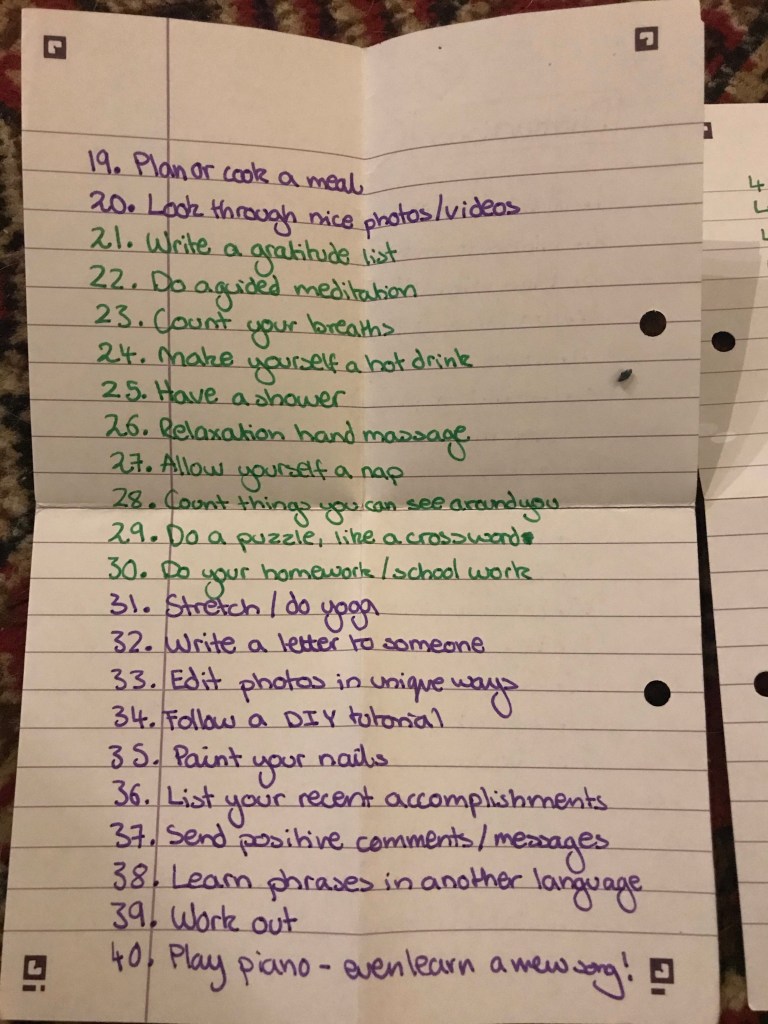
A picture of some of the activities on my distractions list

I hope this has inspired you to think about making a little toolkit for yourself (or even for someone else). Please feel free to ask for any advice or share your ideas for your own happy kit. Sending all my love and support. Xx
Posted in Happy Notes, Notes

Random Acts of Kindness

Kindness is something intangible, and yet it is very real and very powerful. In the Cambridge dictionary kindness is defined as ‘the quality of being generous, helpful, and caring about other people, or an act showing this quality’. If we think back on our lives I’m sure we can think on many moments where people have shown us kindness. Sometimes a seemingly small or insignificant act of kindness can have the greatest impact – for example someone helping someone else carry a bag on a particularly bad day could remind them that there is good in the world and prevent them from spiralling into a worse place mentally. And sometimes it’s the grand gestures of kindness over a long period of time that make an impact on us – for me the fact that my friends never gave up on me during the dark times is one the greatest acts of kindness that I have ever experienced. The point is, what we qualify as a kind act may be vary for each of us, but the underlying caring and generosity always helps to brighten up the world and our lives.

Back in November I posted on my Instagram about a 30 day random acts of kindness challenge. The idea behind it was to inspire myself and others to think about doing something small but kind once a day in order to be more mindful about how we can make a positive impact on the people and world around us. Why? I believe that when we put good energy out there, it spreads – a bit of a butterfly effect if you will – and it goes beyond the original act of kindness. Also, as someone who struggles with their mental health I know that being kind can have a profound effect on how I feel; it makes me feel better about myself and also helps to get me out of the cycle of my thoughts. But don’t forget you can also show yourself kindness, in many forms, and that is just as important. It helps us to be able to function better and feel better and do even more for others.

So here’s a list of 31 random acts of kindness. I would encourage you to try one out, or make it a challenge to do one a day for the next 31 days! Please comment below with any more ideas or stories of how someone else has helped you out:

  1. Tell someone you appreciate them
  2. Sign a petition for a cause you care about
  3. Say hello to someone and ask how they are
  4. Donate old clothes to a charity store
  5. Hold the door for someone
  6. Bake or cook something and give it to someone – a neighbour, family member, coworker
  7. Give three honest compliments
  8. Write a happy note and leave it for someone to find/ post it online (use #ourhappynotes)
  9. Comment something positive on a post
  10. Make/ hang some bird feeders
  11. Leave a thank you note for your mail carrier or another civil worker who does a lot for you
  12. Buy some food for a food bank
  13. Smile at someone
  14. When you’re going on an errand, ask a neighbour/ friend if they need you to do anything for them
  15. Share a post about an issue you care about
  16. Write some positive messages on the pavement with chalk
  17. Leave a bit of change in a vending machine
  18. Bring some food to a homeless person
  19. Wear your mask with vigilance if you can – this one should be some every day!
  20. Support a small local business, either with money or by leaving a positive review/ following them online
  21. Spend the day trying to be kind to yourself – listening to what you need, letting your emotions be, relaxing etc
  22. Do a chore that someone else would usually do
  23. Plant something
  24. Have a complaint free day
  25. Send a letter to an elderly person
  26. Read an article to educate yourself on an issue
  27. Encourage someone
  28. Check in on your friends
  29. Write to your MP/ representative about something you feel needs attention
  30. Let someone go ahead of you in line
  31. Brainstorm more ideas for kindness and how you can incorporate it into your everyday life

Let’s spread some sparkly, shiny, generous energy in the world! Sending all my love and support,

Millie xx

Posted in Advocacy, autism

A Guide to Autism Awareness Month (By an Autistic Girl)

April is autism awareness month, so you might well come across information floating around about autism online. For many autistic people, especially autistic advocates, can find this month difficult or have mixed feelings around it – not all the information circulating will be correct or portray a positive narrative, and this can be frustrating, stigmatising, and exhausting to correct. So here is a short guide on how to navigate autism awareness month for autistics and neurotypicals (people who do not have autism and are not neurodivergent) alike:

The Ground Rules

Firstly, let’s lay some ground rules for autism awareness month – the stuff you really should know. When you read something about autism online, do not automatically assume it’s true. If it’s written by an autistic person, then it’s generally trustworthy. If it shows autism as a problem to be fixed, or a desperate life, then it’s not to be listened to. And if it comes from ‘Autism Speaks’ then completely ignore it (more on that later). Next, make sure you are not correcting autistic people on their own experience, or trying to speak over them. Instead, uplift autistic voices – and all autistic voices. We are as diverse as the world, and we all have value, so make sure you’re paying attention to LBGTQ autistics, Black autistics, non-verbal autistics, autistics with higher support needs… all of us! Finally, don’t use the #actuallyautistic hashtag if you’re not autistic, it’s a hashtag we use to find each other and to identify posts by autistic people.

Acceptance not Awareness

While becoming more aware of the diversity and lived experience of autistic people is amazing, and helps to de-stigmatise autism, it’s not enough. Furthermore, sometimes the idea of awareness can become a connotation of a problem that needs to be solved or cured, which autism is not. So during this month, you may see it called ‘autism acceptance month’ instead. That’s because what autistic people really need is acceptance. More than that we need to be accommodated and valued in society, because every single one of has worth no matter where our traits lie on the spectrum, and when accommodated to we can do so much. So please, make sure that this month you are also thinking about and working on your acceptance and accommodation of autistic people. If you want to read more about why I think autism is amazing, please read my post ‘Autism is My Superpower’ here.

All Year Round

The fact is that autistic people are always autistic – all year round. That means that you cannot only work on accepting autistic people during the month of April. Including us, accommodating us, appreciating us and loving us is a full time job. And it’s important, maybe even paramount, to note that accepting autistic people isn’t just about accepting those who have a diagnosis or are public about that diagnosis. Many of us can’t be open with our diagnosis, or are uncomfortable about being open with it (which is why we need your help to de-stigmatise autism). Many people don’t even know they are autistic. So what does that mean for you? It means accepting the weird kid who only talks about the same few topics or can’t make eye contact, and saying hello to them, regardless of what response you might get. It means not laughing at the way in which someone flaps their hand or the odd noises they make. It’s about being sensitive to the person who finds light and sound overstimulating. It means accommodating the quiet girl, even when she can’t talk at all. It means caring.

No Autism Speaks

You may have heard/ hear about Autism Speaks’ light it up blue campaign, supposedly in support of autistic people. However autism speaks have been hugely damaging to the autism community, portraying autism as a thing that destroys lives and families, and something that needs to be solved. They also do not help autistic people in a financial sense – only a tiny portion of their budget (I believe 4%) actually goes towards autistic people and their families, while their CEO receives an obnoxious amount. Furthermore, not one person on their board actually has autism, which is an outrageous sign that they do not listen to us. So instead of lighting it up blue, please light it up red, a way we are combating Autism Speaks, and use the rainbow infinity symbol instead of the blue puzzle piece of this organisation.

A Guide for The Autistics

This month might get overwhelming for you, especially if you are trying to correct information online or advocate a lot. So this is my reminder for us to check in with ourselves and allow ourselves time to rest and do what we enjoy as well. If you are feeling worn out maybe reach out to someone who knows you well also and ask them for a bit of extra support. You are under no obligation to do anything this month if you don’t want to. And maybe while everyone else is working on their acceptance of us, we can also try to accept ourselves. It’s something we can struggle with as autistic people. But we are so valid, and honestly really awesome.

Thank you so much for reading. If you have any questions please do drop them in the comments, and feel free to get in contact. Sending all my love and support!

Posted in Advocacy, Happy Notes, Mental Health, Notes, Personal Growth

What is positivity?

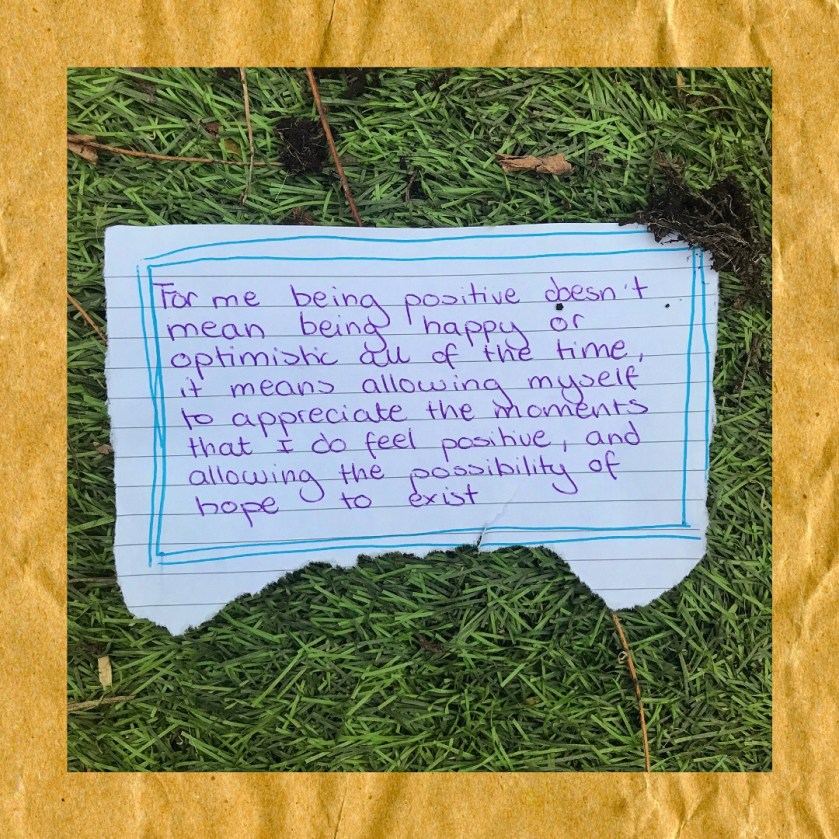
This post is inspired by I note I made for my Instagram – @our.happy.notes – which read: ‘For me being positive doesn’t mean being happy or positive all the time, it means allowing myself to appreciate the moments that I do feel positive, and allowing the possibility of hope to exist’. I wrote it because being the inquisitive person I am and being active on social media brought the thought into my mind – what is positivity? What does positivity mean to me?

I’m a person that tends to find myself living in extremes. There either is or there isn’t. I am all or nothing. So with positivity and a mood disorder, I found that I either lived in a state of overwhelming optimist or complete lack of any positive thought at all. What I have found interesting, and beneficial to my mental health, is exploring the space in between. The idea that even in positive moments I can accept that it won’t last forever, and in the times where I lack such I can acknowledge that it doesn’t mean that positivity has disappeared.

I think sometimes even in well meaning spaces, there can be such a pressure to be positive and see the good in life. Unfortunately this simply isn’t possible all of the time, and when we put pressure on ourselves to feel one way or the other it can lead to us feeling even worse. The reality of the situation is that all emotions on the spectrum are valid. Yet the lack of positivity or hope in one moment does not mean it will never return; that it has ceased to exist. Nowadays this is something I like to remind myself – writing it out helps me to absorb it.

So, what is positivity to me? Positivity is not the blind belief in a bright future, but the acceptance of the fact that a bright future could exist. It is allowing the possibility of a good day for someone else happening, even if it isn’t for me. It is embracing the small, joyful things in life – the most minute parts of the world that make me a little less down, even if only for a moment. It is an intangible thing, an emotion, an idea – a beautiful prospect.

However I recognise that in moments we really can want to increase our positive thoughts and feelings in life. I am no expert on this, though I do have some tools that have helped me. In the morning I write down affirmations for the day – ‘Today can be a good day’, ‘I am enough’, etc. In the evening I write a gratitude list – ‘I have a roof over my head’, ‘someone smiled at me in the street’. I list the small things in life that bring me joy. I allow myself to dream wildly, but remind myself that whether or not these dreams materialise, I will be ok. I smile; sometimes I simply sit there and I smile. And when I feel that positivity is disappearing, that hope is waning, I repeat aloud and write on paper that they are not gone forever. These might seem a little silly, but they are some of the most healing things toward my mental health.

Sending love and support to anyone who needs it today!

Love, Millie x

Posted in Advocacy, Mental Health

Funding Mental Health – An Introductory Question

Today’s post is inspired by @jcss.c (insta)

I’ve spoken about funding for mental health systems here before, but I wanted to write a bit about what we want to fund. The mental health system as it is is flawed – I am certain of this – and while extra funding is needed and would help, it won’t fix everything. That is whey when I talk about improving the mental health system I use the word reform.

When we talk about funding the system we need to consider what we are funding. Do we want to pump money into a fundamentally broken system (because it’s been getting worse for quite a while) or do we want to use that money to reform the way the system works, promote independent person led treatment, and then provide resources to help make that happen? 

Here’s some examples of areas that need to be changed: 

  • fatphobia within ED (eating disorder) treatment. That means not having to be under a certain weight to be validated, the mental side of an eating disorder taking precedent, and providing space for people who don’t fit the ‘typical’ ED profile you might expect 
  • Medical racism. This needs to be tackled at all levels and in all areas of society – they all influence each other
  • Inability for medical practitioners to see individuals rather than symptoms. The individual patient matters; they should have a say in their own treatment; all of who they are should be recognised and celebrated. There’s a difference between having to tick boxes and refusing to see anything outside of those boxes 
  • Inappropriate medication/ sedation in inpatient. There should be more resources and a better system of action that doesn’t lead to drugs so quickly, especially if that is against the patient’s wishes 
  • Criminalisation & lack of human respect for people with substance use issues. 
  • Staff who always validate the experience of the patient, don’t rush patients through, tell them they’re not ‘bad enough’, aren’t rude, aren’t tired etc etc etc 
  • Voluntary treatment truly being voluntary. Rather than ‘admit yourself or we’ll section you’ (which happens far too much) 
  • Language changes. Being labelled as compliant or non-compliant, for example, and threatened with no help at all or penalties on freedom in inpatient, when in reality the reasons behind each person’s choice should be explored and respected. They should be helped to be motivated, and if the treatment isn’t working for them, there should be other options 
  • Space for alternative treatments. For example art therapy, drama therapy, animal therapy – just using other methods to get through to patients can be pivotal in their treatment. There should be the ability for this to happen on a wide scale 
  • Recognition of the wider factors impacting and maintaining mental health. Such as money, identity etc

There’s so much more I could discuss and it’s not like I’ve studied this for years, so this is just the opinion I have developed, but I know I am not alone in this. I’d also like to say that I respect any professionals that want to make a difference for someone struggling with their mental health, but I recognise that in such a strange system, it’s often hard for them to do so, and after time that motivation may just disappear. 

If anyone wants to add anything, please comment below, would love to have a discussion on this topic.

Posted in Advocacy, Mental Health

I Want Change.

This was originally written as a post for Mental Health Awareness week on Instagram. It serves as an introduction to my Mental Health advocacy here at Our Happy Notes:

I’m an advocate for mental health awareness, but sometimes I feel as though I don’t know what to say or do. But I know what I want and I will build from there through myself, my community, and reaching out. 

Positivity and compassion are important, but so is speaking up for change and against the romanticism of mental illness. 

I’m fed up with all these ‘the true side of mental illness’ posts – no, it’s not the ‘truth’, it’s your experience; it’s just as damaging to say it is the only one. Fed up with toxic positivity telling us mental health can be fixed by self care. It will never be ‘fixed’. It will always be a part of us. All of us. Self care is not a singular solution, and we are not failures when it doesn’t take it all away or we can’t commit because brushing our teeth is hard enough. 

Speaking about our experiences is valuable, because there needs to be a tolerance and dialogue, but more than anything there needs to be a system change. I want change. I would never choose to take my illnesses away because they shaped me, and they give me creativity and kindness, but I shouldn’t have had to arrive at that conclusion on my own. 

It shouldn’t be down to a teacher to hand out all the real advice I’m getting – and only then because she’d experienced what I was going through herself. It shouldn’t be a system where we come away from each meeting feeling worse than when we went in, a three month check in from a psychiatrist you had to pay for with charity money otherwise it was an eighteen month wait and quite simply you would be dead by then, but all they did was make sure that you weren’t dead already anyway. Mothers shouldn’t be burdened with such worry when this is something that happens and can be supported. There should be research to prevent the endless trial and error of medications that messes around with yet another patient’s brain. For the kids who need understanding there should be explanations. 

There should be staff for CAMHS and inpatient. When the teachers are so worried, you’re wondering what it might be like to fly, they’re talking about phone calls to parents and police – you shouldn’t be more afraid of hospitals than you are of dying. It shouldn’t have gotten to that point where you weren’t light enough, bad enough, clear enough, strong enough – teenagers shouldn’t have to be strong and blamed for their reluctance when all they’ve known is that they’re not enough. There shouldn’t be so many inequalities – any inequalities – in the system; so much lack of understanding of the challenges that Black people, LGBTQ+ people, disabled people face. 

I want staff. I want research. I want money for the service and societal change led by a government that actually gives a sh*t and we need that now more than ever. I don’t want to see another friend grappling with a mental illness all alone. I don’t want the statistics for suicide and self harm to climb. I don’t want another overdose that could’ve been prevented if only they’d learnt how to cope. I don’t want them to be blamed anymore. I don’t want anyone to feel alone when they are not. To feel unsupported simply because of their identity. 

I want change, and it starts with us. With our dialogue – led by love and compassion and a willingness to learn. I want us to be validated without labels, and yet unafraid if a diagnosis is present. I want the criteria for diagnosis to reflect the diversity of the people who might be diagnosed. I want understanding and support of mental health built into every facet of our lives, including where we are fighting for justice elsewhere, because these are not stand alone issues. The ‘mad’ people are getting mad, and they don’t want that. I want change.

– Millie

Posted in Happy Notes

How to write your own Happy Note (and why you should)

Hello Happies! (Apparently that’s what we’re called now, just came up with it – if you have a better idea do share)

This is a basic guide on how – and why – to write your own Happy Note. There is no set formula, except that you must try to spread joy or motivate and encourage through your words, but it might be helpful to have some ideas. First though, here’s 10 reasons why you should write a Happy Note:

1. Your words could really brighten someone’s day. You never know what someone is going through, so a few kind words found from a stranger could really mean something to them.

2. Even if your note doesn’t have a profound impact on someone else, by consciously writing positive words you are training your brain to think positive thoughts; a happy mindset can change your life.

3. It’s super easy and takes less than 5 minutes, so why not?

4. It’s a great activity for kids to come up with something kind and have fun decorating their note, teaching them skills in creativity and kindness.

5. It helps you to feel good about yourself as you are deciding to do something for someone else and the world around you. This in turn encourages you to do more to aid the causes you are interested in.

6. It’s fun; you can be as artistic as you like because you are in control.

7. You can make a Happy Note wherever and whenever you like: on the go, while watching TV, during a break – it’s up to you!

8. A Happy Note allows you to feel connected to like minded people and be kind to someone else without having to deal with any social interaction, which can be really scary for some people.

9. It’s only a small step towards a happier life and a happier world, so you don’t need to be afraid to give it a go and it doesn’t require a lot of effort – go at your own pace in taking the step. You’re doing great just by reading this!

10. Happy Notes are symbolic in bringing about a more joyful world, and by creating one you are starting the process in making this dream a reality.

So, you’ve decided you want to write your own Happy Note? Great! But where to begin? As we’ve said already, there’s no set formula for your happy note, just so long as it’s full of joy, motivation and/or encouragement. Below you’ll find a step-by-step guide to creating your own Happy Note and some templates. Go spread that positivity!

1. Grab a pen and some paper. If you want you can also grab some other things to jazz up your note such as glitter, Pom Pom or coloured pencils.

2. Decide what you want your note to say. Remember to make it positive, motivational, joyful, encouraging or all four! It could be a quote or a family saying. Perhaps you’d like to tell your story to inspire someone else. Whatever it is, make it kind. (We’ve included some of our fave quotes at the end of this post)

3. If you want, add a little message on the back of your note to let the world know what it is so the movement can spread. You can use this template – or come up with your own:

‘Hi amazing person,

I am a happy note; my purpose is to spread joy, motivate and encourage others. I want the world to be a happy positive place so I’m part of a movement called Our Happy Notes. I hope you’re having a great day, but if not I hope I’ve helped to brighten it a little. Remember it’s ok not to be ok. There are people out there that care. If you want to find out more visit @our.happy.notes on Instagram or http://www.ourhappynote.wordpress.com

4. Choose where you’re going to leave your note – will it be on a train? In a book? On a shelf? Or under a coffee cup? Just make sure it’s somewhere that someone will find it, and it won’t get blown away by the wind.

5. So, you’ve written your first Happy Note, but what now? When the time feels right, write another and spread more joy. In the meantime look around you for the small things you can do to make a difference. Be kind to someone by holding open the door; smiling as you pass; helping carry a shopping bag. And don’t be disheartened if that kindness isn’t returned at first – it’s going to take time, but you are doing something great.

While you’re working towards all this joy for other people it’s possible you may have neglected someone very important: yourself. You can be kind to yourself, it’s not wrong – it’s necessary. When you smile the world smiles with you. It’s a slow process but it is possible (more on this soon).

If all this work for change has got you itching to do more, then we encourage you to find an issue you are passionate about and research so you can apply our principal that a small step can make a big difference to said issue. And while we’re on the topic of passion – if you can find something that sets your soul on fire then it’s going to revolutionise your world. Look into what you are curious about and try out something new. If doing something in person is difficult for you, the internet has a huge variety of courses for you to give a go. We promise it won’t be the end of the world if you try something and don’t like it, so you may as well.

‘You only fail when you stop trying’

‘Happiness can be found even in the darkest of times if only one remembers to turn on the light’ ~Albus Dumbledore

‘You are enough’

‘Happiness is letting go of what you think your life is supposed to look like and celebrating it for everything it is’ ~Mandy Hale

‘You cannot find peace by avoiding life’ ~ Virginia Woolf

‘Only in the darkness can you see the stars’ ~ Martin Luther King

We hope you’ve enjoyed this short guide and now feel equipped to go forth and create your first Happy Note. You’re part of a movement now – a joyful movement.

If you make a note please do share it with us on Instagram @our.happy.notes or via email: our.happy.notes@gmail.com.

Keep Smiling. X