Posted in Happy Notes, Managing Mental Health, Mental Health, Personal Growth

An Anxious Experience

Today’s post is a guest post written by Eya, a follower of Our Happy Notes on Instagram (their username: @the_dangerous_me). It was edited by Millie Bevan, founder of Our Happy Notes. If you would like to collaborate please email ourhappynotes@gmail.com or fill out the contact form on the website.

Anxiety can be a very physical experience where you can’t understand what’s happening to your body.  It’s hard to rationalise; it feels like your hormones have gone into overdrive. And really they have – being afraid or nervous is your body and brain’s way of telling you that there is danger nearby, so you may think at first that the feeling will pass, but anxiety means your brain sees danger everywhere. It doesn’t pass so easily. 

Anxiety is a silent killer. It kills your soul, it cuts you to pieces. Consider yourself as a game to anxiety because it makes you feel like a doll which it plays with. You can’t sleep at night and you constantly question what the people around you might be thinking, getting stuck in a loop with these thoughts going round and round in your head, replaying everything you’ve said and done. I have experienced anxiety since I was 13 years old when I started to lose sleep andi cried at night and i suffered. I felt so alone and it was a dark time in my life. I lost friends, became isolated, and soon started to experience depression as well. But there is  hope. I went to a therapist and day by day I felt better. Anxiety is not a topic to be taken lightly. It can make life so difficult. But you are not alone and you can look after your mental health. Eventually, with patience, it gets better.

There’s a lot of love out there and people that care. You can learn to love yourself again; know that there’s nothing that could stop you from your dreams and achievements. Nowadays I feel so much better, so I want to pass that hope onto you so you can enjoy everyday for yourself. 

Posted in Managing Mental Health, Mental Health

How to Support Someone With Mental Health Issues

It can be extremely hard to watch someone you love and care about going through a tough time regarding their mental health. It can also be painful if someone close to you discloses their mental illness or mental health struggles and you had no idea about it. You may feel like a failure yourself, like there’s nothing you can do, like you are useless. Essentially it may start to impact your mental health as well. That’s why the most important thing to remember when supporting someone with mental health issues is that you need to look after yourself as well. You have to.

1. Look after yourself

Sometimes we want to rush in and save the whole world – fix everything – but this simply isn’t possible. Perhaps at first it may seem like a good idea to try and take on the other person’s issues entirely as your own, without giving yourself the space needed to process your own emotions. In fact for a short while this may actually help the other person – but that’s not sustainable; long term it will lead to you burning out, struggling yourself or becoming resentful, likely making the entire situation worse. That’s why it’s so important to look after yourself, even if this is just journaling at the end of the day to help you sort out the feelings of the day, or doing a hobby once a week, the possibilities are limitless and you have to find what works for you. The important thing is that you do find it. And putting in boundaries with the person you are supporting can also help this, and most likely will help them in the long run too.

2. Listen to them

Many people with mental health issues, especially when they are first opening up about them, doubt themselves, feel ashamed or invalidated. By listening to them with an open mind you can help lessen these feelings. And by listening, I mean just that. Not everyone wants (nor even needs) advice or solutions all the time, sometimes they just need to be heard so they feel a little less alone. When having a conversation about their emotions/ experience it can be really helpful to ask the question ‘would you like me to offer advice or just listen to you?’. Validating their experience through listening to them can have a huge impact for someone struggling and give them confidence and reassurance. Remember that they are the one that lives in their brain, and they know what they are going through better than anyone else; it’s not your job to dictate to them what they are undergoing. However, linking to my last point, it is important that you don’t take on all of their feelings for yourself, so placing boundaries can be really helpful – for example requesting that before they talk to you, they ask you if you are in a place to have that conversation.

3. Involve them

Going through a tough time mentally can feel very isolating, and our brains can make us feel very lonely and rejected. That’s why it’s important to continue to involve someone who is struggling mentally. This could mean continuing to invite them to social events while making clear there is no pressure or expectations placed upon them to attend. If they accept and invitation, it might then mean making some accommodations for them, like helping them order food if that’s a point of anxiety for them or giving them some space if they need it for example. It might also mean offering to meet them one on one for a while if that’s easier for them, or talking with them about plans to keep them safe and checking in with them regularly. To relate to my last point, if you’re unsure of what to do, you can always ask them if they have any ideas or if there’s a way you can accommodate them better. This is a huge sign that you care for and accept them still.

4. Research their experience

If the person you are supporting has a diagnosis or has disclosed to you specific symptoms, it can be helpful for your own knowledge to research this. A quick google search will bring up symptoms lists and examples of how these might affect them, but I would also encourage you to look beyond this and read up on the personal experience of different people from different walks of life to get a clearer picture. This can help you understand the person you are supporting better without the worry that you are prying to much, and it can help them to feel seen as this informs how you support them.

5. Make them a happy kit

I’ve made a previous post on this, which you can read here. A happy kit is essentially a little collection of things that can help someone process their emotions, get through a crisis moment, or just generally cheer them up. It can include some things that they find calming or cheering, and maybe a list of distractions and mini coping exercises to try. Distractions are also a really great way to help someone with a mental health issue – it’s not a long term fix but it can help them escape their brain for a minute and feel more ready to face the day. If a distraction is creative it could also be a way of helping them to express themselves, and feel less alone if you’re doing it together.

6. Help with small tasks

Small tasks such as cleaning, ordering food, or remembering deadlines can become seemingly impossible for someone experiencing a mental health struggle. If you feel up to it you can offer to help them with these small tasks, even if that’s just by doing it with them (for example cleaning together one afternoon, or going food shopping together). As always, asking them how best to help is always a good idea, and if they’re not sure offering something specific – such as sending them a reminder text – might appeal to them.

7. Show them you care

It’s simple, but one of the most helpful and meaningful things anyone has ever done for me during my own struggles has been showing me they cared. This could mean writing someone a supportive letter, or making them a playlist. Just something simple that lets them know you care.

7. Be patient

We all have mental health and it can be a long term challenge to face for many. Someone in the midsts of a struggle isn’t going to overcome it overnight, but with amazing people like you willing to support them, they can find their way through. Keep in mind that you need to be patient – one of the reasons why looking after yourself is so important – and that their struggles are not a comment on you, ever. Eventually the sun will come shining through!

Posted in autism, Managing Mental Health, Mental Health, Personal Growth

How to Make a Happy Kit

I still struggle greatly everyday with my mental health, and that can be enormously frustrating. It can also make it feel like the smaller things I can do to help myself are useless in the long run. However, I know this isn’t true. I know that when I add up all these little bits and pieces (like writing and walking for example) they do make an impact. And, yes, sometimes it’s a very small impact – but I know how much more hopeless and desperate it would make me feel if it wasn’t there. One of my favourite things I ever did to help myself manage my mental health was to make a ‘Happy Kit’ (as I call it). The great thing is that it’s totally unique to me and my needs, so I thought I’d share a little guide on how to make your own Happy Kit to suit you. I really love mine and I would recommend that everyone make something like this, because we all have mental health and challenging days – or simply just bored days. In my case it has loads of stuff in it to help me manage my anxiety, depressive episodes, sensory overload, and boredom; I keep it in my school bag at all times. So here’s how I made it:

My ‘Happy Kit’ is almost like a summary of all the tools I’ve gathered over the years to help myself. However, before you decide on the specifics of what will be in your kit, decide how you want to use it. Do you want it to be a box full of stuff that will keep you entertained when you’re bored at home? Or something you can always keep in your bag? Or maybe it’s something you use to help you wind down in the evenings? Once you’ve decided this, you can then choose what container you’re going to keep it in. I keep mine in a black makeup bag with sparkles sewn into it – I like the texture and the way it catches the light. You might choose to keep yours in a box or on a shelf in your bathroom cupboard for example.

Before I go further, here’s an overview of the contents in my own Happy Kit to give you an idea of what to keep in mind when making yours:

Me and My Happy Kit
  1. Fiddle toys – they help me focus in lessons, ease anxiety, and remain grounded during sensory overload. I have several different kinds with different textures
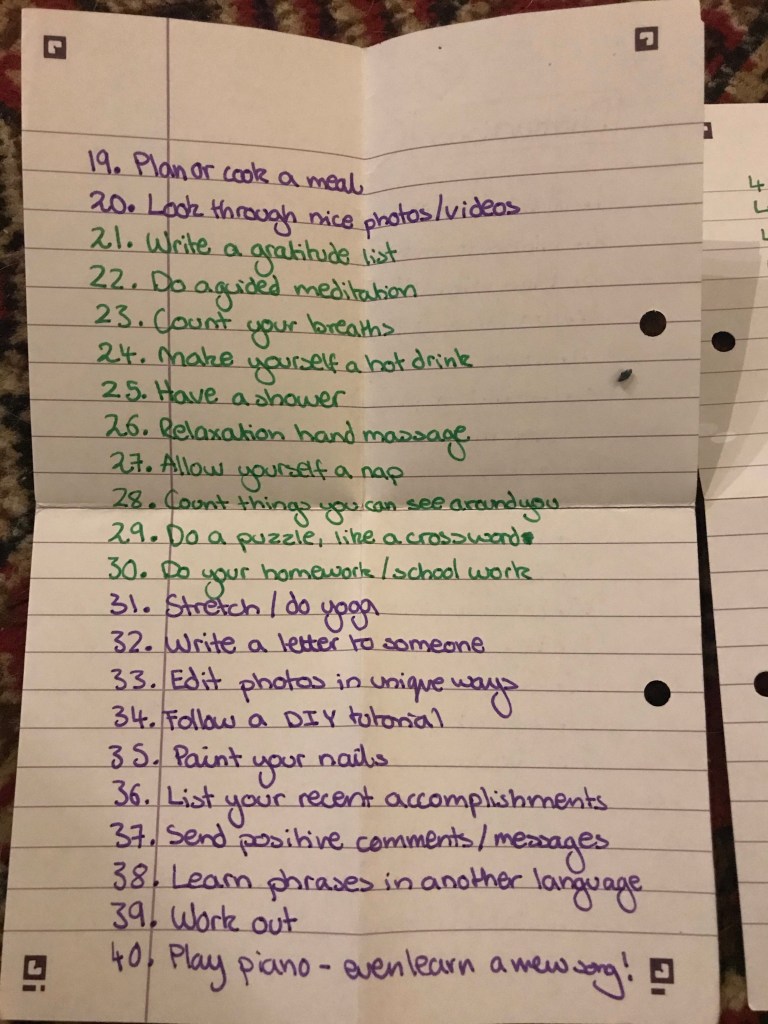
  2. A list of distractions – I have so many different activities on this list! And they range from things that are easier for me to do when I’m feeling low, more creative for when I’m hyper, and calming for when I’m anxious. I have this list because I’m learning that if I can direct myself towards an activity, it eases how I feel, but sometimes I can’t think of anything to do, so I refer to the list. And if I still can’t decide, I can always just pick a random number and do that activity!
  3. Gemstones – I’m not entirely sure if I believe gemstones work, but I do believe they can act as a placebo at least, and I find it very calming to hold them, if only as a way to remind me to try and bring myself back into a more neutral place mentally
  4. Items with sentimental value – To remind me of good times and the love of people in my life
  5. A toolkit list – This is a list with easy to follow steps that summarise particular tools I’ve learnt to help me manage and think more clearly, like how to accept emotions and reduce judgements
  6. Sweets/ mints – Sometimes I have Rescue Remedy sweets in my kit and sometimes I just have normal sweets, but something that tastes nice and I can suck on is just pleasant and calming for me
  7. Something smelly – not smelly in a bad way! Just something that smells pleasing to me, like lavender or essential oils or a mini perfume. Sometimes because they’re calming scents, and sometimes just because they make me feel fancy. As someone who’s autistic smells can also help when I am sensory seeking (kind of the opposite to sensory overload/ avoiding such) in a really simple way
Some of the things in my happy kit

Obviously all of that is specific to what helps me, but it might give you some ideas. If you like fiddle toys or nice textures then put something like that into your kit. For me they represent something calming and soothing to me that I can also use to engage my brain. I’d definitely recommend you to make a list of distractions/ activities regardless of what you’re using your Happy Kit for – you can tailor it to yourself but it comes in really useful in lots of situations. For example if you are making your kit to help you relax in the evening it could have a a list of ten things that you can do to help you relax and you could pick one each evening. If it’s to calm anxiety, then put down a few distractions and a few activities that might calm your anxiety – like breathing exercises, colouring, or reading a book perhaps. And if you’re making your kit for when you are bored then throw down a load of different activities, and make sure to include some you might not usually do (for example, writing a song even if you’re not musical). My list includes a mixture of all these different things! Here’s some of the things on my list:

A picture of some of the activities on my distractions list

I hope this has inspired you to think about making a little toolkit for yourself (or even for someone else). Please feel free to ask for any advice or share your ideas for your own happy kit. Sending all my love and support. Xx

Posted in Happy Notes, Notes

Random Acts of Kindness

Kindness is something intangible, and yet it is very real and very powerful. In the Cambridge dictionary kindness is defined as ‘the quality of being generous, helpful, and caring about other people, or an act showing this quality’. If we think back on our lives I’m sure we can think on many moments where people have shown us kindness. Sometimes a seemingly small or insignificant act of kindness can have the greatest impact – for example someone helping someone else carry a bag on a particularly bad day could remind them that there is good in the world and prevent them from spiralling into a worse place mentally. And sometimes it’s the grand gestures of kindness over a long period of time that make an impact on us – for me the fact that my friends never gave up on me during the dark times is one the greatest acts of kindness that I have ever experienced. The point is, what we qualify as a kind act may be vary for each of us, but the underlying caring and generosity always helps to brighten up the world and our lives.

Back in November I posted on my Instagram about a 30 day random acts of kindness challenge. The idea behind it was to inspire myself and others to think about doing something small but kind once a day in order to be more mindful about how we can make a positive impact on the people and world around us. Why? I believe that when we put good energy out there, it spreads – a bit of a butterfly effect if you will – and it goes beyond the original act of kindness. Also, as someone who struggles with their mental health I know that being kind can have a profound effect on how I feel; it makes me feel better about myself and also helps to get me out of the cycle of my thoughts. But don’t forget you can also show yourself kindness, in many forms, and that is just as important. It helps us to be able to function better and feel better and do even more for others.

So here’s a list of 31 random acts of kindness. I would encourage you to try one out, or make it a challenge to do one a day for the next 31 days! Please comment below with any more ideas or stories of how someone else has helped you out:

  1. Tell someone you appreciate them
  2. Sign a petition for a cause you care about
  3. Say hello to someone and ask how they are
  4. Donate old clothes to a charity store
  5. Hold the door for someone
  6. Bake or cook something and give it to someone – a neighbour, family member, coworker
  7. Give three honest compliments
  8. Write a happy note and leave it for someone to find/ post it online (use #ourhappynotes)
  9. Comment something positive on a post
  10. Make/ hang some bird feeders
  11. Leave a thank you note for your mail carrier or another civil worker who does a lot for you
  12. Buy some food for a food bank
  13. Smile at someone
  14. When you’re going on an errand, ask a neighbour/ friend if they need you to do anything for them
  15. Share a post about an issue you care about
  16. Write some positive messages on the pavement with chalk
  17. Leave a bit of change in a vending machine
  18. Bring some food to a homeless person
  19. Wear your mask with vigilance if you can – this one should be some every day!
  20. Support a small local business, either with money or by leaving a positive review/ following them online
  21. Spend the day trying to be kind to yourself – listening to what you need, letting your emotions be, relaxing etc
  22. Do a chore that someone else would usually do
  23. Plant something
  24. Have a complaint free day
  25. Send a letter to an elderly person
  26. Read an article to educate yourself on an issue
  27. Encourage someone
  28. Check in on your friends
  29. Write to your MP/ representative about something you feel needs attention
  30. Let someone go ahead of you in line
  31. Brainstorm more ideas for kindness and how you can incorporate it into your everyday life

Let’s spread some sparkly, shiny, generous energy in the world! Sending all my love and support,

Millie xx

Posted in Advocacy, autism

A Guide to Autism Awareness Month (By an Autistic Girl)

April is autism awareness month, so you might well come across information floating around about autism online. For many autistic people, especially autistic advocates, can find this month difficult or have mixed feelings around it – not all the information circulating will be correct or portray a positive narrative, and this can be frustrating, stigmatising, and exhausting to correct. So here is a short guide on how to navigate autism awareness month for autistics and neurotypicals (people who do not have autism and are not neurodivergent) alike:

The Ground Rules

Firstly, let’s lay some ground rules for autism awareness month – the stuff you really should know. When you read something about autism online, do not automatically assume it’s true. If it’s written by an autistic person, then it’s generally trustworthy. If it shows autism as a problem to be fixed, or a desperate life, then it’s not to be listened to. And if it comes from ‘Autism Speaks’ then completely ignore it (more on that later). Next, make sure you are not correcting autistic people on their own experience, or trying to speak over them. Instead, uplift autistic voices – and all autistic voices. We are as diverse as the world, and we all have value, so make sure you’re paying attention to LBGTQ autistics, Black autistics, non-verbal autistics, autistics with higher support needs… all of us! Finally, don’t use the #actuallyautistic hashtag if you’re not autistic, it’s a hashtag we use to find each other and to identify posts by autistic people.

Acceptance not Awareness

While becoming more aware of the diversity and lived experience of autistic people is amazing, and helps to de-stigmatise autism, it’s not enough. Furthermore, sometimes the idea of awareness can become a connotation of a problem that needs to be solved or cured, which autism is not. So during this month, you may see it called ‘autism acceptance month’ instead. That’s because what autistic people really need is acceptance. More than that we need to be accommodated and valued in society, because every single one of has worth no matter where our traits lie on the spectrum, and when accommodated to we can do so much. So please, make sure that this month you are also thinking about and working on your acceptance and accommodation of autistic people. If you want to read more about why I think autism is amazing, please read my post ‘Autism is My Superpower’ here.

All Year Round

The fact is that autistic people are always autistic – all year round. That means that you cannot only work on accepting autistic people during the month of April. Including us, accommodating us, appreciating us and loving us is a full time job. And it’s important, maybe even paramount, to note that accepting autistic people isn’t just about accepting those who have a diagnosis or are public about that diagnosis. Many of us can’t be open with our diagnosis, or are uncomfortable about being open with it (which is why we need your help to de-stigmatise autism). Many people don’t even know they are autistic. So what does that mean for you? It means accepting the weird kid who only talks about the same few topics or can’t make eye contact, and saying hello to them, regardless of what response you might get. It means not laughing at the way in which someone flaps their hand or the odd noises they make. It’s about being sensitive to the person who finds light and sound overstimulating. It means accommodating the quiet girl, even when she can’t talk at all. It means caring.

No Autism Speaks

You may have heard/ hear about Autism Speaks’ light it up blue campaign, supposedly in support of autistic people. However autism speaks have been hugely damaging to the autism community, portraying autism as a thing that destroys lives and families, and something that needs to be solved. They also do not help autistic people in a financial sense – only a tiny portion of their budget (I believe 4%) actually goes towards autistic people and their families, while their CEO receives an obnoxious amount. Furthermore, not one person on their board actually has autism, which is an outrageous sign that they do not listen to us. So instead of lighting it up blue, please light it up red, a way we are combating Autism Speaks, and use the rainbow infinity symbol instead of the blue puzzle piece of this organisation.

A Guide for The Autistics

This month might get overwhelming for you, especially if you are trying to correct information online or advocate a lot. So this is my reminder for us to check in with ourselves and allow ourselves time to rest and do what we enjoy as well. If you are feeling worn out maybe reach out to someone who knows you well also and ask them for a bit of extra support. You are under no obligation to do anything this month if you don’t want to. And maybe while everyone else is working on their acceptance of us, we can also try to accept ourselves. It’s something we can struggle with as autistic people. But we are so valid, and honestly really awesome.

Thank you so much for reading. If you have any questions please do drop them in the comments, and feel free to get in contact. Sending all my love and support!

Posted in Advocacy, Mental Health

Overview on Eating Disorder Awareness

As someone who spent a long time struggling with disordered eating – and still continues to grapple with it – I know first hand that eating disorders, diet culture, body image and our relationship with food is so much more complicated than a few statistics. However I also know that de-stigmatisation of mental health starts with awareness, and that de-stigmatising mental illness saves lives and has the power to change communities. So for eating disorder awareness week here’s a short overview I put together on eating disorder awareness. Follow this blog for more in depth posts to come on this topic:

Eating Disorder Misconceptions:

Not everyone with an eating disorder;

… is skinny

… is underweight

… goes to hospital

… knows they have one

… gets diagnosed

… recovers

… is white

… is female

… has anorexia or bulimia

… is a teenager

… looks like they have one

… restricts or purges

… survives

… has body dysmorphia

Eating Disorder Facts:

⁃ Around 25% of those affected by an eating disorder are male

⁃ Only around 10% of people suffering with an eating disorder are anorexic

⁃ Eating disorders are not a choice or for attention – they are a mental illness

⁃ Research suggests that people that have a family member with an eating disorder are more likely to develop one

⁃ Black teenagers are 50% more likely to exhibit symptoms of bulimia than white teenagers

⁃ LGBTQ people are more likely to develop an eating disorder

⁃ Research suggests that up to 20% of autistic people exhibit traits of eating disorders, and while anorexia is the second least common eating disorder among non-autistic people it is the most common among autistic people

⁃ Approximately 1.25 million people in the U.K. have an eating disorder

⁃ Anorexia has the highest mentality rate of any psychiatric disorder

Types of Eating Disorders:

⁃ Anorexia Nervosa

Anorexia (or anorexia nervosa) is a serious mental illness where people lose a lot of weight due to restricting how much they eat and drink. They may develop “rules” around what they feel they can and cannot eat, as well as things like when and where they’ll eat, and around exercise. Anorexia can affect anyone not matter their age, gender, ethnicity or background.

⁃ ARFID

Avoidant restrictive food intake disorder, more commonly known as ARFID, is a condition characterised by someone avoiding certain foods or types of food. They may restrict overall intake of intake of certain foods, and have foods that they deal as “safe”.

⁃ Binge Eating Disorder

Binge eating disorder (BED) is a serious mental illness where people eat very large quantities of food while feeling like they are not in control or what they are doing. Evidence suggests it is more common than other eating disorders, and is often misunderstood.

⁃ Bulimia

People with bulimia feel caught in a cycle of eating large quantities of food (called bingeing), and then trying to compensate for that overeating by purging in some way. That may be vomiting, taking laxatives or diuretics, fasting, or exercising excessively.

⁃ OSFED

Anorexia, bulimia, and binge eating disorder are diagnosed using a list of expected behavioural, psychological, and physical symptoms, however sometimes a person’s symptoms don’t exactly fit the expected criteria for any of these three specific eating disorders. In that case, they might be diagnosed with an “other specified feeding or eating disorder” (OSFED).

Things not to say to someone with an eating disorder (or literally anyone for that matter)

⁃ Are you really going to eat all that?

⁃ That’s a meal not a snack!

⁃ You’re just attention seeking

⁃ You’re weak

⁃ Just eat more/less

⁃ Get over it

⁃ But you’re eating well, how can you have an eating disorder?

⁃ I could never starve myself, I wish I was as devoted as you

⁃ Why don’t you just stop throwing up?

⁃ What diet are you on?

⁃ You should just go on a diet

⁃ Pointing out their weight gain, weight loss, anything about their body or anyone else’s body; try to compliment people through things unrelated to appearance

Eating Disorder help

⁃ Recovery is completely possible; the worst day in recovery is better than a single day being ill

⁃ No one with an eating disorder has anything to be ashamed of; there are so many loving and supporting people out there ready to help

⁃ Asking for help is not weak; it is brave

⁃ If you are a family member or friend supporting someone with an eating disorder you deserve to be supported as well

⁃ You deserve to have a healthy, sustainable and accepting relationship with your body and food

-You are not alone

Goeree, Sovinsky, & Iorio, 2011; Beateatingdisorders.co.uk; Autism.org.uk; Health.com

Posted in Advocacy, autism, Personal Growth

Autism is My Superpower

I’m autistic. Having autism in a neurotypical world is not easy because generally the world isn’t built for us and proves to be confusing, but for anyone struggling with their diagnosis/ symptoms (and any neurotypicals unclear on the individual nature of autism) I want to make it clear that having autism isn’t a defect. Nor is it a mental illness. In fact, it can be a bonus in many situations, and when accommodated to autistic people can provide new perspectives and skills to the benefit of others. I, for one, like to think that my autism is my superpower, and this is my personal experience:

I learnt to ‘mask’ my autism – consciously learning how to act and react from other people’s behaviour; having to put effort into learning social rules that came naturally to others. Masking can be exhausting, so I know it’s essential that I take breaks and find time for myself, but like a superhero in a costume, it can also be powerful. How? Because my passion is theatre, and when I become the character I act out on stage, I am easily able to slip myself into their shoes – I know how they would behave and why. It comes effortless to me. The misconception is that autistic people are like robots and can only slot into certain careers. In reality we are varied like everyone else, and our uniqueness is incredible. We exist in every identity there is: every race, every gender, every sexuality, as parents and children. Our variety is often overlooked.

My increased sensory input is a key feature of my superpower. I observe more, hear more, taste more. This translates to a benefit in so many situations. You don’t know your train time? Don’t worry, I glanced at the board quickly and noticed it. You’re lost and don’t know the way back? Don’t worry, I spotted landmarks along the way, I know where we’re going. You’re trying to remember where you put your glasses? Never fear, I spotted them. And if we’re thinking about sound and music, my greater sensory input comes to my aid once again – that along with my ability to spot patterns as part of my autism, and my synaesthesia (which is far more prevalent among autistic people than the general population). When I hear a piece of music, it is alive to me. It is full of colour, I hear every layer of the rich instruments, and I can see the patterns the notes are forming. If I want to then play that piece on piano, I need only translate the pattern onto the keys – give me a bit of time and I can paint the picture I hear all by myself. This is my superpower. 

Not to mention the fact that I am quite simply neurodivergent. I think experience the world in a way that is different to ‘the norm’, or rather the majority. Why is this a feature of my superpower? Because I can come up with new ideas and perspectives that may have been overlooked or not thought of at all. In certain situations this can become the way I overcome challenges or help others to do so; in the right combination my divergent thinking could be innovative. Us autistic people have a place in this society, no matter where our traits lie on the spectrum, and if we are accommodated we may even be able to offer solutions, certainly valuable contributions at the least. 

Like a superhero may have an emblem, sign, or symbol, I have my stims. By stims I mean self stimulatory behaviour. Why is this so amazing? Well, it indicates to me how I am feeling (different stims, like tapping my fingers on my palm or twirling my ankle, correspond to different moods). Not only this, but should I start to feel an uncomfortable emotion, stimming freely can help calm me down. There’s a lot of people out there that don’t have something so simple in their toolbox, so this is powerful to me. It’s also such a pure form of expression, and can even help me release my creativity, tapping into my flow. Furthermore, my stims evolve over time – hitting my head morphed into covering my head and now I need only put on a hat to feel at home. How awesome is that? 

This barely scratches the surface of my positive autistic experience, but I hope it has enlightened you. Autism is not a bad thing – quite the opposite. And the beautiful part of it is that no one autistic person’s experience is the same as another. We have a place in this world, and we’re not going anywhere, so the more that neurotypicals begin to understand and help us meet our needs, the more we can give.

Posted in Mental Health, Personal Growth

Letter to Anyone With Disordered Eating

Dear you,

I’ll start by saying hello and that I care, in case no one has said that to you today. Where you are right now, I’ve been there. Maybe not physically, but in some way mentally, and certainly in empathy with you. Some days you’ve probably told yourself you’re not struggling, it’s not hard, it’s worth it – I know I did. And deep down I also know that you know it’s not. It never will be. So here’s my letter to you. Not to say stop or that the pain goes away overnight, just to speak to you as someone who cares, and let you be.

You may think this is all about ‘skinny’; that this is all about achieving the version of yourself that you ‘should’ be. You might think you’re in control. It feels good to be in control right? To know your goals, your focus for the day or the month. I get that. The problem is that in the end, you’re not. And, wow, that is painful to realise. It crushed me when I did. It brought back the struggle of every step I’d been through. But it was necessary. In the end it controls you – whether that is your thoughts or this system telling you that you will never be enough until you fit into that dress, it controls you. And all of a sudden what you were fighting for becomes the thing you are fighting to get away from. In a way, if you really look, you can see this all along. I don’t want you to feel that terror or that hurt, but I want you to know you are not alone in that and the sooner you can get away from it the better.

The good news is that you can. I’m not forcing you to – I’m not another voice telling you to eat more or eat less or do this or that because they can be annoying right? And they can fuel us, I know they did for me. I lived for the finger on my spine telling me how skinny I’d gotten; I lived for the voice telling me how healthy I looked, thinking I’d failed. You’ve never failed. There’s never anything you should be. All I want to do is remind you of your power and your strength because my goodness have you got a lot of it. Think I’m wrong? Well let’s have a look at it, logically – maybe you’ve been restricting for months, purging for years, feeling unworthy for what seems like a lifetime, binging every night? That takes effort. That is blood and sweat and tears, often literally. But the effort it took just to put into that system shows you just how much power you have in you to reverse it. That strength can be turned around to go the other way and to learn, or relearn perhaps, that you are enough just the way you are. What makes you who you are is not your body.

Words like that seem futile though sometimes, don’t they? Well, I’ll let you in on a secret, I don’t love my body. Most people don’t love their bodies, at least not everyday. But what I do have now is a deep appreciation for how incredible the inner workings of my body are. They’re insane! And most days – I have acceptance. That’s all I need. Acceptance that this food fuels my brain, and that I am enough in this moment. Just enough. Not to say I don’t still struggle, because I do, I really do, but I look back on the pain I was in and I wonder how I ever survived. I didn’t even realise it at the time. It took someone reaching out and telling me they’d been there too for me to even comprehend the idea that this wasn’t healthy for me to be under such mental stress, let alone physical. You are not alone.

Most likely you know all the issues that await if you head down this road further, so I’m not here to preach that to you, but to give you hope of a life outside of this. Of an acceptance and tolerance I for one could not even dream of at one point. My dear you are doing alright – whatever has brought you to this point does not deserve your magnificence or your power. I want to remind you that help is a brave word and there are so many people out there ready and willing to help you in so many different capacities no matter what your struggle may be. I love you, and you are worthy of a life outside of a fixation on your looks. We all are.

Your friend,

Millie

Posted in Advocacy, Mental Health

Reducing Mental Health Stigma

I have been fortunate that I have not personally come up against too much explicit stigma throughout my mental health journey so far – and when I have, there has been an incredible amount of supportive people surrounding me. However just a quick trip online reveals how much stigma still exists around mental health, and backhanded comments such as ‘just snap out of it’ or ‘you don’t look mentally ill’ are far too common. Sometimes I am afraid that I will be left out from job opportunities or educational experiences in the future because of my struggles. And so it is important to me, for my benefit and the benefit others, that I do what I can to reduce stigma in my advocacy. For me that means sharing my story, educating myself (especially on the intersectionality of mental health in society), and being open in conversation. Here is my quick guide on what anyone can do to reduce mental health stigma.

  1. Change your language

It might insignificant, but language holds power. What I mean by this is avoiding calling someone who is mentally ill ‘crazy’, and instead validating their experience. Another way to adapt our language is to avoiding using conditions as adjectives. For example instead of saying ‘I’m a bit OCD’ say ‘I like things to be tidy’, and instead of saying ‘She’s so bipolar’ say ‘she’s a bit moody today’. Changing our language can signify a shift in how we approach topics, and encourages us to be more mindful of how what we say can impact someone.

2. Educate yourself

Education is a powerful tool. Educate yourself on the warning signs of mental health issues, different conditions, and the reality of the lived experience of those struggling with their mental health (they’re not the dangerous, horrible people that some media may lead us to believe they are). And educate yourself on the fact that everyone has mental health, and everyone deserves to look after it. Furthermore, educate yourself on how mental health is intersectional with identity and social issues. Here is a post from my instagram that has some basic statistics on this.

3. Listen

When someone speaks up about their mental health, listen. Actively listen. Do not try to shut them down or tell them to toughen up. Listen to what they need and what they are experiencing.

4. Speak up

If someone says something ignorant in a conversation about mental health, try to gently educate them. If you are able to, speak up in your workplace or school to ask for better training for employees on mental health, and policies to support employees/ students.

5. Speak to power

Sign petitions that lobby for better and more inclusive mental health support nationwide and in our communities. Write an email to your MP (or other political representative) about improving mental health systems.

8. Support mental health charities

Whether this is by donating, sharing their campaigns, or engaging with their programmes, their work is so important.

7. Carry openness in your life

Include people in your workplace; continue to invite friends with mental health issues even if they don’t always come along. Treat everyone with dignity and respect, and offer them encouragement in their day to day life and when seeking professional support. Never blame anyone for their struggles. Be kind.

Thank you for taking the time to read this post. All of my love and support to you today,

Millie xx

Posted in Notes

It Doesn’t Have to be a Merry Christmas

There is a lot of pressure put on the holidays of what they should be and feel like – they must be joyous and magical and a time for family. But the thing is, we can’t force happiness, and many people don’t have a traditional family setup. This year more than any other year the majority of people have had to adjust to a new way of doing the holidays, and that’s not easy. And for many people with mental health issues this is even harder, on top of the holidays often being a challenging time – for example with food relationships. So here’s a very short reminder that it doesn’t have to be a Merry Christmas, and a few affirmations to, hopefully, brighten up your day if you are struggling:

  • You deserve space if that’s what you need; your needs are worthy and important, even at Christmas
  • You are not alone, even if you feel it
  • Comparison can bring a lot of negative feelings to us, so remember that you don’t need to do it
  • You deserve to eat. Your body is an incredible thing, but you are so much more than it
  • It’s ok not to be ok
  • Your feelings are valid
  • This won’t last forever
  • You are so strong
  • You are so brave
  • You are magical
  • There is always good in the bad

I hope that all of you have the best time you can. Sending you all love and support this Christmas xx