Posted in Advocacy, Mental Health

Overview on Eating Disorder Awareness

As someone who spent a long time struggling with disordered eating – and still continues to grapple with it – I know first hand that eating disorders, diet culture, body image and our relationship with food is so much more complicated than a few statistics. However I also know that de-stigmatisation of mental health starts with awareness, and that de-stigmatising mental illness saves lives and has the power to change communities. So for eating disorder awareness week here’s a short overview I put together on eating disorder awareness. Follow this blog for more in depth posts to come on this topic:

Eating Disorder Misconceptions:

Not everyone with an eating disorder;

… is skinny

… is underweight

… goes to hospital

… knows they have one

… gets diagnosed

… recovers

… is white

… is female

… has anorexia or bulimia

… is a teenager

… looks like they have one

… restricts or purges

… survives

… has body dysmorphia

Eating Disorder Facts:

⁃ Around 25% of those affected by an eating disorder are male

⁃ Only around 10% of people suffering with an eating disorder are anorexic

⁃ Eating disorders are not a choice or for attention – they are a mental illness

⁃ Research suggests that people that have a family member with an eating disorder are more likely to develop one

⁃ Black teenagers are 50% more likely to exhibit symptoms of bulimia than white teenagers

⁃ LGBTQ people are more likely to develop an eating disorder

⁃ Research suggests that up to 20% of autistic people exhibit traits of eating disorders, and while anorexia is the second least common eating disorder among non-autistic people it is the most common among autistic people

⁃ Approximately 1.25 million people in the U.K. have an eating disorder

⁃ Anorexia has the highest mentality rate of any psychiatric disorder

Types of Eating Disorders:

⁃ Anorexia Nervosa

Anorexia (or anorexia nervosa) is a serious mental illness where people lose a lot of weight due to restricting how much they eat and drink. They may develop “rules” around what they feel they can and cannot eat, as well as things like when and where they’ll eat, and around exercise. Anorexia can affect anyone not matter their age, gender, ethnicity or background.

⁃ ARFID

Avoidant restrictive food intake disorder, more commonly known as ARFID, is a condition characterised by someone avoiding certain foods or types of food. They may restrict overall intake of intake of certain foods, and have foods that they deal as “safe”.

⁃ Binge Eating Disorder

Binge eating disorder (BED) is a serious mental illness where people eat very large quantities of food while feeling like they are not in control or what they are doing. Evidence suggests it is more common than other eating disorders, and is often misunderstood.

⁃ Bulimia

People with bulimia feel caught in a cycle of eating large quantities of food (called bingeing), and then trying to compensate for that overeating by purging in some way. That may be vomiting, taking laxatives or diuretics, fasting, or exercising excessively.

⁃ OSFED

Anorexia, bulimia, and binge eating disorder are diagnosed using a list of expected behavioural, psychological, and physical symptoms, however sometimes a person’s symptoms don’t exactly fit the expected criteria for any of these three specific eating disorders. In that case, they might be diagnosed with an “other specified feeding or eating disorder” (OSFED).

Things not to say to someone with an eating disorder (or literally anyone for that matter)

⁃ Are you really going to eat all that?

⁃ That’s a meal not a snack!

⁃ You’re just attention seeking

⁃ You’re weak

⁃ Just eat more/less

⁃ Get over it

⁃ But you’re eating well, how can you have an eating disorder?

⁃ I could never starve myself, I wish I was as devoted as you

⁃ Why don’t you just stop throwing up?

⁃ What diet are you on?

⁃ You should just go on a diet

⁃ Pointing out their weight gain, weight loss, anything about their body or anyone else’s body; try to compliment people through things unrelated to appearance

Eating Disorder help

⁃ Recovery is completely possible; the worst day in recovery is better than a single day being ill

⁃ No one with an eating disorder has anything to be ashamed of; there are so many loving and supporting people out there ready to help

⁃ Asking for help is not weak; it is brave

⁃ If you are a family member or friend supporting someone with an eating disorder you deserve to be supported as well

⁃ You deserve to have a healthy, sustainable and accepting relationship with your body and food

-You are not alone

Goeree, Sovinsky, & Iorio, 2011; Beateatingdisorders.co.uk; Autism.org.uk; Health.com
Posted in Advocacy, autism, Personal Growth

Autism is My Superpower

I’m autistic. Having autism in a neurotypical world is not easy because generally the world isn’t built for us and proves to be confusing, but for anyone struggling with their diagnosis/ symptoms (and any neurotypicals unclear on the individual nature of autism) I want to make it clear that having autism isn’t a defect. Nor is it a mental illness. In fact, it can be a bonus in many situations, and when accommodated to autistic people can provide new perspectives and skills to the benefit of others. I, for one, like to think that my autism is my superpower, and this is my personal experience:

I learnt to ‘mask’ my autism – consciously learning how to act and react from other people’s behaviour; having to put effort into learning social rules that came naturally to others. Masking can be exhausting, so I know it’s essential that I take breaks and find time for myself, but like a superhero in a costume, it can also be powerful. How? Because my passion is theatre, and when I become the character I act out on stage, I am easily able to slip myself into their shoes – I know how they would behave and why. It comes effortless to me. The misconception is that autistic people are like robots and can only slot into certain careers. In reality we are varied like everyone else, and our uniqueness is incredible. We exist in every identity there is: every race, every gender, every sexuality, as parents and children. Our variety is often overlooked.

My increased sensory input is a key feature of my superpower. I observe more, hear more, taste more. This translates to a benefit in so many situations. You don’t know your train time? Don’t worry, I glanced at the board quickly and noticed it. You’re lost and don’t know the way back? Don’t worry, I spotted landmarks along the way, I know where we’re going. You’re trying to remember where you put your glasses? Never fear, I spotted them. And if we’re thinking about sound and music, my greater sensory input comes to my aid once again – that along with my ability to spot patterns as part of my autism, and my synaesthesia (which is far more prevalent among autistic people than the general population). When I hear a piece of music, it is alive to me. It is full of colour, I hear every layer of the rich instruments, and I can see the patterns the notes are forming. If I want to then play that piece on piano, I need only translate the pattern onto the keys – give me a bit of time and I can paint the picture I hear all by myself. This is my superpower. 

Not to mention the fact that I am quite simply neurodivergent. I think experience the world in a way that is different to ‘the norm’, or rather the majority. Why is this a feature of my superpower? Because I can come up with new ideas and perspectives that may have been overlooked or not thought of at all. In certain situations this can become the way I overcome challenges or help others to do so; in the right combination my divergent thinking could be innovative. Us autistic people have a place in this society, no matter where our traits lie on the spectrum, and if we are accommodated we may even be able to offer solutions, certainly valuable contributions at the least. 

Like a superhero may have an emblem, sign, or symbol, I have my stims. By stims I mean self stimulatory behaviour. Why is this so amazing? Well, it indicates to me how I am feeling (different stims, like tapping my fingers on my palm or twirling my ankle, correspond to different moods). Not only this, but should I start to feel an uncomfortable emotion, stimming freely can help calm me down. There’s a lot of people out there that don’t have something so simple in their toolbox, so this is powerful to me. It’s also such a pure form of expression, and can even help me release my creativity, tapping into my flow. Furthermore, my stims evolve over time – hitting my head morphed into covering my head and now I need only put on a hat to feel at home. How awesome is that? 

This barely scratches the surface of my positive autistic experience, but I hope it has enlightened you. Autism is not a bad thing – quite the opposite. And the beautiful part of it is that no one autistic person’s experience is the same as another. We have a place in this world, and we’re not going anywhere, so the more that neurotypicals begin to understand and help us meet our needs, the more we can give.

Posted in Mental Health, Personal Growth

Letter to Anyone With Disordered Eating

Dear you,

I’ll start by saying hello and that I care, in case no one has said that to you today. Where you are right now, I’ve been there. Maybe not physically, but in some way mentally, and certainly in empathy with you. Some days you’ve probably told yourself you’re not struggling, it’s not hard, it’s worth it – I know I did. And deep down I also know that you know it’s not. It never will be. So here’s my letter to you. Not to say stop or that the pain goes away overnight, just to speak to you as someone who cares, and let you be.

You may think this is all about ‘skinny’; that this is all about achieving the version of yourself that you ‘should’ be. You might think you’re in control. It feels good to be in control right? To know your goals, your focus for the day or the month. I get that. The problem is that in the end, you’re not. And, wow, that is painful to realise. It crushed me when I did. It brought back the struggle of every step I’d been through. But it was necessary. In the end it controls you – whether that is your thoughts or this system telling you that you will never be enough until you fit into that dress, it controls you. And all of a sudden what you were fighting for becomes the thing you are fighting to get away from. In a way, if you really look, you can see this all along. I don’t want you to feel that terror or that hurt, but I want you to know you are not alone in that and the sooner you can get away from it the better.

The good news is that you can. I’m not forcing you to – I’m not another voice telling you to eat more or eat less or do this or that because they can be annoying right? And they can fuel us, I know they did for me. I lived for the finger on my spine telling me how skinny I’d gotten; I lived for the voice telling me how healthy I looked, thinking I’d failed. You’ve never failed. There’s never anything you should be. All I want to do is remind you of your power and your strength because my goodness have you got a lot of it. Think I’m wrong? Well let’s have a look at it, logically – maybe you’ve been restricting for months, purging for years, feeling unworthy for what seems like a lifetime, binging every night? That takes effort. That is blood and sweat and tears, often literally. But the effort it took just to put into that system shows you just how much power you have in you to reverse it. That strength can be turned around to go the other way and to learn, or relearn perhaps, that you are enough just the way you are. What makes you who you are is not your body.

Words like that seem futile though sometimes, don’t they? Well, I’ll let you in on a secret, I don’t love my body. Most people don’t love their bodies, at least not everyday. But what I do have now is a deep appreciation for how incredible the inner workings of my body are. They’re insane! And most days – I have acceptance. That’s all I need. Acceptance that this food fuels my brain, and that I am enough in this moment. Just enough. Not to say I don’t still struggle, because I do, I really do, but I look back on the pain I was in and I wonder how I ever survived. I didn’t even realise it at the time. It took someone reaching out and telling me they’d been there too for me to even comprehend the idea that this wasn’t healthy for me to be under such mental stress, let alone physical. You are not alone.

Most likely you know all the issues that await if you head down this road further, so I’m not here to preach that to you, but to give you hope of a life outside of this. Of an acceptance and tolerance I for one could not even dream of at one point. My dear you are doing alright – whatever has brought you to this point does not deserve your magnificence or your power. I want to remind you that help is a brave word and there are so many people out there ready and willing to help you in so many different capacities no matter what your struggle may be. I love you, and you are worthy of a life outside of a fixation on your looks. We all are.

Your friend,

Millie

Posted in Advocacy, Mental Health

Reducing Mental Health Stigma

I have been fortunate that I have not personally come up against too much explicit stigma throughout my mental health journey so far – and when I have, there has been an incredible amount of supportive people surrounding me. However just a quick trip online reveals how much stigma still exists around mental health, and backhanded comments such as ‘just snap out of it’ or ‘you don’t look mentally ill’ are far too common. Sometimes I am afraid that I will be left out from job opportunities or educational experiences in the future because of my struggles. And so it is important to me, for my benefit and the benefit others, that I do what I can to reduce stigma in my advocacy. For me that means sharing my story, educating myself (especially on the intersectionality of mental health in society), and being open in conversation. Here is my quick guide on what anyone can do to reduce mental health stigma.

  1. Change your language

It might insignificant, but language holds power. What I mean by this is avoiding calling someone who is mentally ill ‘crazy’, and instead validating their experience. Another way to adapt our language is to avoiding using conditions as adjectives. For example instead of saying ‘I’m a bit OCD’ say ‘I like things to be tidy’, and instead of saying ‘She’s so bipolar’ say ‘she’s a bit moody today’. Changing our language can signify a shift in how we approach topics, and encourages us to be more mindful of how what we say can impact someone.

2. Educate yourself

Education is a powerful tool. Educate yourself on the warning signs of mental health issues, different conditions, and the reality of the lived experience of those struggling with their mental health (they’re not the dangerous, horrible people that some media may lead us to believe they are). And educate yourself on the fact that everyone has mental health, and everyone deserves to look after it. Furthermore, educate yourself on how mental health is intersectional with identity and social issues. Here is a post from my instagram that has some basic statistics on this.

3. Listen

When someone speaks up about their mental health, listen. Actively listen. Do not try to shut them down or tell them to toughen up. Listen to what they need and what they are experiencing.

4. Speak up

If someone says something ignorant in a conversation about mental health, try to gently educate them. If you are able to, speak up in your workplace or school to ask for better training for employees on mental health, and policies to support employees/ students.

5. Speak to power

Sign petitions that lobby for better and more inclusive mental health support nationwide and in our communities. Write an email to your MP (or other political representative) about improving mental health systems.

8. Support mental health charities

Whether this is by donating, sharing their campaigns, or engaging with their programmes, their work is so important.

7. Carry openness in your life

Include people in your workplace; continue to invite friends with mental health issues even if they don’t always come along. Treat everyone with dignity and respect, and offer them encouragement in their day to day life and when seeking professional support. Never blame anyone for their struggles. Be kind.

Thank you for taking the time to read this post. All of my love and support to you today,

Millie xx

Posted in Notes

It Doesn’t Have to be a Merry Christmas

There is a lot of pressure put on the holidays of what they should be and feel like – they must be joyous and magical and a time for family. But the thing is, we can’t force happiness, and many people don’t have a traditional family setup. This year more than any other year the majority of people have had to adjust to a new way of doing the holidays, and that’s not easy. And for many people with mental health issues this is even harder, on top of the holidays often being a challenging time – for example with food relationships. So here’s a very short reminder that it doesn’t have to be a Merry Christmas, and a few affirmations to, hopefully, brighten up your day if you are struggling:

  • You deserve space if that’s what you need; your needs are worthy and important, even at Christmas
  • You are not alone, even if you feel it
  • Comparison can bring a lot of negative feelings to us, so remember that you don’t need to do it
  • You deserve to eat. Your body is an incredible thing, but you are so much more than it
  • It’s ok not to be ok
  • Your feelings are valid
  • This won’t last forever
  • You are so strong
  • You are so brave
  • You are magical
  • There is always good in the bad

I hope that all of you have the best time you can. Sending you all love and support this Christmas xx

Posted in Advocacy, Happy Notes, Mental Health, Notes, Personal Growth

What is positivity?

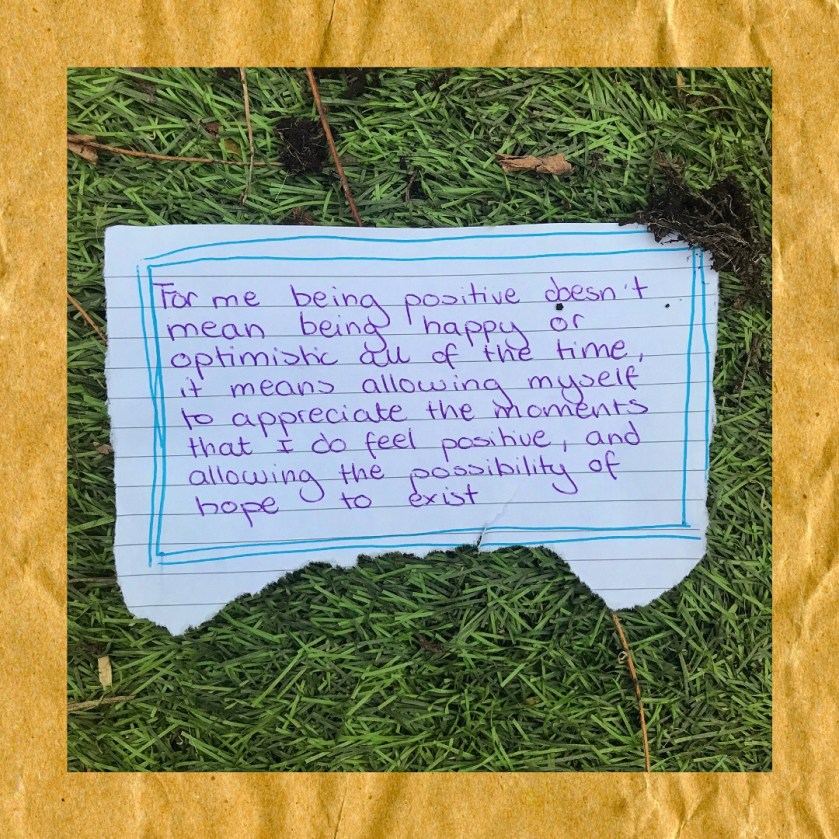
This post is inspired by I note I made for my Instagram – @our.happy.notes – which read: ‘For me being positive doesn’t mean being happy or positive all the time, it means allowing myself to appreciate the moments that I do feel positive, and allowing the possibility of hope to exist’. I wrote it because being the inquisitive person I am and being active on social media brought the thought into my mind – what is positivity? What does positivity mean to me?

I’m a person that tends to find myself living in extremes. There either is or there isn’t. I am all or nothing. So with positivity and a mood disorder, I found that I either lived in a state of overwhelming optimist or complete lack of any positive thought at all. What I have found interesting, and beneficial to my mental health, is exploring the space in between. The idea that even in positive moments I can accept that it won’t last forever, and in the times where I lack such I can acknowledge that it doesn’t mean that positivity has disappeared.

I think sometimes even in well meaning spaces, there can be such a pressure to be positive and see the good in life. Unfortunately this simply isn’t possible all of the time, and when we put pressure on ourselves to feel one way or the other it can lead to us feeling even worse. The reality of the situation is that all emotions on the spectrum are valid. Yet the lack of positivity or hope in one moment does not mean it will never return; that it has ceased to exist. Nowadays this is something I like to remind myself – writing it out helps me to absorb it.

So, what is positivity to me? Positivity is not the blind belief in a bright future, but the acceptance of the fact that a bright future could exist. It is allowing the possibility of a good day for someone else happening, even if it isn’t for me. It is embracing the small, joyful things in life – the most minute parts of the world that make me a little less down, even if only for a moment. It is an intangible thing, an emotion, an idea – a beautiful prospect.

However I recognise that in moments we really can want to increase our positive thoughts and feelings in life. I am no expert on this, though I do have some tools that have helped me. In the morning I write down affirmations for the day – ‘Today can be a good day’, ‘I am enough’, etc. In the evening I write a gratitude list – ‘I have a roof over my head’, ‘someone smiled at me in the street’. I list the small things in life that bring me joy. I allow myself to dream wildly, but remind myself that whether or not these dreams materialise, I will be ok. I smile; sometimes I simply sit there and I smile. And when I feel that positivity is disappearing, that hope is waning, I repeat aloud and write on paper that they are not gone forever. These might seem a little silly, but they are some of the most healing things toward my mental health.

Sending love and support to anyone who needs it today!

Love, Millie x

Posted in Mental Health, Personal Growth

Small Steps

Hey there! 

I’ve been thinking recently on how I can help myself to maintain a better state of mental health, when I’m already feeling a bit better in myself, but also how I can make it easier to lift out of those darker moments. Through some conversations, therapy, and self reflection I have come to appreciate how important the small steps we take to support our mental health are.

However, when you’re feeling particularly blue it can be difficult to even begin to do the smallest things; people can often get annoyed at us for this as well. For me one way of overcoming this is by breaking them down into even smaller steps. For example if my aim is to take my meds, then I’ll start by walking to the drawer, then opening the draw, taking them out, laying them out etc etc. It may seem silly at first – I know for me it almost felt like I was patronising myself – but it might just be of use to try this, and it is a huge thing to take any of these steps so you deserve congratulating for that! 

So what are some of the small steps I’ve come up with to help maintain my mental health? Writing my diary; gratitude and affirmation lists; meds and vits; drinking enough water; walking; allowing myself downtime; using planners to keep on top of work; reading (to make learning fun); making my happy notes; doodling and using fiddle toys; playing piano; meditating and more…

I hope you can find some small steps that will help you maintain your mental health! We all have it and we all need to look after it 

See ya later 🙂

Posted in Advocacy, Mental Health

Funding Mental Health – An Introductory Question

Today’s post is inspired by @jcss.c (insta)

I’ve spoken about funding for mental health systems here before, but I wanted to write a bit about what we want to fund. The mental health system as it is is flawed – I am certain of this – and while extra funding is needed and would help, it won’t fix everything. That is whey when I talk about improving the mental health system I use the word reform.

When we talk about funding the system we need to consider what we are funding. Do we want to pump money into a fundamentally broken system (because it’s been getting worse for quite a while) or do we want to use that money to reform the way the system works, promote independent person led treatment, and then provide resources to help make that happen? 

Here’s some examples of areas that need to be changed: 

  • fatphobia within ED (eating disorder) treatment. That means not having to be under a certain weight to be validated, the mental side of an eating disorder taking precedent, and providing space for people who don’t fit the ‘typical’ ED profile you might expect 
  • Medical racism. This needs to be tackled at all levels and in all areas of society – they all influence each other
  • Inability for medical practitioners to see individuals rather than symptoms. The individual patient matters; they should have a say in their own treatment; all of who they are should be recognised and celebrated. There’s a difference between having to tick boxes and refusing to see anything outside of those boxes 
  • Inappropriate medication/ sedation in inpatient. There should be more resources and a better system of action that doesn’t lead to drugs so quickly, especially if that is against the patient’s wishes 
  • Criminalisation & lack of human respect for people with substance use issues. 
  • Staff who always validate the experience of the patient, don’t rush patients through, tell them they’re not ‘bad enough’, aren’t rude, aren’t tired etc etc etc 
  • Voluntary treatment truly being voluntary. Rather than ‘admit yourself or we’ll section you’ (which happens far too much) 
  • Language changes. Being labelled as compliant or non-compliant, for example, and threatened with no help at all or penalties on freedom in inpatient, when in reality the reasons behind each person’s choice should be explored and respected. They should be helped to be motivated, and if the treatment isn’t working for them, there should be other options 
  • Space for alternative treatments. For example art therapy, drama therapy, animal therapy – just using other methods to get through to patients can be pivotal in their treatment. There should be the ability for this to happen on a wide scale 
  • Recognition of the wider factors impacting and maintaining mental health. Such as money, identity etc

There’s so much more I could discuss and it’s not like I’ve studied this for years, so this is just the opinion I have developed, but I know I am not alone in this. I’d also like to say that I respect any professionals that want to make a difference for someone struggling with their mental health, but I recognise that in such a strange system, it’s often hard for them to do so, and after time that motivation may just disappear. 

If anyone wants to add anything, please comment below, would love to have a discussion on this topic.

Posted in Mental Health, Personal Growth

Letter to My Mental Illnesses

Hello, 

There’s no need to introduce myself, we know each other well, don’t we? As such I know that you have a habit of finding new ways to creep into my life – you’re always going to be here I suspect, so I suppose it’s time I had a proper conversation with you. Embraced you. Accepted that you are, and always will be, a part of me. 

Well I’d rather not start with the negatives, so let me thank you. You have taught me strength in ways I could never have imagined just a few years ago. You tried to break me – hell, you still do – and yet my scars hold power as a consequence. So thank you for that. And thank you for teaching me kindness, empathy and wisdom. If it wasn’t for you I never would have known what to say to my friends in distress. I never could have overcome issues unrelated to you. If you’re going to stick around you might as well teach me some more of those lessons, because I appreciate them, I really do. And thank you for showing me how lost I was. Thank you for teaching me who I am. Do not mistake me, I am not you. You are a part of me yes, but in realising that I have seen some of the other parts of me that I failed to notice previously. Pretty amazing really. 

Now if you were a physical person I would probably beat bloody at this point. I would scream at you until my throat was raw. I would cry at you, how dare you try to take me away, how dare you try to take my friends, how dare try to cause my family such pain. I would shout at you for every opportunity you took away from me – I wanted to go on that trip. All those days I missed. I actually wanted to be able to go to lessons and focus. I wanted to be around my friends. I wanted to be able to be a stupid teenager for just one day without there being the constant reminder that at any moment I could be struck with the feeling that my heart might explode, or the knowledge that addiction is in my blood.

Yet note I speak in past tense. For in the end, whether you taught me, or I found ways to learn it through necessity to survive, I realised I didn’t really want those things. For every opportunity I missed, I was presented with something else that formed me. And the ones I didn’t miss were golden as a result. If I could let go in the ways I wished, I wouldn’t be me. I wouldn’t be able to see the world in the ways I do. 

Still, know this, if you were a person I saw you run at someone else – god forbid someone I love – I would not hesitate to put myself between you and them, for no one deserves that pain, and my dear we are not done fighting yet. 

Seriously though, you are just made of hopelessness and chaos. Some days I think, surely my mental illness must be exhausted because I sure am, but no, there you are again. So come at me. Come at me with everything you’ve got and watch me rise, because I have come too far to give in to you. I will take the creativity from mania and your chaos and I will make something beautiful. I will take the desperation of your darkness and the shaking mess from your anxiety and I will use it to cling to the others who are suffering to make sure we get through. To ensure that you never have such a grip over another person’s life. Come at me – I think you forget that you are a part of me. We have to find some way to live in harmony or we will destroy each other. Come at me old friend, and watch me grow.

Posted in Advocacy, Mental Health

I Want Change.

This was originally written as a post for Mental Health Awareness week on Instagram. It serves as an introduction to my Mental Health advocacy here at Our Happy Notes:

I’m an advocate for mental health awareness, but sometimes I feel as though I don’t know what to say or do. But I know what I want and I will build from there through myself, my community, and reaching out. 

Positivity and compassion are important, but so is speaking up for change and against the romanticism of mental illness. 

I’m fed up with all these ‘the true side of mental illness’ posts – no, it’s not the ‘truth’, it’s your experience; it’s just as damaging to say it is the only one. Fed up with toxic positivity telling us mental health can be fixed by self care. It will never be ‘fixed’. It will always be a part of us. All of us. Self care is not a singular solution, and we are not failures when it doesn’t take it all away or we can’t commit because brushing our teeth is hard enough. 

Speaking about our experiences is valuable, because there needs to be a tolerance and dialogue, but more than anything there needs to be a system change. I want change. I would never choose to take my illnesses away because they shaped me, and they give me creativity and kindness, but I shouldn’t have had to arrive at that conclusion on my own. 

It shouldn’t be down to a teacher to hand out all the real advice I’m getting – and only then because she’d experienced what I was going through herself. It shouldn’t be a system where we come away from each meeting feeling worse than when we went in, a three month check in from a psychiatrist you had to pay for with charity money otherwise it was an eighteen month wait and quite simply you would be dead by then, but all they did was make sure that you weren’t dead already anyway. Mothers shouldn’t be burdened with such worry when this is something that happens and can be supported. There should be research to prevent the endless trial and error of medications that messes around with yet another patient’s brain. For the kids who need understanding there should be explanations. 

There should be staff for CAMHS and inpatient. When the teachers are so worried, you’re wondering what it might be like to fly, they’re talking about phone calls to parents and police – you shouldn’t be more afraid of hospitals than you are of dying. It shouldn’t have gotten to that point where you weren’t light enough, bad enough, clear enough, strong enough – teenagers shouldn’t have to be strong and blamed for their reluctance when all they’ve known is that they’re not enough. There shouldn’t be so many inequalities – any inequalities – in the system; so much lack of understanding of the challenges that Black people, LGBTQ+ people, disabled people face. 

I want staff. I want research. I want money for the service and societal change led by a government that actually gives a sh*t and we need that now more than ever. I don’t want to see another friend grappling with a mental illness all alone. I don’t want the statistics for suicide and self harm to climb. I don’t want another overdose that could’ve been prevented if only they’d learnt how to cope. I don’t want them to be blamed anymore. I don’t want anyone to feel alone when they are not. To feel unsupported simply because of their identity. 

I want change, and it starts with us. With our dialogue – led by love and compassion and a willingness to learn. I want us to be validated without labels, and yet unafraid if a diagnosis is present. I want the criteria for diagnosis to reflect the diversity of the people who might be diagnosed. I want understanding and support of mental health built into every facet of our lives, including where we are fighting for justice elsewhere, because these are not stand alone issues. The ‘mad’ people are getting mad, and they don’t want that. I want change.

– Millie