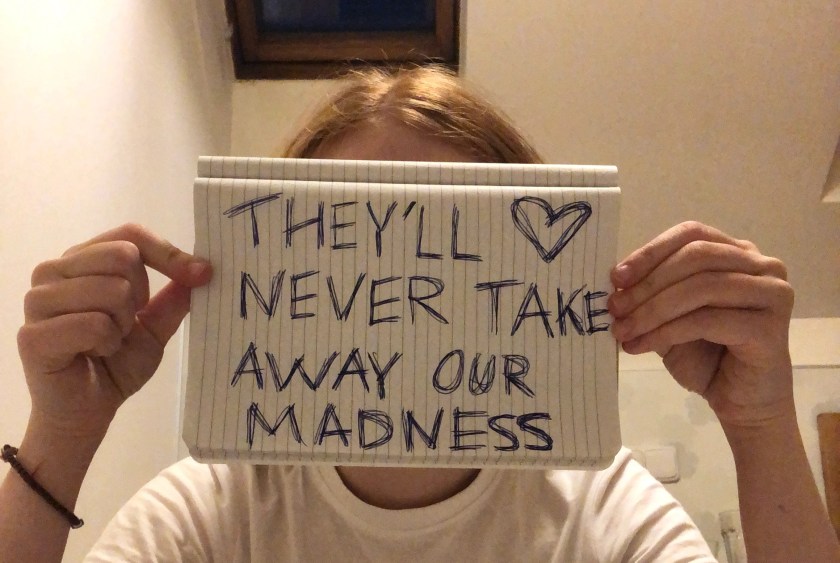
Posted in Happy Notes, positivity

50 Compliments That Are Not Appearance Based

I know personally that it can feel a bit awkward to give or receive compliments, the protocol on when to compliment someone and how to react is a bit confusing to me. But I also like to imagine a society in which complimenting people was a more normal thing to do; where being open about how we feel (including our positive feelings towards others – complimenting them) was encouraged and normalised. However much of the time when we do compliment people it is appearance based. This is difficult because it can sometimes reduce someone to their appearance, which they don’t always have control over, and looks past who they are as a person and what they mean in our lives – especially when it’s to do with their body and not the way they dress (something they may use as a form of expression) for example. So I’ve put together a list of 50 compliments and open statements that are not appearance based. My challenge to you is to compliment at least one person a day for the next week on something other than their appearance. Let me know how it goes and any other ideas for compliments in the comments below!

  1. You make me smile 
  2. You’re funny 
  3. You make me happy 
  4. You’re kind 
  5. You make me feel safe 
  6. You glow 
  7. Your sensitivity is so strong 
  8. I appreciate you 
  9. You inspire me 
  10. You’re so strong 
  11. I admire your work ethic 
  12. You mean a lot to me 
  13. I love your honesty 
  14. You have a great mindset 
  15. You’re so brave
  16. You’re so loving 
  17. You’re are worthy 
  18. I am comfortable around you 
  19. You did great today 
  20. You are a warm person 
  21. You’re so understanding 
  22. You are a good listener 
  23. You are really insightful 
  24. You always care 
  25. You’re wonderfully unique 
  26. You are perfect exactly as you are 
  27. I wish more people were like you 
  28. I respect you 
  29. I trust you 
  30. I’m so happy you’re in my life 
  31. You’ve flourished as a person 
  32. You make a difference 
  33. You’re becoming even more amazing – and I didn’t think that was possible
  34. Your personality lights up the room 
  35. You deserve good things 
  36. You’re great at giving advice 
  37. I love how passionate you are about (blank)
  38. I love your imagination 
  39. You matter to me
  40. I love being around you 
  41. I love how confident you are 
  42. You make people feel important 
  43. I respect your integrity 
  44. You are a generous person
  45. You’re have an open heart 
  46. You are on your perfect path 
  47. I’m proud of you 
  48. Your ideas/ beliefs matter 
  49. Your happiness is infectious 
  50. You are a great leader
Posted in Managing Mental Health, Mental Health

Nature and Mental Health

I think the connection between nature and mental health is under-utilised. 

There are hundreds of studies out there looking at the proven positive effect time in and connection with nature has on our mental health, but I’ll be talking from a more holistic/ theorised place today. 

I think we have learnt to see ourselves as separate from nature, but the truth is we are part of nature. We breathe the same air as all animals, given to us by trees and plants. We are connected to the same ground as all flowers and vegetables, all fruits and roots. We are nature. We’re nature with opposable thumbs. So of course climate change affects us – not only on an intellectually anxious level, but a deep intrinsically natural level. Of course a sunset or a flight of birds can inspire us on an instinctual level. We don’t need to completely understand it, define it – of course at a scientific level that’s useful. But on an emotional level? I think just leaning into that connection can help set us free. 

The pace of the world we live in is in direct juxtaposition to nature. In the western world at least we run at what I think is an unattainable pace. The capitalistic society is intent on promoting not only individualism but also productivity. And we’ve learnt that productivity is a good word. The model citizen is a productive citizen – this really means blindly following the rules put upon us and always striving for more, at a faster rate. Not only does this harm us individually, but it is a driving cause behind the industries that are contributing most to climate change and destroying the nature we are so deeply connected with. So we are severed from the nature we are a part of, and told to keep busy enough that we never question the system we have become a part of; perhaps more importantly, in order to have the resources to survive we cannot question. We are placed in a deep survival mode, and often forced to be unaware of it. 

The next logical step would be to assume that a person with a mental health issue is individually at fault. A weakness in the mind, a personal problem. It isolates the sufferer further and gives the rest of the world and excuse to keep going as is. The common narrative surrounding mental health awareness continues to ignore, on the whole, how much societal and economic factors are contributors and causes of mental illness – and by extension how a lack of connection with our roots in nature is a contributing factor. It should be made clear I am not advocating for full blown communism or anarchism or anything like that – it’s not like we haven’t seen ample issues when those structures have tried to be deployed in the past! In fact I have very little idea how to face these issues on a wider scale. But I know how to face them on a smaller scale; I know where to start (I think) and maybe that’s enough for now. To start, perhaps we look to the pace of nature; to the connection we inherently have (but so often ignore) with nature and our fellow beings. 

Nature does not rush. It works at exactly the pace it needs to. In fact time itself is a structure we have projected onto the world to help us make sense of it – with very obvious reasons for helping us level our experience with each other. But what the construction of time can tell us is that though we may share hours between us, we can redesign what the contents of an hour should be. To explain: resting for an hour in the grass can be redefined to be just as important as furiously analysing stocks to meet a deadline. We can redefine what productivity means and looks like. Nature rests in winter – its pace changes to match the weather and the temperature, the presence of bees and hibernation of bears. And nature still survives. So by extension, perhaps we can learn to respect our rhythms. To work with the sun, to respect the rain, to rest when we are tired and flow when we are not. We are not machines – we do not have endless energy or an ability to always be running. We are not all designed to sleep and wake at exactly the same times each day. We are nature. Maybe we can learn from it. 

Then of course there is the simple benefit of being among other nature. As mentioned countless studies – and poems and songs and personal experiences in each of our lives – record the boost to our mental health when among nature. Simply taking time to sit under a tree and imagine our own roots connecting, or take a walk in the woods (if that’s possible – everyone should have access to green spaces), or swim in a lake, run through a field, watch the flowers in the breeze or the sea crash to shore. Simply taking the time, even if it is only a minute, to start learning how to just be again – alongside our nature – can have a huge positive impact. It can calm us, make us feel more connected, happier, lighter. 

Oh and by the way, this isn’t new or revolutionary. It’s been strategically forgotten and hidden. Native communities around the world have known this for such a long time; the colonial view of society and mental health has detached us from this. I’m not at all the person to be listening to on this perspective and this history  – but here’s just one article written by Indigenous writer Edson Krenak Naknanuk from Brazil about connection with nature: https://www.culturalsurvival.org/publications/cultural-survival-quarterly/indigenous-peoples-are-essential-rights-nature

As the article explores, a view to see nature as a part of us – something in a reciprocal relationship – is important when looking to solving climate change too. 

Remember – we all breathe the same air; we share a consciousness of being through nature. So why do we seek to intellectualise that connection always? How does that separate us from our connection with freedom of mental health? How can nature support us mentally, as a community and individuals?

Sending so much love and support to you all today xx

P.S. For a related science look at some of these topics I would recommend the book ‘Beyond Biocentrism’ by Robert Lanza and Bob Berman

Posted in Mental Health, neurodiversity

Mania @ 5:15am – A Poem

I’ve written a bit before about how important creativity is to me in my mental health journey. I think creativity’s power is often overlooked. It’s expressive, healing, connecting, expanding and freeing. I think sometimes too sharing creative works can present ideas we may not otherwise be able to share. So here’s another one of my poems, written about my experience with mania:

Mania @ 5:15am

I see a girl running in the rain clothes pressed up against her body like an embrace from a lover she’s forgotten or hasn’t yet had it doesn’t matter she is wild and she is free and she is crying tears it could be ecstasy it could be the crashing waves pounding in her soul it could they flood her heart her mind it could be drugs she can’t remember what she was doing BRIGHT there is only now she is running the other people’s eyes burn something like concern or envy she keeps running there’s blood and bruises each drop of rain tastes like gin on her tongue they are every shout she’s ever heard she is drunk on life her feet pounding are like every hit she’s ever endured punching in at work her at home no confines don’t exist she learnt the best tactics she plays the game and never loses she wins by losing every inhibition sense of self it is a mask feet gliding like she’s flying air lifting she’ll never need to breathe again not ever all is in this flight her plight ongoing shriek of breaks on wet tarmac like a shattered plate thrown at the head of an eight year old unsuspecting she’s young all the wisdom of a thousand years old keeps running keep running can’t be caught she’s the leader corruption of every leads the way to BRIGHT hope to know it

life live

Running don’t 

slip.

Posted in Advocacy, autism, Mental Health, neurodiversity, Personal Growth, sobriety, therapy

Hurt by Psychiatry

Content warning: ED, psychiatric abuse, suicidal ideation, any mental health topic really

I want to write a really strong and defiant letter. I want to write some crazy, proud, creative theatre piece. I want to write something truly hopeful. And while I do have hope, and I do have gratitude – because it is essential to my survival – I also have a lot of pain. And anger. I can talk openly about so many traumas and just general shitty things that have happened in my life. But the one I’ve never been able to write about, never even been able to get through a conversation about without screaming and crying, is the pain endured under the psychiatric complex. Because they were meant to help me. Time and time and time again I have gone looking for help and time and time and time again I have been turned away with only more hurt. I know help is a brave word. I’m not afraid to say it. But I am afraid that when I say it no one will listen. This is my story of a journey through the mental health system. 

Just a disclaimer, because as a writer on mental health I feel it is my responsibility – if you are in a bad place and looking for professional help, please do not use this as your excuse not to. I do know some people have been greatly helped by the mental health system, and you could be too. This is not intended to invalidate anyone’s good experiences, but rather to say that all of us deserve to have those good experiences. This is simply my story as someone who feels they have slipped through the cracks. If you feel this may affect you negatively I implore you to take the decision not to read any further. 

I first asked for help from the mental health system when I was 12 years old. I was experiencing mood swings and distress that were really bothering me – maybe just normal teenage things, maybe not, but the point is it doesn’t matter. They were bothering me. Anyone who wants help, even just to navigate daily life, should be given it. I was assigned a counsellor from the early intervention team. I didn’t like them, so I asked to change. I was discharged from the service – I took that as a message that if I had an opinion on my care, my care would be withdrawn from me. 

My first contact with CAHMS (child and adolescent mental health services) was due to an eating disorder at 14. My life was being ruled by it – I had complete meltdowns when I couldn’t exercise, was hyper fixated on food all the time, was weak and angry and alone; I was really hurting. They weighed me. They told me I wasn’t a low enough weight. I took that to mean I wasn’t sick enough. Without any regard for how I felt, or how food was ruling my life; without anyone trying to find out anything about my experience they denied me the help I so desperately needed. Suggested possibly a meal plan – with no support to implement it or formulate it. If a teacher hadn’t sat with me at lunch every single day for a year and coached me through it because she’d been there too, I don’t know how I would’ve gotten through it. 

I severely relapsed with my eating behaviours twice more, and I still struggle with some thought patterns and triggers to this day (though I am in a much better place, largely due to recovery in other areas giving me the tools to transfer). But I never felt like I really recovered from it, or had the support I needed. Even 9 months ago that teacher would still notice when my old behaviours around food crept in – even before I did – and help me to recognise and head them off. I am immensely grateful for that… but it wasn’t her job. It was never her job to be the main guidance and support in eating disorder recovery. 

CAHMS did offer me six sessions of group therapy. This was to deal with my overwhelming anxiety – much of it around socialising – and deep depression. They didn’t see it as deep depression. It was. It was really, really dark. I stopped going to any lessons and lost all sense of self and hope. But yeah, six sessions would be enough apparently (obviously not). I freaked out at the thought of group therapy, it was entirely unsuitable for me. Once again I received the message in response that if I had an opinion on my care, I wouldn’t get any care. They wanted to discharge me right then, but my wonderful mum stuck up for me so they offered me three – I repeat THREE – CBT sessions. They were not useful. I was put on a years long waiting list for an autism assessment. I was offered no more support. I continued to struggle. 

My mum’s determination to get me the help I deserved was incredible, and probably the only reason I got any support at all. (My mum is probably reading this, so thanks mum). She found a charity that was amazing in supporting us through my teen years, and funded me to see a private psychiatrist – this would not have been possible without them. However I wouldn’t say that was particularly helpful either. That psychiatrist did diagnose me with autism (side note – the assessment for autism really needs to be changed), anxiety and depression. I am eternally grateful for my autism diagnosis – it truly did change my life knowing I was autistic. But it changed my life because I went away and learnt about it, as did my family. The psychiatrist did not formulate a treatment plan for any of this, or provide any further support. Some medication that didn’t work was all she offered. 

In this time I also saw a few therapists – I didn’t like them, one of them didn’t like me and kinda dumped me. All of them were privately paid for. The subpar care I received was paid for privately – can you imagine how much worse it would have been if we hadn’t been able to afford it?

I know this is all a lot of information, but stick with me here. This journey is important to understand because it is something so so many people face. I slipped through the cracks of this system – even with the privilege of being a white, cisgendered woman. I had it reasonably easy. 

In February 2020 I had what I now recognise to be my first (and most intense) mixed episode. I cannot even put this experience into words but essentially it was all the darkness of depression with all the heightened energy and irritability of mania at the same time. I felt reality slipping away from me and I have never been in such intense distress. Two teachers stayed with me at school hours after school ended to try and keep me safe. They eventually helped me calm down, but I later found out they were so concerned they were about to call an ambulance or the police, as the crisis line wasn’t helping. I went to the GP during this episode begging for help. She prescribed me valium to calm me down, but when I begged her for more support I remember her chastising me for being so emotional because she had other patients waiting. I took that as a message that I still wasn’t sick enough; still wasn’t important enough. 

In March 2020 the private psychiatrist diagnosed me with cyclothymia. We had to pay extra for an emergency appointment. She decided I was now too complicated to be under her care and needed more support so referred me back into the NHS. They did not follow up on her recommendation for more support. By the time they saw me I was a bit calmer so apparently that meant I didn’t need help. In her eyes I was too bad, in their eyes I wasn’t bad enough. So I was left with nothing. This was the trend that would continue for the next three years. 

In September 2020 I wound up in A&E. I was broken and desperate. When the CAHMS crisis person finally arrived she acted annoyed about me being there, annoyed she had to be there, uncaring. She essentially asked ‘if things are so bad then why haven’t you killed yourself yet?’ and sent me home with no support. They didn’t follow up on any support because I calmed down a bit after, so I was no longer considered in crisis when they finally did get in contact (even though they hadn’t helped me when I was in crisis) and because I was drinking at the time. Just so we are all clear – if a young person is drinking as heavily as I was, that is exactly the time they need support. I went to my first AA meeting after I left the hospital that day. And excuse my french but thank fuck I did. I have no idea if I would still be alive otherwise. And having connected with others who have been subjected to inpatient treatment, I am incredibly grateful I did not have to bear that extra trauma. This is how bad the surface level service is – it’s even worse inside. 

After I got sober in July 2021 I was still struggling. I finally got to see a psychiatrist on the NHS in October 2021 because of my mum’s insistent fighting for me. When he asked me what I wanted from the meeting, he chastised my response. He was unclear. He shouted at me, and revoked what I thought I had been diagnosed with in a letter. I was meant to see him again in 10 weeks and he cancelled. I got discharged from CAHMS without them ever asking to talk with me about how I was doing. 

The one professional who has been a saving grace is my therapist. She is autistic herself and very flexible. But again – if I wasn’t able to fund that privately I don’t know where I would be. After my charity funding stopped when I turned 18 I had to take the sessions down to every 2 weeks, even with her sliding scale, which is significantly less helpful. Luckily I’ve also found amazing peer support, especially through AA, and spent a lot of time reflecting and doing my own work, so I’ve managed to build myself a much brighter life. But it’s been hard. And sometimes I really do need some more help – no one should have to do this alone.

I Went back to the NHS this October and had my first ever good meeting with anyone, just someone in my GP clinic. Why? He was honest. He genuinely seemed to care, but there was nothing they could offer me. He explained that as far as the system saw it, I had already been helped.

In late 2022 my mental health really started to decline again. I went back to the NHS this October and had my first ever good meeting with anyone, just someone in my GP clinic. Why? He was honest. He genuinely seemed to care, but there was nothing they could offer me. He explained that as far as the system saw it, I had already been helped. So from October I was searching for a psychiatrist who would see me. 

I was turned down by over 10 private psychiatrists for being too complex, having comorbidities, or my favourite way of putting it: ‘them not being able to offer the support I need at that time’. So I was again too bad for private and not bad enough for the NHS. One of the only people who would see me charged just under £1000 a session. Others said they would consider seeing me, but were booked up until 2024.

Finally in March 2023 – 5 months later – I got to meet with a private psychiatrist. And wow, he was amazing. We had three meetings so we could cover everything. He was kind, listened to me – really listened – and didn’t patronise. He treated me like an adult, and made it clear I would have a say in my care plan and the final report that would be sent to my doctor. I would have a say? I almost thought that wasn’t allowed. I’m still sceptical, it still doesn’t feel real. 

He diagnosed me with Bipolar type 1. Just think about that for a minute – an 18 year old has been dealing with undiagnosed bipolar 1, unsupported, emerging from 12 years old. I have no idea where I would be without the angels placed in my life along the way; without the undying support of my family and friends; without the flexibility of my school. I knew something more was going on, I knew how much pain I was in, and no one in the mental health industry was listening. I was screaming into a void and not even hearing the echoes of my own screams. (A separate issue is that we shouldn’t need labels to validate that level of human distress, which is what it is at its core, but diagnosis can be so validating. Read more about that here). 

I am not in any way saying this one experience erases all the rest. It does not. It absolutely does not. And it doesn’t not mean that psychiatry isn’t built on an oppressive, harmful foundation whose history has been hidden. It is. But it was a little hope given back to me. A relief at the very least. Before I went into that meeting I said ‘I’ll take them just not being actively mean to me’. How sad is that? What a desperately low bar. 

I’m still scared. He has instructed my GP to refer me back to secondary care teams in the NHS, which I still – like always – hope might offer some help. But the main thing offered seems to be medication, which I have some serious and valid concerns about. But I am terrified of raising these concerns or asking about alternatives for fear that a) I will be labelled as disordered and my new diagnosis weaponised against me or b) I will be labelled as non-compliant/ not wanting help enough, and sent away again. I wish I didn’t want help from them, and maybe one day I’ll be able to find a path that avoids dealing with the mental health system altogether. But I’m not there yet. Nor should I have to avoid it. It should be an inclusive, varied, accessible service. It should have community and individualised care. It should have alternative treatments and input from patients. It should see the human condition as a spectrum. But it doesn’t. And being mentally ill makes me scared that if I voice any of this, I will not be taken seriously. How can anyone ever prove that they are sane?

I deserve better. Everyone deserves better; we deserve to know that no matter what we’re going through there will be appropriate support for us. But it’s not there. And this broken system is quite literally killing people. We can’t just say fund the system either, the system needs to change. I need it to change, we all need it to change. 

I think I’m sharing this because the younger version of me wanted desperately to read it from someone else. So the core message is that you are not alone. You are not alone in the hurt psychiatry has caused you. You are allowed to be angry about it, and distrusting of it. You are allowed to choose your own care and your own path – even if others don’t understand it! (And that applies to all paths – mental illness should not be policed). Your pain is valid, completely valid, and I see you. I see you.

Sending love and support to you all today xx
Posted in Advocacy, Mental Health

The Casey Review and What it Means for Mental Health

Content Warning: Police misconduct, abuse, and discrimination

This post is a short overview of how the recent Casey Review relates to the mental health system. There are many more implications for the mentally ill and all intersectional issues so I would really encourage you to do some more research into the review and the topic of police misconduct – it affects all of us, especially the most vulnerable.

What is The Casey Review?

The Casey Review is an independent investigation and review of the standards of behaviour and the internal culture of the Met Police in the UK. Baroness Casey was appointed to head up the review in October 2021 after the kidnap and murder of Sarah Everard by a police officer and several other deeply troubling incidents. The final report has just been released (March 2023) and it is a damning condemnation of the Met Police.

What Did The Review Find?

The police were found to be institutionally racist, misogynistic, and homophobic. Specifically that it has failed to protect the public from officers who abuse women; that organisational changes have put women and children at greater risk; and that female officers and staff routinely experience sexism.

Much of what is found in the report isn’t a surprise to the communities who face discrimination and targeting from the police, and also echos what was said in the MacPherson report back in 1999 after the murder of Black teenager Stephen Lawrence. This isn’t a news – it’s a continually pressing issue that cannot continue to be ignored. This isn’t news – it’s a continually pressing issue that cannot continue to be ignored.

What Does it Have to Do with Mental Health?

Mental Illness has been criminalised in this country for a long time. Police play a key role in enforcing the Mental Health Act (which is used to section people against their will). This means their attitude, organisation and behaviour can have a huge direct impact on those of us with perceived mental health difficulties.

As Mind puts it: ‘This matters to us because we know that people with mental health problems are more likely to be victims of crime, more likely to feel that impact more acutely, and less likely to get the support they need’. And yes – people with mental health problems are more likely to be the VICTIMS of a crime, despite continual stigma that we are more likely to perpetrate crime.

One key way this directly impacts mentally ill people and the mental health system is the institutional racsim. Black people are already 5x more likely to be sectioned, and to reach the mental health system through ‘negative’ routes such as police and court. And this is one of the reasons why – the institutional, systematic racism that pervades our society and police. Once within that system Black people are likely to face more trauma and forced control, a lack of appropriate care and understanding. Their distress likely compounded by the racism they face daily anyway, more trauma is created within the system and only compounded further if they also face homophobia and sexism.

The ways the findings of this report impact the mental health of individuals, and the mental health system are myriad. It is directly in opposition to justice, freedom, and healing.

Ways to Help:

  • Sign up to become a Mind campaigner
  • Look for alternatives to institutionalised care that you can support in your area
  • Contact the Met Police and put pressure on them
  • Contact your local police and MP to ask that they review their own behaviour
  • Donate food and supplies to local charities that support your community
  • Raise your voice however feels best for you – maybe you can use art, or song.
  • See this page for a list of further reading looking at the idea of police abolition and how our systems function for a deeper understanding (and a much better look at ways you can help!)
  • There’s not one way to make change, it happens together!
Posted in autism, neurodiversity

Non-Canonical Autistic Characters

Ok so this is actually a list of characters that I have decided are autistic/ neurodiverse – not actual canonically autistic characters. In fact the only media representation of a canonically autistic character I have ever seen is Sam in Atypical – and I really struggled with this series. The only book I’ve read with an autistic character is The Curious Incident of a Dog in the Nighttime. To this day I have never – I repeat, NEVER – read a book or come across a media representation of a canonically autistic character who is female or gender diverse. Ever. I only realised that two days ago while thinking about this post and it made me really sad. In many ways I feel the media is moving forwards, and I do not feel I lack autistic representation in my life because I have had the privilege to be able to actively seek that out online. But to have never come across an autistic girl in the media I consume? I’ve heard there is an autistic character in Heartstopper so I will have to give that a watch soon. I’ve realised how much I want to consume content with autistic characters, so for the first time I think I’m going to actively seek that out. 

But anyway, what’s the point of this? What’s the point of calling characters autistic? Well, in part for fun. This is simply my opinion and not a critical analysis of any of these characters. But also for representation, in a non-direct way. Resonating with fictional characters and relating to the world through them is a huge part of my neurodiverse experience, so if I can see myself in them a little more by calling them autistic, it’s really comforting. And finally also to raise a little awareness of an ongoing trend of creating autistically coded characters (characters with clear neurodiverse traits) without calling them autistic. It lends itself to another ongoing trend where people love the quirky characters on screen or in books – they even seem to worship them – but in real life people with the same traits are bullied and left behind. Recognising that I, as an autistic person, resonate with neurodiverse traits of characters begs two questions: 1 – Why aren’t characters called autistic? Perhaps because people are afraid to relate too closely to neurodiversity, it threatens them; 2 – Why do we celebrate difference in fiction but create intolerance to it in reality? 

With that being said, here are some character I (and other autistics) have decided are autistic:

  1. Sheldon Cooper – The Big Bang Theory and Young Sheldon 

The fact that the creators refused to admit Sheldon is autistic (like literally entirely based on autistic traits and stereotypes) is a source of great frustration – though it may be because they wouldn’t be able to make fun of him in the same way if he was autistic. But nonetheless, I really love seeing some of my traits on a big screen, especially in Young Sheldon, which at times seems to mirror my own childhood experiences exactly. Though it should be noted that autism is so much more complex and varied than the representation of Sheldon (and other similar characters like in Rainman). 

Some of his autistic traits include:

  • Sensory sensitivity (sound, taste, smell)
  • Different speech and intonation patterns 
  • Love of routine 
  • Difficulty dealing with change 
  • Lacking social skills
  • Hyperfixations and special interests
  • The list is literally endless 
  1. Wednesday Addams – Wednesday 

I mean the character of Wednesday is overall very neurodiverse, but the recent representation in Wednesday on Netflix was really relatable for a lot of autistic people. 

Some autistic traits include:

  • Monotone speech 
  • Less facial expressions 
  • Different way of moving (the iconic dance scene)
  • Sensory sensitivities (allergic to colour)
  • Bluntness 
  • Difficulty interpreting others emotions – ‘It’s not my fault I can’t interpret your emotional morse code’
  • Strong sense of justice 
  1. Matilda – Matilda 

I have always been obsessed with Matilda, and that’s probably at the core of why I see her as a neurodiverse character. I think I’ve read the book more than any other book (including in Spanish) and I’ve seen the musical more than any other show. I love it. As a kid I would spend hours staring at objects trying to get them to move with my mind, and I feel as though I’ve had my own ‘Miss Honey(s)’ in my life too. 

Some of Matilda’s autistic traits include:

  • Strong sense of justice 
  • The loudness in her head and different way of perceiving the world (‘But I wonder if inside my head/ I’m not just a bit different from some of my friends […] And when everyone shouts / Like they seem to like shouting/ The noise in my head is incredibly loud’)
  • Different from her peers and family 
  • Hyperlexia (can read very well very early)
  • Special interests (reading)
  • Direct way of communicating 
  • Sensory sensitivity – to Ms Trunchbull’s shouting and the TV for example 
  1. Hermione – Harry Potter 

Mentioning Harry Potter can seem a bit of a tightrope walk nowadays, but it was a very important part of my childhood and forms part of who I am today. That being said, trans women are women – always have been, always will be. So let’s reclaim the narrative further and say that Hermione is autistic! I was so obsessed with Hermione that all the new clothes I bought at 12 were based on her costumes. She was super smart and didn’t let others put her down because of it, and as someone who was often ‘ahead’ in school this was so comforting to see. Also Luna Lovegood is 100% autistic as well and I love her. 

Some autistic traits:

  • Strong sense of justice 
  • Sensory sensitivity – notices details others miss 
  • Lacks social skills (at least in first few books) and skips social niceties 
  • Special interests and hyperfixations (intense devotion to studying)
  • Obsession with learning and following the rules 
  • Hyperlexia 
  1. Phoebe – Friends 

Another one of my comfort shows, I have watched Friends more times than I can count. And the more I’ve watched it, the more I’ve related to and appreciated Phoebe’s character. Watching it again after being diagnosed was really interesting because I remember wondering for the first time about how Phoebe was showing a load of those traits I had just been asked about in my assessment. I’m not convinced she’s autistic, maybe ADHD or something else – but she is definitely neurodiverse. 100%. 

Neurodiverse traits:

  • Doesn’t care about social niceties (will just leave or say she doesn’t want to do something)
  • Unique fashion sense 
  • Sensory sensitivity (she can hear music and voices and feel spirits etc, I’m putting this under sensory sensitivity, maybe it’s an extra sense)
  • Special interests – guitar 
  • Different way of communicating 
  • Moves her hands in different ways 
  • Wandering thoughts 
  • Hyper empathy 
  • Strong beliefs that don’t bend to social expectations

So there’s five there. Is that representation good enough? No, because it’s not really a representation. Is it a bit comforting to think about, personally? Yeah, it is. Can we do better? Yeah, we can. A lot. I’m not looking for a whole series about autistic experiences. But I’d like to see myself in the media occasionally, because there’s a lot of autistic people here in the world. Just for already autistically coded characters to maybe have a moment of recognition on screen, a single mention of it, would be huge. If I – a privileged, white, verbal, cis autistic woman – haven’t seen myself represented yet, how long will it be before we start seeing the Black autistics, non-verbal autistics, physically disabled autistics represented? It might seem like a little thing if you have seen yourself on screen and in books all your life, but it can have such a huge impact. I remember crying the first time I read a book with a gay woman. It meant I wasn’t alone. I enjoy a lot of the media I consume, because I can relate to lots of different people with lots of different experiences, and I can enjoy media I don’t directly relate to. So why are people so afraid to relate to us once in a while instead? 

Thanks for reading! Sending all my love and support today xxx

Posted in Happy Notes, Managing Mental Health, Personal Growth, positivity

Gratitude Practice

How often do you take time to stop and appreciate life? Even when it feels like everything’s going wrong? It’s not a test, I just want to encourage you to honestly consider how often you purposefully notice the good in the world. How often do you pause? You might be the kind of person that never does this, or the kind that laughs it off as some more mindfulness nonsense (I know that word can get on my nerves sometimes). Or maybe you try but it’s too difficult, or you feel like you aren’t present enough, aren’t appreciating things enough, so you might as well not try because you’re not getting it right. Maybe sometimes you do this a lot and other times not at all. 

Personally I make a list at the end of every single day with things I’m grateful for. And some days I really deeply feel that gratitude – somewhere indescribable in my core. And other days I’m more like going through the motions. But I make this list every day, and I have for the last 617 days – since I started addiction recovery. I guess that’s kind of been helpful for motivating me to continue with the gratitude practice because I do kind of see it as a life or death thing personally – I either do the things that keep me sober or my life takes a serious turn for the worse. However, that’s not the only reason I do it; I’ve genuinely come to love what practising gratitude in specific (such a small thing) does in my everyday life. And looking back on my mental health journey I’ve realised it became an instinct for me to practise gratitude very early on – though I didn’t realise that’s what I was doing. And that’s interesting. 

When I started to recover from my first full-blown, 9 months long, very-not-good depressive episode, I started this little practice for myself. Every day I recorded: 3 good things I noticed in the world that day, 2 good things I did that day, and 1 good thing someone else did for me that day. They could be as small as I ate some food, or got out of bed (which are not always small feats at all), or someone said hello back, the colours of the leaves are changing on the trees etc. Sometimes they were much bigger than that of course, but actually the best emotional rewards came out of finding those tiny little things to list every day, especially on the days it felt like there wasn’t anything good in the world. I realise now I had created for myself a sort of gratitude practice. 

This came about because at one of my very lowest points, in a desperate attempt to help myself (I was essentially in a headspace of ‘this has got to work or there is no hope left’) I came up with the idea to write two lists. First I wrote a list of all the good things in the world – with the caveat that I didn’t have to think they were good at the time – because nothing seemed good at the time – I just had to have thought they were good/ fun/ not utterly miserable at some point in time. The second list was all the things I would never get to do if I wasn’t around anymore. And something incredible happened while I was writing those lists. Half way through writing the first list I started to realise I wasn’t just remembering things that used to feel good, I was actually starting to feel a faint sense of happiness about these things in the present. Half way through writing the second list I realised I wasn’t listing things I would never get to do, I was listing things I wanted to do in the future. I could actually, faintly, see a future and feel joy. 

It’s interesting to me looking back for several reasons:

  1. My natural instinct when searching for something to help me was to practise gratitude
  2. Practising gratitude had an immediate effect 
  3. Despite not wanting to do many things, I wanted to continue to practise gratitude 
  4. Practising gratitude consistently actually started to change my perspectives on the world and allowed me to be able to take a step back when things got tough again. It essentially created and trained a little voice in my head that no matter how bad things got was there whispering that it would be ok, that not everything was awful

My instincts for survival and healing are fascinating to me because as someone who slipped through cracks of the mental health system, I find them a practically spiritual thing that came to me in depths of hurt. Of course that might not be the way you look at it, and gratitude has been proven in multiple studies to be a powerful tool, but for me the fact that I automatically reached for gratitude suggests that there must be powerful forces of ‘good’ and love in the universe. 

Fast forward a few years and I found myself in addiction recovery, where practising gratitude daily is a foundation of healing. That’s where I realised that what I had done those years before in creating those lists was practising gratitude. So I started doing it again, listing things I am grateful for every day, and in fact sharing them with others – another very healing exercise. Being grateful doesn’t mean we ignore the hurt and wrongdoing in the world, nor does it mean we have to settle for the way our lives are currently. But it does allow us a stable basis to build from; a calm to return to. And it really increases how wonderful the bright things in life feel!

From a scientific standpoint gratitude has been proven to yield many benefits. Here are just five:

  1. It improves empathy and reduces aggression 
  2. It helps improve sleep 
  3. It boosts self confidence 
  4. It strengthens relationships with family, friends, and romantic partners 
  5. It aids the immune system 

Personally it grounds me, makes me feel connected to the wider world, helps me feel more peaceful and content, and takes me out of my thoughts. 

I encourage everyone to try practising gratitude daily for a few weeks, and see how it affects you. If a few weeks seems like too much, then just start with today. The very simple way to practise gratitude is to simply ask yourself the question: What am I grateful for? Allow any thoughts, images and feelings to arise, and try not to judge them. It might help to take a deep breath and sit somewhere quiet – or it might help to have something to entertain your hands like a fidget toy, depending on how your brain works (it’s stuff that gets said a lot, I know, but it is actually helpful). 

Here are some questions to ask and ways to record your gratitude practice:

  • You could try writing out a list of 10 things you’re grateful for; that’s what I do most often
  • You could do a mind map 
  • Illustrate some things you’re grateful for 
  • Make a moodboard on pinterest or from magazine clippings 
  • Ask, what is a kind thing someone else has done for me today? What are the kindest things people have ever done for me?
  • What brings me joy? What used to bring me joy as a child?
  • What makes me smile? 
  • What are the three most important items to me?
  • Who are influential people in my life?
  • The possibilities are limitless 

I really hope you enjoyed reading this blog and that you give some gratitude practice a go! Best thing is it’s not a new skill, it’s something you’ve likely felt many times throughout your life – all we’re doing is tapping into an emotional tool with intentionality. Let me know your experiences in the comments below!

Sending love and support to you all today xxx

Posted in Advocacy, Personal Growth

Being Vulnerable

Thought I’d share something a little different today. The text below is directly copied from ruminations in my diary about being vulnerable (specifically online). Half formed thoughts and unanswered questions, which is kind of the point of what I was writing about – allowing an ‘unfinished’ image of self to be seen. I’ve thought about it more and this quote in particular resonated with me: ‘Vulnerability is the least celebrated emotion in our society’ ~ Mohadesa Najumi. I’m a growing, changing person whose views will inevitably change, but I don’t think I want to live holding back because I may think differently in the future. All we’ve got is now right? So this post is a little less about mental health, and more about the process of learning to be a mental health advocate (if I can allow myself that title!). Please enjoy this copy of my wandering thoughts:

‘I think I naturally ‘overshare’ a lot, though keep some things very hidden. And it’s part defence mechanism, but also part not understanding what’s meant to be hidden. I don’t see my ‘personal life’ as any more personal or precious just because it’s mine. It doesn’t really bother me if more people know, in fact sometimes that makes it more special to me. But is that just a need for validation? Or am I broken, or missing something – because I don’t seem to understand the idea of personal life in the way the messaging of the world does??

And also, of course I’m afraid of judgement. The biggest fears being that sharing I’ve had problems with alcohol – for example – will stop me getting a job in the future. But if no one speaks openly about these things then they remain something to be feared or judged. Right? Social media is so often used to show the ‘end product’ of healing, discovery, creation etc… the polished, acceptable version. But that’s not life! I’m ok being a flawed, growing person. I have to be because I always will be. I want to show that too. 

But is there a right and wrong way to do that? Or is that just more expectations? Or is social media in fact not suitable for that? Of course it will always be just a snapshot of life – does that mean we cannot snapshot the vulnerability too? Indeed – what is vulnerability? I feel we live in a culture where we are afraid to make mistakes, especially in changemaking settings. But mistakes are a part of life. It’s all very confusing, but I don’t want to be afraid of the journey of figuring it out. I choose to move forwards with love and acceptance.’

Posted in Advocacy, Managing Mental Health, Mental Health

Reframing Healing

We receive a lot of messages, consciously and subconsciously, about what healing is. I have my own opinions, some of which will be evident in this post, but I think one of the most important things to keep in mind is what does healing mean to you? There may be limitations to our ideas of a dream life, because we don’t live in a vacuum, but only you get to decide what your healing actually means and looks like. Unfortunately it’s something that is quite overlooked in a lot of mental health spaces, and we’re not often encouraged to really define it for ourselves. But that doesn’t mean we can’t. 

Personally, an important part in redefining healing for myself has been understanding what I’ve been taught about healing. A lot of what I’ve learnt is to see ‘getting better’ as this hyper-individualistic thing. We’re told that ‘getting better’ is about becoming a productive member of society again, going back to work full time, having more output, and living up to the expectations placed on us. A lot of therapy is often about this idea – it’s about mitigating the factors that get in the way of productivity rather than fostering genuine happiness. The idea of compliance and non-compliance in the mental health system is a huge part of reinforcing this and getting in the way of anyone who needs to stop and question whether this striving for efficiency under societal norms is actually what they need. 

We don’t live in a vacuum, so I think it’s only logical to suggest that we don’t heal in a vacuum either. And yes it is possible to have personal peace without those around you experiencing the same, but that’s not to say our healing is entirely individual. We are connected; we are even a part of nature. When bears hibernate or trees shed their leaves we don’t look at them and say they should be doing more, they should be doing better; we understand that they are in a season of their life. Yet we so often fail to extend this same understanding and grace to ourselves. We are a part of nature too, and so we are connected to those around us and every part of the world around us. It is only logical to think we should lean into this connection and these seasons to find peace. So I would say healing is community. Healing is working together. Not in order to fix or mend one broken individual, but to recognise what in our living, breathing system of life contributed to their pain in the first place, and to heal all of us. I’ve found that when I am held by a community, only then am I able to find my own inner peace. 

We also seem to see healing as this end destination – we arrive at ‘healed’ and then we continue there as before… until maybe we need to be healed again. But I don’t see it like this. Healing is an ongoing, every day process for me. Just like I see myself as a continually ‘recovering’ alcoholic, I also see myself as a continually ‘healing’ person. Partly because there are new challenges to life every day; partly because I have chronic mental illness; and partly because I see healing in a larger sense too, one of societal healing. That can be hard to conceive sometimes, or to not get wrapped up in. But I see it as a source of hope rather than a drain of hope. A source of power. That healing, as an ongoing, everyday practice, also means trying to help others and be connected with their struggles. Trying to learn how we can all work together to do better, to build better infrastructure, to break the chains and patterns of the past, to move forwards.

So what does healing mean to you? Does healing mean connection? Does healing mean going back to the life you had before? Or is that just the easiest life to imagine? Does healing mean productivity, or does it mean inner happiness and peace? What do you need to see that realised? Is healing individual, or collective, or aided by the collective? Is healing a destination or a journey? 

I’m not saying there’s one right way to redefine healing. It is personal in how it manifests in our lives, but the very fact that so many out there are healing and recovering shows that while it is personal, it is not individual. And I think the mental health system needs to recognise that too. 

Sending all of my love and support to you today xxx

Posted in Mental Health, Personal Growth

Letter To A Younger Me

Hey sweetie, 

I’m writing you this letter because you’ve been on my mind a lot lately. And the thing is, I know you won’t actually read it, you can’t, I can’t actually travel back and give it to you. So there’s no real point in me giving you advice; any advice I do write is, I suppose, more of a reminder for me now – born from the gifts you gave me just by keeping going. Yeah, this letter isn’t really for you. It’s for me now, or us now. To heal a little bit and reflect in a way that doesn’t consume us back to where you are. If that makes any sense? 

I want to comfort you. I want to hug you, hold you tight, and whisper ‘I’ve got you’. Which is something to remember when you feel like the worst person ever, because eventually we’re able to look back and show ourselves compassion. I know it hurts. And I know you feel really lonely, I know. 

I think I’m writing this to you at about age 13, maybe just turned 14. Right as all the mental health stuff really took off, and before you’d gone through enough of it to have any perspective on it. It was all new and you had no reason to think it wouldn’t last forever. But, hey, spoiler alert – it doesn’t last forever. I won’t lie to you, it does get worse. And then maybe worse again. And again. But there’s this magic process you haven’t come across yet, where even though in some ways it gets worse, it never feels quite as bad as that very first time. Because you’re growing and learning and after you survive it once you always know, deep down inside of you, that you’re going to survive it again. And you’re going to learn all these little skills – and big skills! – that help you get through. You’re going to be ok. Maybe not always, but you are going to be ok. 

I would say please don’t drink, but if you’re 13/14 it’s already too late for that. So I’ll say this instead: you know how you always knew, from when you were really little, that you didn’t want to drink? And you were adamant that you never would, and you always thought if you did it wouldn’t end well, but you didn’t know why? Well, that was your gut instinct, and it was a good one. Learn to listen to your gut – it very rarely serves you wrong. So I know you’ve already had a drink, and done some other things, and I know it feels really great right now. I also know I can’t change what happened (or is going to happen, from your perspective). So I’ll say enjoy it while you can. Enjoy it while it’s fun and have those memories that we treasure. The world is a confusing place; it’s a paradox and time is a funny thing – things can be both good and bad. But listen, when it gets too much, know there is hope. Know that this isn’t going to be forever, and you are going to be ok again, I promise. I promise you the madness it’s going to cause is not going to rule your whole life. And I promise you that one day you’ll actually be grateful for it, strange as that may seem. 

But that’s a few years away yet anyhow. For now it might be more relevant to say that food isn’t the enemy and that you are allowed to take up space. You are allowed to exist and feel and show that you feel. I know right now a lot of your time is taken up thinking about food, and actually you don’t even think that’s a problem yet. Well, you’ll figure it out. There’s a lot of cycles and waves in this life, and you’re gonna ride every one of them out. And you’re not going to do it alone. 

In a few months you’re going to meet this amazing person – she’s a bit crazy. I’d like to say thank you for trusting your gut instinct that first day you met her; the one that says ‘this person gets me’. She does. She’s going to help you. And that’s also going to unleash a whole load of other sh*t in your head because once you open the floodgates of emotion, it’s hard to close them. But you’re not going to be alone. Lean into the people who help you, even when it feels uncomfortable and you’re ashamed to do it, because one day you’re going to be able to show them it was worth it. You are going to meet like-minded, supportive people, and make true deep friendships. Loneliness isn’t going to go away completely, I doubt it ever does, but slowly you’re going to learn to make connections and redefine what that means for you. It’s a process we’re still going through – and we’ve come to appreciate it’s actually kind of a wonderful thing that learning is lifelong. You never stop growing. 

I want you to know that I forgive you. I forgive you. All the unforgivable things that make you think there’s no point, the whirlwind of self-destructive hate that spirals out to others – I forgive you for all of it. You are doing the best you can. And one day you’re going to be able to do better. And in 5,10,15 years you’ll be able to do better again! So I not only forgive you, but I thank you for trying so damn hard to keep going when it all seems impossible. 

If I could actually give this letter to you, the one thing I would probably most like to say is that you’re autistic. Surprise! You’re going to find out in about two years and it’s going to make a whole lot of sense and it’s going to change your life. It’s going to be a catalyst in helping you to understand yourself and learn to exist in this world. Because you’re not broken, you’re living in a world that wasn’t built for you. So when in a few months the whole world comes crashing in around you and you can’t be the perfect A* student you built your identity around (don’t worry, it’s actually a blessing to get to rebuild your sense of self and be able to do other things), know that you are allowed to express your needs. You are allowed to be tired and burnt out and unable to carry on at that level without support or understanding. You are allowed to take up space – I’ve said it once, I’ll say it again. 

Ok, what else would you like to know? We’re still obsessed with Carrie Fisher. You were right, we do have a developing mood disorder. Also anxiety, a lot of it. Oh! You’re going to act! You’re going to see your dreams becoming reality and it’s going to feel even better after all this hurt because you’ll understand how precious it really is. You’re actually quite funny, and it wouldn’t hurt you to trust that you can lean into your comedy every now and then. You write a lot, including a lot of poetry (we like poetry now). You went around Europe on your own for 2 months at 17, just like we’d always dreamed! You run a mental health space, have been on a podcast, won an award. We’re still gay. So yeah, you’re ok. You’re not perfect, no one is, so it’s ok to stop chasing that idea of perfection. And you don’t need to do crazy, harmful things to gain other people’s approval and affection. Laughter is the key to making it through rough times – you have to be able to find life funny. Oh and also – not everyone can hear colour?? We were 15 by the time we realised that! 

I love you, always, through all of it. You’ve got this, even when it feels like you don’t. And I’ll be waiting right here for you in a few years, 

Love, 

You.