Posted in Advocacy, Happy Notes, Mental Health, Personal Growth

OHN Hopes for 2023 (and beyond!)

I struggle with the idea of New Year’s resolutions. After all, New Year’s Day is simply just another day. The sun will continue to rise and there will always be new tomorrows; new opportunities for change and growth – in fact it happens every day. However I do realise that years are markers of points in our lives and our developments, so I wanted to share some hopes and aims for this space in the coming year and beyond! In the interest of transparency, I don’t have a clear plan on how to achieve everything on this list. But I’m working on it. Just like I’m working on learning more and listening to more voices on mental health and its intersections every day. My hopes will change, my perspectives will change. And I am so glad to have all of you along for the ride. 

Thank you all so much for your support of this space and mental health advocacy in 2022. 

If you would like to be more directly involved with Our Happy Notes – whether on the blog, instagram, or something else! – please do reach out. I would love to hear from you! You can fill out the contact form on this website or email ourhappynotes@gmail.com 

So without further ado, here are the hopes for Our Happy Notes in 2023:

1. More tangible actions 

2. More pressures on governments and organisations 

3. Consistent blog posting

4. Regularly get back to how it started – distributing happy notes!

5. Create connections

Posted in Managing Mental Health, Mental Health, Personal Growth, therapy

Types of Therapy

Let’s start today’s post by busting some myths about therapy – scroll down to find out more about all the different kinds of therapy out there! (Spoiler alert – there’s lots of them!)

Myth: Therapy is only for people with a mental illness

Truth: While therapy can definitely help people facing mental illness, it can also be really helpful for anyone by providing a space to express and explore emotions and situations 

Myth: There is only one kind of therapy 

Truth: There are lots of different kinds of therapy that address different experiences, work better for different people, and approach therapy from a different angle. If you haven’t found what’s right for you yet, it doesn’t mean it isn’t out there! 

Myth: Therapy is only in person 

Truth: Some therapists provide online or telephone support instead or in addition to in person therapy! 

Myth: All therapists are the same, it doesn’t matter who the therapist is

Truth: The individual therapist and your relationship with them is extremely important and can vary hugely – it took me a long time to find the right person for me 

Myth: Going to therapy is something you should hide 

Truth: there’s nothing shameful about going to therapy 

Myth: Therapy is accessible to everyone 

Truth: Currently therapy is not equally accessible to everyone, and this needs to change. It can depend on location, financial situation and identity (for example) as to how accessible it is. However the NHS, charities, insurances and local initiatives do offer certain kinds of therapy and support so it’s definitely worth looking into what’s available to you! 


Now here’s an introduction to the kinds of therapy available. If one sounds appealing to you, or like it would be a good fit for you or a loved one, I would encourage you to do some more research on it and have a look to see who is available to deliver that kind of therapy in your area. 

CBT 

CBT stands for cognitive behavioural therapy and is one of the most popular/ available therapies out there – for example the IAPT services in England (Improving Access to Psychological Therapies) only offer CBT. It’s based on the idea that thoughts, emotions and physical sensations are linked and that negative thoughts lead to negative cycles. It centres around  learning to break these thought patterns in practical ways, so is therefore more focused on changing the way you’re feeling in the present or with behaviours in a particular situation rather than a deep dive into past experiences, for example. 

Many people find CBT to be of great help, but for some people it just doesn’t click. If you are neurodivergent and thinking of trying CBT I would definitely recommend trying to find a neuro-inclusive CBT service, as from personal experience the typical delivery of CBT is much more focused on a neurotypical thought pattern – however that is only my opinion! 

The great thing about CBT’s popularity is that the structured skills it provides to deal with thought patterns, along with its basic concepts are now widely available for free. So if therapy isn’t viable/ comfortable for you at the moment then you can still learn some skills to implement. My personal favourite app to learn CBT skills is called Woebot. It’s laid out in an easy to explore and pleasing format, and you learn the skills from a cute little robot therapist. Definitely worth a look if you’re thinking of learning some more about CBT. 

DBT

This next acronym stands for dialectical behaviour therapy. It’s based on CBT, but it’s specially adapted for people who feel emotions very intensely. Personally I liked this therapy more than DBT not because I am someone who experiences intense emotions (which I definitely am) but because of the way it was structured. It just made more sense to me personally. 

DBT is often used to treat personality disorders and was originally developed for borderline personality disorder (a somewhat controversial condition), and has had success helping mood disorders, self harm, and suicidal ideation. It works in a way like CBT to break negative cycles and make positive changes, but also focuses on accepting who you are at the same time. A DBT therapy programme can be more intensive and involve group sessions also, however individual therapists using DBT skills can also be found. 

Counselling

Counselling is often seen as less ‘deep’ than therapy, but this isn’t necessarily the case. For some people (me included) the idea of counselling – talking with a therapist about an issue or your ongoing life, rather than focusing on specific structured skills  – is really beneficial. With this kind of support though I think it’s perhaps even more important that you are comfortable talking to the counsellor, particularly if it is longer term, as your relationship with them is central to the strength of the conversations. 

Many people also see counselling as a more short term therapy, but to me this is counterintuitive. Finding a therapist to build a long term, ongoing conversation with gives us a space to express our feelings about our daily lives and mitigate problems before they arise. Unfortunately ongoing therapy is rarely available through the NHS currently, but I hope to see that change soon! 

Many therapists will be able to provide either counselling or more focused therapy, so it’s worth asking for a mixture of sessions/ approaches if you think that might work for you. 

EMDR

EMDR stands for eye movement desensitisation and reprocessing. It is designed to help alleviate and process the distress caused by past traumatic memories and experiences, and is quite different from the other therapies mentioned already. During the therapy the patient will briefly revisit the traumatic memory in a sequential (and guided) way whilst also focusing on external stimuli. This external stimuli is often the therapist directing the patients eye movements laterally, but could also include other variations such as hand tapping and audio input. It’s thought that this allows accessing the traumatic memory network in a way that kickstarts further processing and new positive associations. It allows for total processing, relearning, better present memories and more by activating your natural healing process and removing blocks. The process is highly structured and includes evaluation for readiness for EMDR, exploration and explanation of current symptoms, and making sure you have several tools to handle emotional stress. EMDR was initially designed to help patients with PTSD, many from army settings, but is now helpful for a variety of people with different symptoms and experiences. If this sounds like it could be helpful for you I would definitely recommend researching this incredible form of therapy further!

Psychodynamic Therapy 

This kind of therapy is derived from psychoanalysis and the theories of Freud. It focuses on helping you understand how your current feelings and behaviour are shaped by your past experiences, along with your unconscious mind and impulses. It could be said that this kind of therapy focuses more on interpretation and the perspective of the client than a singular ‘problem’ like in CBT. Like all therapy the relationship with the therapist is very important, but this is one of the therapies where it is even more pronounced as it may involve discussing childhood memories, relationship with parents, etc. Psychodynamic therapy may even be what comes to mind when you first think of therapy! It’s less structured than DBT or EMDR for example, and many therapists will allow for free association in sessions (discussing whatever comes to mind). Some therapists may also combine this approach with others, so it’s worth having a look at what’s offered. 

Interpersonal Therapy

As the name might suggest, interpersonal therapy focuses on a patient’s relationships with those around them. It looks to improve relationships in their life to alleviate symptoms, because a central idea in interpersonal therapy is that psychological problems can be understood as a response to current everyday difficulties in relationships with other people. It is structured; time limited; focuses on the present; aims to improve interpersonal communication, functioning, and social support. If you are struggling with interpersonal relationships in general or specifically with family (for example) and you feel this is causing difficulties, then interpersonal therapy might be a good idea to help!

Gestalt Therapy 

This is another kind of therapy that focuses on a client’s present life rather than past experiences, so will be more effective or relevant to some than others. It also revolves around taking responsibility rather than placing blame. Like psychodynamic therapy it involves the idea of perception – exploring how a person understands the world around them, and the context of their whole life. It operates on a basis that rather than purposefully digging up past experiences, as a client becomes more self aware they will start to overcome existing blocks. It is a less structured form of therapy. 

Art/ Drama/ Music/ Animal Therapy 

Ok I’ve lumped these all together because they essentially include a common theme of using a creative medium or a way of connection to work through difficulties. Art therapy involves expressing emotions and ideas through art for example, and animal therapy involves spending time around animals which can be very calming and help with empathy etc. Different therapists using another medium in therapy may have different approaches. For some it may just be about letting the patient self-direct and spend time engaging with music, animals etc. Others may still use structured approaches or conversational exploration in conjunction with mediums as an extra tool for expression, learning, or helping a client relax so that therapy is more accessible. Talking to a therapist to ask about their individual approach before starting is a good idea. 


There are even more types of therapy than the ones mentioned above, and many things to think about when choosing a therapist or kind of therapy. Unfortunately therapy, or different kinds of therapy, are also not equally available. If you can please consider donating to local funds to support others on their healing journey, and write to your MP to demand change in the system. If you found this post informative or helpful please also follow this blog to support any work and get notified of future posts. Let me know if you have any questions in the comments below

Have a great day!

Sources: 

https://www.nhs.uk/mental-health/talking-therapies-medicine-treatments/talking-therapies-and-counselling/cognitive-behavioural-therapy-cbt/overview/

Sedated: How modern capitalism created our mental health crisis, by James Davies 

https://www.mind.org.uk/information-support/drugs-and-treatments/talking-therapy-and-counselling/dialectical-behaviour-therapy-dbt/

https://www.nhs.uk/mental-health/talking-therapies-medicine-treatments/talking-therapies-and-counselling/types-of-talking-therapies/

https://www.emdr.com/what-is-emdr/

https://www.bacp.co.uk/about-therapy/types-of-therapy/eye-movement-desensitisation-and-reprocessing-emdr/

https://www.bacp.co.uk/about-therapy/types-of-therapy/psychodynamic-therapy/

https://positivepsychology.com/psychodynamic-therapy/

https://www.camh.ca/en/health-info/mental-illness-and-addiction-index/interpersonal-psychotherapyhttps://www.verywellmind.com/what-is-gestalt-therapy-4584583#:~:text=Gestalt%20therapy%20is%20a%20form,considering%20the%20challenges%20they%20face.
Posted in autism, Personal Growth

Guide for Autistic Travellers

This summer I embarked on a two month solo trip around Europe as a female identifying autistic teenager – and it was wonderful. It was made even more wonderful by the fact that some of it was awful (I see the bad moments as adding more depth to the whole experience). So I thought that from my experience I would make a little guide to travelling for my fellow autistic people! Firstly a little disclaimer – this post is based on my experience travelling in Europe during the summer months; there may be information that does not apply to travelling at different times or different areas of the world. Also not every autistic person’s experience of the world will align with mine, so please find the information you find relevant and feel free to ignore the rest. With that being said, here’s my tips:

In London, ready to embark on the journey

Consider Your Companions

Personally, I find social interaction to be draining, especially when in unfamiliar situations. I am also pretty independent, so for me doing the majority of this trip on my own was the best option as it meant I could go at my own pace and organise my own days without having to balance that with someone else. However, I did have my moments of overwhelm and difficulties so it was really important that I had people (notably my parents and sponsor) on standby who I could call to help me in those moments. 

There is a lot to think about when travelling and a lot of new environments to deal with. It’s worth considering whether you think you will be able to handle this on your own or whether you would get more out of the experience by having someone with you to help manage this. If you do need someone, remember that is totally acceptable! It’s about getting the best experience for you. However I would recommend thinking carefully about who you bring. It needs to be someone you are comfortable being around for long periods of time and who you are comfortable expressing emotions around (as there will almost certainly be emotional moments along the way). 

If you are like me and think that you would prefer to travel alone, but also want to have some shared memories along the way, you could always invite a friend or family member to come and join you at one location. This is what I did and it worked really well. It meant I got to explore a few places with someone, but our time together was limited and we didn’t have to manage lots of travelling (and so scheduling) together. It made those experiences feel more special for me personally. 

Do whatever feels right for you – but take some time to consider this in particular as it’s one of the most impactful parts of travelling.

A la playa en Barcelona

Sensory Considerations

Something I underestimated before this trip was the variation of sensory experiences in different places. It is completely manageable, but it might have been helpful for me to be more aware of it before. Firstly, travelling in the summer months meant it was often really sunny. Before this trip I actually didn’t think I was an autistic person that was affected by light very much – but I soon realised I most definitely was (and that’s a really helpful thing to know now!). I think because I was in a new place, my sensory reactions were sometimes more sensitive, so that’s why I’m really glad I got a pair of good sunglasses before I went. I wore them everywhere and they made everything so much more pleasant. So I would recommend investing in a pair of good sunglasses (and if you wear prescription, possibly getting a back up pair) before going travelling. 

Next up is smells – different cities have different smells. This was both very surprising and not surprising at all. I got more used to it as the trip progressed but in the first few cities it was definitely on my mind a lot. If you are someone that gets affected by smells I would recommend bringing some essential oils you like to smell or even getting a nose plug of some kind for travelling as it’s a part of new cities that can’t really be avoided. 

Likewise, every city had different sounds. I had my airpods with me the whole time and had a podcast or music playing every time I was out and about to help me manage this. I actually spent a while beating myself up over this, thinking I wasn’t being ‘present’ enough simply because I couldn’t live up to the idea that in order to be present in a museum, for example, I had to stand there in silence while footsteps echoed around me. So my note here is for the autistic people who need controlled sound playing to engage with the world – that is totally ok! Whatever you need to make the most of your experience is totally ok! I also had my loop earplugs with me for when I wanted to take in some of the city noise but not be overwhelmed. This kind of earplug is really good because you can get different kinds to filter out different levels of sound to suit you. Considering bring ear defenders could also be really useful for dealing with sound. 

Next for sensory issues is a bit of an odd one – pillows. I stayed in a lot of different hotels and hostels and I can say that without a doubt the thing that varies most between them all was their pillows. I had no idea this would affect me, but it did. So if you think different kinds, shapes and heights of pillows could be weird for you, please consider bringing your own. I packed really lightly but if I had to recommend one larger thing to bring it would be a pillow; even a blow up one that you are used to the feeling of. 

Finally, consider the clothes you bring. I know personally I only really wear clothes that have a comfortable texture and feel for me. However when I was travelling I found it even more important than usual that I was wearing comfortable clothes, especially in the heat. I also found that with so much other information and choices in a day, choosing an outfit was much easier when the majority were variations of the same outfit. For example – I had four different tops that were all the same but different colours to match with four different pairs of cycling shorts that were all the same but different colours. I just found that really helpful.

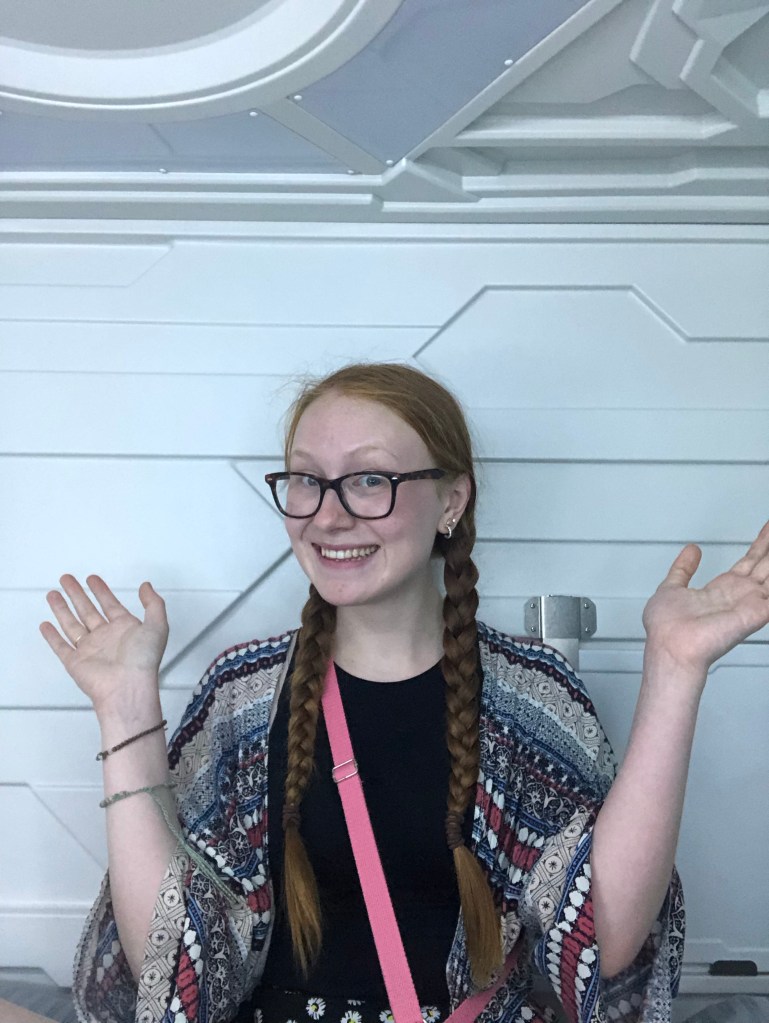
In a space pod for the night!

Accommodation Choices

It’s really tempting while travelling to choose a shared room in a hostel because it’s the cheapest option, or because you feel like that’s what you should be doing for the ‘travelling experience’. This is your reminder to always, always choose what’s best for you and not what’s the easiest option or what you feel you’re meant to do. For the majority of my trip I had my own room and it was 100% the right option for me. I needed that space that I could retreat to and reflect in and not feel like I was ‘on’ all the time. I got single rooms in hotels, air b&b etc mainly because this was often a lot cheaper than getting a single room in a hostel. However if you want to also have the option of more social events and interaction then getting a single room in a hostel would be a great compromise if you’re someone like me that also needs their own space!

 I did stay in hostels for a few nights, and I’m glad to have had that experience, but I found it much more draining so I’m also glad I didn’t do it for the whole trip, and had my own room immediately afterwards. It was 100% worth the little bit of extra money to have my own room. Whatever you decide I’d just recommend you look into it carefully, read all the reviews, and be clear on what you need.

Next up on my accomodation advice is to book in advance. It might sound fun being spontaneous and just booking in when you get somewhere, but if you are travelling in summer like I was this is not only expensive but can be nerve wracking when everywhere is sold out. If you have your accommodation booked in advance it’s just one less thing you have to think about at the time, which might not seem like a big deal right now, but when you’re faced with travel tiredness and some other issue to solve, it’s a huge relief to have the basics sorted. I used booking.com’s app for nearly all my bookings so they were all in one place and easy to sort through; plus it meant I only had to get used to one interface. 

Finally, in terms of food – if you’re worried about the unpredictability of food at all then I would recommend finding places to stay that have facilities for you to make your own food. This also helps save money when you’re on a budget.

At Teufelsburg, Berlin

Where To Visit

Again, when choosing where to visit (both in terms of places and what to do in those places) don’t be swayed by what you feel you should be doing. I didn’t go to a single club or bar while travelling and I do not feel like I missed out at all, because I was happy with what I was doing. 

In terms of places I personally found Venice very overwhelming in the summer with the large volume of people in small streets. Turin on the other hand was a beautiful, small Italian city that was quiet in the summer. Look into what kind of vibe you want and what places are like at particular times of the year (I much prefer visiting Rome in the winter for example). Guide books and the many travel blogs online will often be able to give you recommendations for quieter or less busy places to visit as well if too many people are overwhelming (Teufelsburg in Berlin was truly amazing). Basically – travelling is a personal thing. Make personal choices. 

I found travel days to be the most draining, and although easier because it was planned, there was a level of getting used to each place once I arrived. If you think having to adjust to several different places in a short period would mean that you enjoyed them less, then consider staying in each place for more extended periods of time. That way you can settle in and explore each location at your own pace. 

Finally, if you have a diagnosis and are in receipt of any official disability support (DSA, PIP etc) then take proof of this with you because loads of attractions give reduced or even free entry! I saved €70 in Barcelona in a single day so it really is worth it. You can also get someone else free with you at a lot of places! Disneyland in particular had amazing disability support for free – I got a pass that meant I could skip queues with up to 4 people and had my own place to stand for the parades. It really meant I could enjoy the day. But it’s not just big attractions like that – churches, museums, tours etc often have disability reductions.

At Prague Castle

General Advice

  • Bring a portable charger and keep it charged 
  • Have emergency cash 
  • Have a small across body bag to put valuables in 
  • Get medical insurance – GET MEDICAL INSURANCE 
  • There are shops everywhere – you can buy what you need, so don’t panic if you forget anything
  • Have key contacts and information written down, including your hotel addresses and a photocopy of your ID kept separate to the original
  • Print off a card with ‘i’m autistic’ in different languages if this makes you feel better 
  • Have more underwear than you think you need
  • Bring a water bottle and remember to stay hydrated – it’s often the basic stuff we forget first 
  • Take breaks if you need to and only do as much as you want to. You got this!! 

If you have any questions or extra tips please let me know below! Love and support to you all xx

Posted in Advocacy, Managing Mental Health, Mental Health, Personal Growth

Journey Through Panic Attacks

The first time I experienced a panic attack I was 11 years old. I had come home early from school that day with a headache and some other physical symptoms I now know were anxiety, and I had gone upstairs to have a nap before dinner. My mum came to wake me up when it was time to eat, but I must have been in the wrong phase of my sleep cycle because I awoke disoriented, thinking it was the morning. We’ve all been there when we wake up not quite sure what’s going on. So I thought it was the morning, and when my mum told me it was time to eat I responded asking about breakfast. There was some confused back and forth with my mum trying to convince me it was in fact dinner time, and still the day before, and I suddenly spiralled into my first panic attack. I don’t remember a whole lot of the details while it was happening, but I do remember how terrifying it was. I remember feeling like I couldn’t breathe; I simply could not get the air into my lungs. I felt faint, and sick, I thought my legs couldn’t hold me up. I don’t know if I had the thought that can come alongside panic attacks where you think you’re going to die, but I knew something was very, very wrong; I definitely thought I was going to faint. Somehow I ended up at the bottom of the stairs, gasping for air and sipping water out of a bottle cap (I think that was the only way I could manage to do it?) as it subsided, and I can still recall the exhaustion after that first one and how foreign it felt. My mum suggested it had been a panic attack, and at that point I didn’t know what that meant. I had no idea they would become such a huge part of my life. 

I have had many panic attacks since this day. I’ve also had some anxiety attacks, which are more prolonged and less intense, and I experience sensory overload too as an autistic young person. Sometimes sensory overload meltdowns and panic attacks can be hard for me to distinguish, and sometimes they overlap or morph into the other, but it’s helpful sometimes to figure out which is which as it can aid in the recovery process both long and short term – for example in a panic attack changing my jumper probably isn’t going to help and may not even be a possibility, but with sensory overload changing the material of my clothing or my environment may help it to subside or avoid it altogether when I feel it building. This year I have felt the strongest mentally overall that I have in a very long time, but I still have panic attacks. Some months I have none; others I have many. For example in May I had seven.

 It’s important to note that while I find the label panic attacks useful, it is a pathologised word. That means there is a certain medical connotation attached to it. However panic attacks are a total overload of our nervous systems; an explosion of tension and anxiety. We cannot talk about expressions of mental distress without recognising that they are often responses to a traumatic and stressful world, whether immediate results of a specific trigger or a build up over time. For example in May I was dealing with exam stress, difficult atmospheres at home, grief for my safe place, and more time on my hands. These all contributed to my spike in panic attacks I have no doubt. Other times I may make it to the other side of a stressful event and then experience panic attacks, almost like a hangover of emotions. It’s not an individual failure, but an understandable reaction to a difficult world. You are not broken for experiencing anxiety. You are not shameful for having panic attacks. 

I am a firm believer that to appreciate life fully we need to be able to laugh, even at the bad stuff. There are certain events surrounding some of my panic attacks that I find kind of hilarious looking back on and that helps me to deal with any embarrassment or regret surrounding them I may have. For example, I have terrible stage fright (despite being an actress, ironic I know). Before the final dress rehearsal for Bugsy Malone – my first show in a proper theatre – I had a panic attack in the wings. I was crouched behind a prop box in heels I could barely walk in and my tailored sparkly dress writhing my legs in pain and sobbing without air. It was a pretty desperate moment, though the juxtaposition itself is amusing looking back. The next thing I remember is a stagehand saying into their walkie talkie ‘can someone please come and remove the fire hazard from the wings?’. I was the fire hazard because I couldn’t move myself out of the way, and I was carried back to my dressing room by my director. Talk about a diva moment. Looking back I cannot help but laugh at the absurdity of the experience. 

That particular panic attack also showed me how loving people can be. I hope that someday everyone experiencing mental health issues gets to experience the pure love and support that I did that day. I had to go on stage just after recovering to do a mic check. I was so exhausted – my bones were heavy; the exhaustion of a panic attack travels to your core and can make you feel like your body isn’t your own – so all I could do was stand centre stage. The rest of the cast sat in the audience as I weakly sang ‘My Name is Tallulah’. Half way through the song I raised my eyes and saw that they were all swaying along, waving their hands in the air; at the end of the song they stood up and cheered and called out encouragement. It was beautiful. No one judged, no one whispered or pointed. They rallied and supported me. That’s what we all deserve. 

Another amusing panic memory was when I fell on my face in the mud on a rainy day trying to escape prying eyes and instead drawing them all to me; again, it wasn’t as embarrassing or well remembered as I feared it would be. Or when my teacher gave me their scarf to wrap around me and help me feel safer and I immediately snotted into it – I got to keep that for a while rather than immediately returning it. Or the time I went to get help while having a panic attack but there was already a girl in the office having a panic attack and it became like a queue for a very strange and unwanted product.

 I’ve been alone on bathroom floors, writhed my legs, hit my chest, backed myself into literal corners to try and feel a bit safer, thought I was going to die, taken off most of my clothes because I thought my skin was going to burn, and just general cried and made weird sounds while trying to breathe. Point of all of this is – I survived. And each one has become a little easier to recover from. The worst a panic attack will do is make you pass out; it cannot kill you. Remember that – it cannot kill you. If you are having one, it is horrible and tiring and painful, but you are safe. And if you are with someone experiencing one it’s ok to remind them of that; if you can recognise what it is and call it what it is. Tell them it’s a panic attack and that they are safe. Often it helps not to try and suppress it either but rather to ride it out, let it be. Because they are not the end of the world, but they are super scary and it’s ok to recognise that too. 

I hope that maybe reading this has helped someone feel a little less alone in their experience. If you’d like a more in depth guide on how I deal with my panic attacks let me know in the comments below! Sending love and support to you all today! Xx

Posted in Happy Notes, Managing Mental Health, Mental Health, Personal Growth

An Anxious Experience

Today’s post is a guest post written by Eya, a follower of Our Happy Notes on Instagram (their username: @the_dangerous_me). It was edited by Millie Bevan, founder of Our Happy Notes. If you would like to collaborate please email ourhappynotes@gmail.com or fill out the contact form on the website.

Anxiety can be a very physical experience where you can’t understand what’s happening to your body.  It’s hard to rationalise; it feels like your hormones have gone into overdrive. And really they have – being afraid or nervous is your body and brain’s way of telling you that there is danger nearby, so you may think at first that the feeling will pass, but anxiety means your brain sees danger everywhere. It doesn’t pass so easily. 

Anxiety is a silent killer. It kills your soul, it cuts you to pieces. Consider yourself as a game to anxiety because it makes you feel like a doll which it plays with. You can’t sleep at night and you constantly question what the people around you might be thinking, getting stuck in a loop with these thoughts going round and round in your head, replaying everything you’ve said and done. I have experienced anxiety since I was 13 years old when I started to lose sleep andi cried at night and i suffered. I felt so alone and it was a dark time in my life. I lost friends, became isolated, and soon started to experience depression as well. But there is  hope. I went to a therapist and day by day I felt better. Anxiety is not a topic to be taken lightly. It can make life so difficult. But you are not alone and you can look after your mental health. Eventually, with patience, it gets better.

There’s a lot of love out there and people that care. You can learn to love yourself again; know that there’s nothing that could stop you from your dreams and achievements. Nowadays I feel so much better, so I want to pass that hope onto you so you can enjoy everyday for yourself. 

Posted in autism, Managing Mental Health, Mental Health, Personal Growth

How to Make a Happy Kit

I still struggle greatly everyday with my mental health, and that can be enormously frustrating. It can also make it feel like the smaller things I can do to help myself are useless in the long run. However, I know this isn’t true. I know that when I add up all these little bits and pieces (like writing and walking for example) they do make an impact. And, yes, sometimes it’s a very small impact – but I know how much more hopeless and desperate it would make me feel if it wasn’t there. One of my favourite things I ever did to help myself manage my mental health was to make a ‘Happy Kit’ (as I call it). The great thing is that it’s totally unique to me and my needs, so I thought I’d share a little guide on how to make your own Happy Kit to suit you. I really love mine and I would recommend that everyone make something like this, because we all have mental health and challenging days – or simply just bored days. In my case it has loads of stuff in it to help me manage my anxiety, depressive episodes, sensory overload, and boredom; I keep it in my school bag at all times. So here’s how I made it:

My ‘Happy Kit’ is almost like a summary of all the tools I’ve gathered over the years to help myself. However, before you decide on the specifics of what will be in your kit, decide how you want to use it. Do you want it to be a box full of stuff that will keep you entertained when you’re bored at home? Or something you can always keep in your bag? Or maybe it’s something you use to help you wind down in the evenings? Once you’ve decided this, you can then choose what container you’re going to keep it in. I keep mine in a black makeup bag with sparkles sewn into it – I like the texture and the way it catches the light. You might choose to keep yours in a box or on a shelf in your bathroom cupboard for example.

Before I go further, here’s an overview of the contents in my own Happy Kit to give you an idea of what to keep in mind when making yours:

Me and My Happy Kit
  1. Fiddle toys – they help me focus in lessons, ease anxiety, and remain grounded during sensory overload. I have several different kinds with different textures
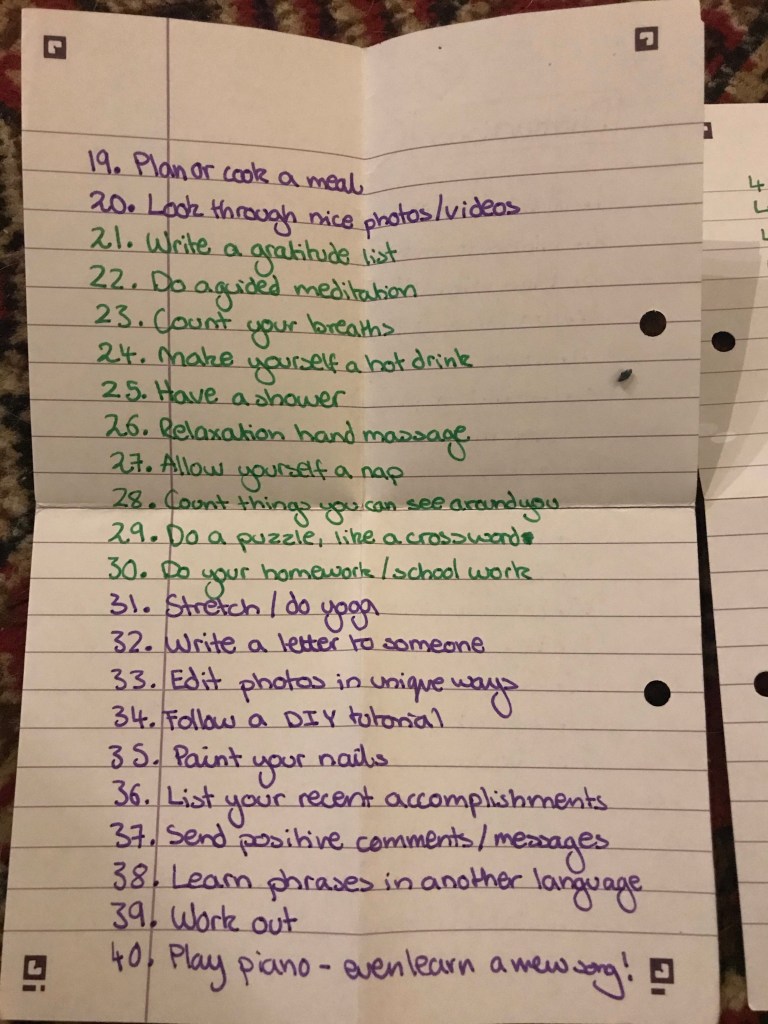
  2. A list of distractions – I have so many different activities on this list! And they range from things that are easier for me to do when I’m feeling low, more creative for when I’m hyper, and calming for when I’m anxious. I have this list because I’m learning that if I can direct myself towards an activity, it eases how I feel, but sometimes I can’t think of anything to do, so I refer to the list. And if I still can’t decide, I can always just pick a random number and do that activity!
  3. Gemstones – I’m not entirely sure if I believe gemstones work, but I do believe they can act as a placebo at least, and I find it very calming to hold them, if only as a way to remind me to try and bring myself back into a more neutral place mentally
  4. Items with sentimental value – To remind me of good times and the love of people in my life
  5. A toolkit list – This is a list with easy to follow steps that summarise particular tools I’ve learnt to help me manage and think more clearly, like how to accept emotions and reduce judgements
  6. Sweets/ mints – Sometimes I have Rescue Remedy sweets in my kit and sometimes I just have normal sweets, but something that tastes nice and I can suck on is just pleasant and calming for me
  7. Something smelly – not smelly in a bad way! Just something that smells pleasing to me, like lavender or essential oils or a mini perfume. Sometimes because they’re calming scents, and sometimes just because they make me feel fancy. As someone who’s autistic smells can also help when I am sensory seeking (kind of the opposite to sensory overload/ avoiding such) in a really simple way
Some of the things in my happy kit

Obviously all of that is specific to what helps me, but it might give you some ideas. If you like fiddle toys or nice textures then put something like that into your kit. For me they represent something calming and soothing to me that I can also use to engage my brain. I’d definitely recommend you to make a list of distractions/ activities regardless of what you’re using your Happy Kit for – you can tailor it to yourself but it comes in really useful in lots of situations. For example if you are making your kit to help you relax in the evening it could have a a list of ten things that you can do to help you relax and you could pick one each evening. If it’s to calm anxiety, then put down a few distractions and a few activities that might calm your anxiety – like breathing exercises, colouring, or reading a book perhaps. And if you’re making your kit for when you are bored then throw down a load of different activities, and make sure to include some you might not usually do (for example, writing a song even if you’re not musical). My list includes a mixture of all these different things! Here’s some of the things on my list:

A picture of some of the activities on my distractions list

I hope this has inspired you to think about making a little toolkit for yourself (or even for someone else). Please feel free to ask for any advice or share your ideas for your own happy kit. Sending all my love and support. Xx

Posted in Advocacy, autism, Personal Growth

Autism is My Superpower

I’m autistic. Having autism in a neurotypical world is not easy because generally the world isn’t built for us and proves to be confusing, but for anyone struggling with their diagnosis/ symptoms (and any neurotypicals unclear on the individual nature of autism) I want to make it clear that having autism isn’t a defect. Nor is it a mental illness. In fact, it can be a bonus in many situations, and when accommodated to autistic people can provide new perspectives and skills to the benefit of others. I, for one, like to think that my autism is my superpower, and this is my personal experience:

I learnt to ‘mask’ my autism – consciously learning how to act and react from other people’s behaviour; having to put effort into learning social rules that came naturally to others. Masking can be exhausting, so I know it’s essential that I take breaks and find time for myself, but like a superhero in a costume, it can also be powerful. How? Because my passion is theatre, and when I become the character I act out on stage, I am easily able to slip myself into their shoes – I know how they would behave and why. It comes effortless to me. The misconception is that autistic people are like robots and can only slot into certain careers. In reality we are varied like everyone else, and our uniqueness is incredible. We exist in every identity there is: every race, every gender, every sexuality, as parents and children. Our variety is often overlooked.

My increased sensory input is a key feature of my superpower. I observe more, hear more, taste more. This translates to a benefit in so many situations. You don’t know your train time? Don’t worry, I glanced at the board quickly and noticed it. You’re lost and don’t know the way back? Don’t worry, I spotted landmarks along the way, I know where we’re going. You’re trying to remember where you put your glasses? Never fear, I spotted them. And if we’re thinking about sound and music, my greater sensory input comes to my aid once again – that along with my ability to spot patterns as part of my autism, and my synaesthesia (which is far more prevalent among autistic people than the general population). When I hear a piece of music, it is alive to me. It is full of colour, I hear every layer of the rich instruments, and I can see the patterns the notes are forming. If I want to then play that piece on piano, I need only translate the pattern onto the keys – give me a bit of time and I can paint the picture I hear all by myself. This is my superpower. 

Not to mention the fact that I am quite simply neurodivergent. I think experience the world in a way that is different to ‘the norm’, or rather the majority. Why is this a feature of my superpower? Because I can come up with new ideas and perspectives that may have been overlooked or not thought of at all. In certain situations this can become the way I overcome challenges or help others to do so; in the right combination my divergent thinking could be innovative. Us autistic people have a place in this society, no matter where our traits lie on the spectrum, and if we are accommodated we may even be able to offer solutions, certainly valuable contributions at the least. 

Like a superhero may have an emblem, sign, or symbol, I have my stims. By stims I mean self stimulatory behaviour. Why is this so amazing? Well, it indicates to me how I am feeling (different stims, like tapping my fingers on my palm or twirling my ankle, correspond to different moods). Not only this, but should I start to feel an uncomfortable emotion, stimming freely can help calm me down. There’s a lot of people out there that don’t have something so simple in their toolbox, so this is powerful to me. It’s also such a pure form of expression, and can even help me release my creativity, tapping into my flow. Furthermore, my stims evolve over time – hitting my head morphed into covering my head and now I need only put on a hat to feel at home. How awesome is that? 

This barely scratches the surface of my positive autistic experience, but I hope it has enlightened you. Autism is not a bad thing – quite the opposite. And the beautiful part of it is that no one autistic person’s experience is the same as another. We have a place in this world, and we’re not going anywhere, so the more that neurotypicals begin to understand and help us meet our needs, the more we can give.

Posted in Mental Health, Personal Growth

Letter to Anyone With Disordered Eating

Dear you,

I’ll start by saying hello and that I care, in case no one has said that to you today. Where you are right now, I’ve been there. Maybe not physically, but in some way mentally, and certainly in empathy with you. Some days you’ve probably told yourself you’re not struggling, it’s not hard, it’s worth it – I know I did. And deep down I also know that you know it’s not. It never will be. So here’s my letter to you. Not to say stop or that the pain goes away overnight, just to speak to you as someone who cares, and let you be.

You may think this is all about ‘skinny’; that this is all about achieving the version of yourself that you ‘should’ be. You might think you’re in control. It feels good to be in control right? To know your goals, your focus for the day or the month. I get that. The problem is that in the end, you’re not. And, wow, that is painful to realise. It crushed me when I did. It brought back the struggle of every step I’d been through. But it was necessary. In the end it controls you – whether that is your thoughts or this system telling you that you will never be enough until you fit into that dress, it controls you. And all of a sudden what you were fighting for becomes the thing you are fighting to get away from. In a way, if you really look, you can see this all along. I don’t want you to feel that terror or that hurt, but I want you to know you are not alone in that and the sooner you can get away from it the better.

The good news is that you can. I’m not forcing you to – I’m not another voice telling you to eat more or eat less or do this or that because they can be annoying right? And they can fuel us, I know they did for me. I lived for the finger on my spine telling me how skinny I’d gotten; I lived for the voice telling me how healthy I looked, thinking I’d failed. You’ve never failed. There’s never anything you should be. All I want to do is remind you of your power and your strength because my goodness have you got a lot of it. Think I’m wrong? Well let’s have a look at it, logically – maybe you’ve been restricting for months, purging for years, feeling unworthy for what seems like a lifetime, binging every night? That takes effort. That is blood and sweat and tears, often literally. But the effort it took just to put into that system shows you just how much power you have in you to reverse it. That strength can be turned around to go the other way and to learn, or relearn perhaps, that you are enough just the way you are. What makes you who you are is not your body.

Words like that seem futile though sometimes, don’t they? Well, I’ll let you in on a secret, I don’t love my body. Most people don’t love their bodies, at least not everyday. But what I do have now is a deep appreciation for how incredible the inner workings of my body are. They’re insane! And most days – I have acceptance. That’s all I need. Acceptance that this food fuels my brain, and that I am enough in this moment. Just enough. Not to say I don’t still struggle, because I do, I really do, but I look back on the pain I was in and I wonder how I ever survived. I didn’t even realise it at the time. It took someone reaching out and telling me they’d been there too for me to even comprehend the idea that this wasn’t healthy for me to be under such mental stress, let alone physical. You are not alone.

Most likely you know all the issues that await if you head down this road further, so I’m not here to preach that to you, but to give you hope of a life outside of this. Of an acceptance and tolerance I for one could not even dream of at one point. My dear you are doing alright – whatever has brought you to this point does not deserve your magnificence or your power. I want to remind you that help is a brave word and there are so many people out there ready and willing to help you in so many different capacities no matter what your struggle may be. I love you, and you are worthy of a life outside of a fixation on your looks. We all are.

Your friend,

Millie

Posted in Advocacy, Happy Notes, Mental Health, Notes, Personal Growth

What is positivity?

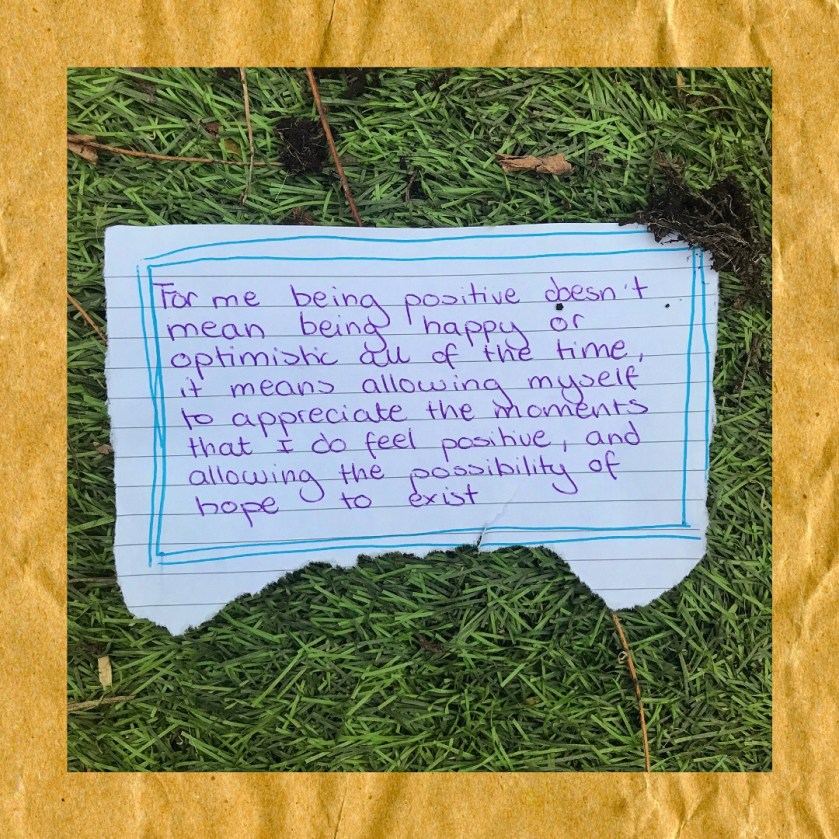
This post is inspired by I note I made for my Instagram – @our.happy.notes – which read: ‘For me being positive doesn’t mean being happy or positive all the time, it means allowing myself to appreciate the moments that I do feel positive, and allowing the possibility of hope to exist’. I wrote it because being the inquisitive person I am and being active on social media brought the thought into my mind – what is positivity? What does positivity mean to me?

I’m a person that tends to find myself living in extremes. There either is or there isn’t. I am all or nothing. So with positivity and a mood disorder, I found that I either lived in a state of overwhelming optimist or complete lack of any positive thought at all. What I have found interesting, and beneficial to my mental health, is exploring the space in between. The idea that even in positive moments I can accept that it won’t last forever, and in the times where I lack such I can acknowledge that it doesn’t mean that positivity has disappeared.

I think sometimes even in well meaning spaces, there can be such a pressure to be positive and see the good in life. Unfortunately this simply isn’t possible all of the time, and when we put pressure on ourselves to feel one way or the other it can lead to us feeling even worse. The reality of the situation is that all emotions on the spectrum are valid. Yet the lack of positivity or hope in one moment does not mean it will never return; that it has ceased to exist. Nowadays this is something I like to remind myself – writing it out helps me to absorb it.

So, what is positivity to me? Positivity is not the blind belief in a bright future, but the acceptance of the fact that a bright future could exist. It is allowing the possibility of a good day for someone else happening, even if it isn’t for me. It is embracing the small, joyful things in life – the most minute parts of the world that make me a little less down, even if only for a moment. It is an intangible thing, an emotion, an idea – a beautiful prospect.

However I recognise that in moments we really can want to increase our positive thoughts and feelings in life. I am no expert on this, though I do have some tools that have helped me. In the morning I write down affirmations for the day – ‘Today can be a good day’, ‘I am enough’, etc. In the evening I write a gratitude list – ‘I have a roof over my head’, ‘someone smiled at me in the street’. I list the small things in life that bring me joy. I allow myself to dream wildly, but remind myself that whether or not these dreams materialise, I will be ok. I smile; sometimes I simply sit there and I smile. And when I feel that positivity is disappearing, that hope is waning, I repeat aloud and write on paper that they are not gone forever. These might seem a little silly, but they are some of the most healing things toward my mental health.

Sending love and support to anyone who needs it today!

Love, Millie x

Posted in Mental Health, Personal Growth

Small Steps

Hey there! 

I’ve been thinking recently on how I can help myself to maintain a better state of mental health, when I’m already feeling a bit better in myself, but also how I can make it easier to lift out of those darker moments. Through some conversations, therapy, and self reflection I have come to appreciate how important the small steps we take to support our mental health are.

However, when you’re feeling particularly blue it can be difficult to even begin to do the smallest things; people can often get annoyed at us for this as well. For me one way of overcoming this is by breaking them down into even smaller steps. For example if my aim is to take my meds, then I’ll start by walking to the drawer, then opening the draw, taking them out, laying them out etc etc. It may seem silly at first – I know for me it almost felt like I was patronising myself – but it might just be of use to try this, and it is a huge thing to take any of these steps so you deserve congratulating for that! 

So what are some of the small steps I’ve come up with to help maintain my mental health? Writing my diary; gratitude and affirmation lists; meds and vits; drinking enough water; walking; allowing myself downtime; using planners to keep on top of work; reading (to make learning fun); making my happy notes; doodling and using fiddle toys; playing piano; meditating and more…

I hope you can find some small steps that will help you maintain your mental health! We all have it and we all need to look after it 

See ya later 🙂