Posted in Advocacy, Mental Health

Why We Should All Be Mental Health Advocates

Why Should You Care About Mental Health?

  • We all have mental health 
  • 1 in 4 people are dealing with what can be classified as mental illness every year 
  • Any of us may need to navigate dealing with or loving someone with mental illness at any time 
  • Any of us may end up trying to navigate the mental health system at any time
  • Mental health is intertwined with every part of our lives – think about the impact that grief, food scarcity, racism, work stresses and expectations etc etc etc have on our mental wellbeing 
  • People are dying

Why should you care about mental health advocacy?

(in other words, advocating for better support, systems, awareness and more around mental health)

  • The mental health system is currently failing – and in many cases harming and abusing – the vulnerable people looking for help. We all deserve better
  • Mental health advocacy can encompass lots of different areas of interest and support, like access to food and environmental connection, so no matter your field of interest you can incorporate it into your life – and together we can make a difference 
  • Better societal structures surrounding mental health would help us all on a daily basis (for example different expectations of productivity at work, no poverty, suitable housing for all, proper support for cost of living, community support etc etc)
  • Lives could be saved
  • We could have better ability and language to describe our experiences and understand the human condition to connect with each other 
  • Mental health advocacy can build community and genuine connections 
  • You can be part of a movement full of love and care, and get to help redefine what human distress means
  • Mental health advocacy hopes for all of us to lives happier, freer lives

How can you start getting involved?

  • Question what you assume to be true about the mental health system and the way we view mental illness; listen to psychiatric survivors and mad and mentally ill voices to expand your understanding, and your views of what the future of care could look like. Always keep learning and listening 
  • Start conversations with family and friends 
  • Write to your MP (or other representative)
  • Share information, but be careful what information you share 
  • Support local food banks, housing associations, and all range of initiatives in your local community – help build community
  • Look after yourself and define what healing means in your own life 
  • Connect with others who care about mental health advocacy – you can do this online as well as in person 
  • Use your own skill set – if you are an artist or a writer, an organiser or a fundraiser… use these skills! Don’t ever believe that you have less power just because you aren’t doing the same thing as others; we are stronger as a group, with everyone chipping in 

Please share this post with people in your life to start the conversation around mental health advocacy, and how we can make a change together.

Posted in Advocacy, Mental Health

Mad Liberation: The Missing Piece of The Puzzle

There are a lot of social movements now that are gaining awareness and support in new ways thanks to the global communication the internet has made possible. For example, feminism, Black Lives Matter, climate activism etc. And it’s very encouraging to see that more people are becoming aware of how these all link together too. There’s still a very very long way to go, that’s for sure, and in some ways the enormity can seem overwhelming. But there’s certainly movement happening in these movements, and a lot of passion. But what about mental health? 

When we think of the mental health movement we think of mental health awareness. And for the vast majority of people what they come in contact with under ‘mental health awareness’ is hotline numbers, slogans telling people to reach out, self care tips, and really very repetitive, surface level approaches. The general public does not seem to be aware of the deep issues and abuses in psychiatry, how we view mental health, and how it really impacts all of our lives. In all the fighting for a better future, mad liberation is overlooked, underestimated, misunderstood, or ignored. And that’s damaging for all of us. We cannot be fighting for racial justice, trans rights, and human rights without mad liberation. And yet so few people seem to be aware of it – in fact many people seem scared to approach the topic, which just shows how deeply the stigma and ignorance runs. Maybe, just maybe, mad liberation is the missing piece in the social justice fight. 

Take for example the language we use to describe other social movements – you are a climate activist, a civil rights activist, a human rights activist, but you are a mental health advocate. That’s not to say advocate is a bad word, it is absolutely not, and it’s a badge I’m proud to wear. But to call myself a mental health ‘activist’ sounds wrong. Why? Is it because advocacy feels more acceptable? Perhaps it connotes simply raising awareness within the status quo, continuing to adhere to systems already in place rather than radically opposing them and fighting for change. Maybe not, but I certainly think there’s something in the language.

 Furthermore, why is it always mental health advocate, and rarely mental illness advocate, or madness advocate? For me that sums up the major narrative surrounding the mental health movement, because it focuses on the palatable part that challenges less assumptions and less people, that appeals to everyone. Everyone has mental health, so everyone should care about mental health! Yeah – that’s not wrong. But a lot of people are deemed mentally ill. A lot of people deal with the consequences of madness in this society their entire lives. And the narrative focusing on the easily digestible, easily implemented parts of mental health awareness leaves them behind yet again. It silences and harms them. 

Psychiatry uses mental illness to uphold societal values. Always has. That’s why drapetomania was a proposed mental illness to explain why slaves wanted to escape slavery. That’s why being gay was classified as a mental illness until 1990, and being trans was classified a mental illness until 2019. And that is why one of the major diagnostic criteria for mental illness nowadays is disruption to a person’s ability to work – productivity and fitting into expectations of normality are societal values. 

But people are very rarely encouraged to consider this. They are encouraged to be aware of the signs of common mental illness in the context of deriving from the expectations placed upon us, and recovery in the context of making people be productive citizens again. The common mental health awareness narrative traps us. It does not allow us to redefine healing, to discover the socioeconomic factors in wellbeing, to find community, or to change the pace at which we live. It does not allow us to think about the deeper questions of why, and how can this really be better. 

But what would happen if we questioned? We would hear the voices of psychiatric survivors shouting about the abuse they have endured in the mental health system. We would discover how mental illness and criminalisation are deeply intertwined, and perhaps discover how to create true justice by supporting and liberating people in new ways. We would start to ask, what would happen if we didn’t sedate people into the same reality, but rather found ways to help people incorporate their own reality into their world? We would find new ways of sharing resources, kindness, connection, and changing the pace at which we live. We would find new language to define our human experience. We would free all of us to actually consider what happiness entails. Finally, we would find the link to all the other socioeconomic problems we are facing today, and in doing so find new solutions and progress towards all of them. 

We need to be kind and we need to be supportive, but we don’t need to be afraid to really ask questions about mental health, its presentation, and the treatment of madness as it is. Mental health activism is needed. Mad liberation is needed. But a deep held belief that mad people need protecting – or being protected from – has too often tried to stifle the missing piece in social justice movements. Mad people deserve to be heard, believed, and treated with respect and dignity in social action spaces just like anyone else. 

So I ask the question – is mad liberation the missing piece? 

Maybe. I don’t know for sure. But I think it might be. I certainly think solidarity between oppressed, hurting, and caring people is necessary for progress. We won’t fix everything; we will get things wrong. But as long as we keep questioning, and keep learning, we can make a difference. It’s worth a try at the very least.

Posted in Advocacy, Mental Health

Mental Health is Intersectional

Today is a blog reminding everyone of a certain point I try to illuminate all the time through my advocacy: mental health is intersectional. What does this mean? It means mental health is not a stand alone issue; it is connected to all other social justice issues, and all other parts of our lives. Intersectionality is about where these issues cross over, and how they cross over, and how if someone falls in the intersection of more than one (for example are faced with racism and ableism) it can create more problems for them that may be overlooked, ignored, or misunderstood by even the most well intentioned people – myself included. But intersectionality for me also is not just about these disadvantages and discriminations – which are of course very real and very harmful and deserve to be seen. It is also about problem solving, and hope. 

The systemic issue of mental illness and its manifestation in individual people’s lives is not a stand alone issue. So it can be overwhelming to consider in a wider context because how the hell are we supposed to solve everything? I get it. It can be overwhelming, scary, and sometimes makes me want to just give up. But what if we chose to see intersectionality as empowering and a source of hope? Because it means we’re not just isolated as mental health advocates, or people who care about climate justice, or people who are trying to solve poverty. It means we are united as people who care. Understanding intersectionality, and continuing to be aware of how our understanding and circumstances may shift, allows us to be more creative in our solutions and more effective in our actions. 

If we start to realise mental health care also means community care then we are not left helplessly shouting into an abyss; perhaps instead we are empowered to create a community event, or connect with friends in a more intentional way. If we realise mental health care also means food security, then we are empowered to donate to our local food banks and come up with innovative ways to share with our community. If we realise mental health care means antiracism then we are empowered to learn and be intentional in sharing this learning with the next generation. When we realise mental health care is intersectional, we actually create stronger bonds, stronger supports, and stronger futures. 

We cannot shut our eyes to the world around us. But we might have a little bit of power over how we choose to view it. This country is becoming more and more authoritarian, and I don’t think it is an exaggeration to say it is sliding towards fascism in many ways. 

From the 3rd May more laws restricting and criminalising protest – including union action! – will come into effect. Over the weekend over 50 people were arrested for protesting peacefully during the coronation ‘celebrations’ – which cost millions while more people than ever are below the poverty line. A country without protest is not a democracy. A country where the gap between rich and poor continues to widen with government support is not looking after its citizens. We cannot ignore this and we cannot allow this, and we have to recognise how it relates to all our social justice issues. How can we ever hope to see a country with good mental health if people do not have free speech and cannot afford to eat? 

The good news is, resistance isn’t one size fits all. And understanding intersectionality can allow us to fight back in an effective, loving way. If everyone who can supports their food bank and creates community driven initiatives to eradicate food insecurity, the government can’t ignore it. If the artists create art, and the people who can protest go to protests, and the workers all strike, then it sends a message loud and clear that they can try all they want, but we aren’t having it. We care about each other and we want to see a brighter future. And that big message starts with small actions. It starts with having a conversation, donating a can of beans, drawing a picture, and offering to help out a neighbour. Even if you’re only making a difference to one person, and even if that person is you, you are still making a difference. Never think you cannot make a difference; it’s at least worth a try. However that looks for you, even if it looks like rest right now. You matter. And it all intersects. 

Sending so much love and support to you all today xxx

Posted in Advocacy, autism, Mental Health, neurodiversity, Personal Growth, sobriety, therapy

Hurt by Psychiatry

Content warning: ED, psychiatric abuse, suicidal ideation, any mental health topic really

I want to write a really strong and defiant letter. I want to write some crazy, proud, creative theatre piece. I want to write something truly hopeful. And while I do have hope, and I do have gratitude – because it is essential to my survival – I also have a lot of pain. And anger. I can talk openly about so many traumas and just general shitty things that have happened in my life. But the one I’ve never been able to write about, never even been able to get through a conversation about without screaming and crying, is the pain endured under the psychiatric complex. Because they were meant to help me. Time and time and time again I have gone looking for help and time and time and time again I have been turned away with only more hurt. I know help is a brave word. I’m not afraid to say it. But I am afraid that when I say it no one will listen. This is my story of a journey through the mental health system. 

Just a disclaimer, because as a writer on mental health I feel it is my responsibility – if you are in a bad place and looking for professional help, please do not use this as your excuse not to. I do know some people have been greatly helped by the mental health system, and you could be too. This is not intended to invalidate anyone’s good experiences, but rather to say that all of us deserve to have those good experiences. This is simply my story as someone who feels they have slipped through the cracks. If you feel this may affect you negatively I implore you to take the decision not to read any further. 

I first asked for help from the mental health system when I was 12 years old. I was experiencing mood swings and distress that were really bothering me – maybe just normal teenage things, maybe not, but the point is it doesn’t matter. They were bothering me. Anyone who wants help, even just to navigate daily life, should be given it. I was assigned a counsellor from the early intervention team. I didn’t like them, so I asked to change. I was discharged from the service – I took that as a message that if I had an opinion on my care, my care would be withdrawn from me. 

My first contact with CAHMS (child and adolescent mental health services) was due to an eating disorder at 14. My life was being ruled by it – I had complete meltdowns when I couldn’t exercise, was hyper fixated on food all the time, was weak and angry and alone; I was really hurting. They weighed me. They told me I wasn’t a low enough weight. I took that to mean I wasn’t sick enough. Without any regard for how I felt, or how food was ruling my life; without anyone trying to find out anything about my experience they denied me the help I so desperately needed. Suggested possibly a meal plan – with no support to implement it or formulate it. If a teacher hadn’t sat with me at lunch every single day for a year and coached me through it because she’d been there too, I don’t know how I would’ve gotten through it. 

I severely relapsed with my eating behaviours twice more, and I still struggle with some thought patterns and triggers to this day (though I am in a much better place, largely due to recovery in other areas giving me the tools to transfer). But I never felt like I really recovered from it, or had the support I needed. Even 9 months ago that teacher would still notice when my old behaviours around food crept in – even before I did – and help me to recognise and head them off. I am immensely grateful for that… but it wasn’t her job. It was never her job to be the main guidance and support in eating disorder recovery. 

CAHMS did offer me six sessions of group therapy. This was to deal with my overwhelming anxiety – much of it around socialising – and deep depression. They didn’t see it as deep depression. It was. It was really, really dark. I stopped going to any lessons and lost all sense of self and hope. But yeah, six sessions would be enough apparently (obviously not). I freaked out at the thought of group therapy, it was entirely unsuitable for me. Once again I received the message in response that if I had an opinion on my care, I wouldn’t get any care. They wanted to discharge me right then, but my wonderful mum stuck up for me so they offered me three – I repeat THREE – CBT sessions. They were not useful. I was put on a years long waiting list for an autism assessment. I was offered no more support. I continued to struggle. 

My mum’s determination to get me the help I deserved was incredible, and probably the only reason I got any support at all. (My mum is probably reading this, so thanks mum). She found a charity that was amazing in supporting us through my teen years, and funded me to see a private psychiatrist – this would not have been possible without them. However I wouldn’t say that was particularly helpful either. That psychiatrist did diagnose me with autism (side note – the assessment for autism really needs to be changed), anxiety and depression. I am eternally grateful for my autism diagnosis – it truly did change my life knowing I was autistic. But it changed my life because I went away and learnt about it, as did my family. The psychiatrist did not formulate a treatment plan for any of this, or provide any further support. Some medication that didn’t work was all she offered. 

In this time I also saw a few therapists – I didn’t like them, one of them didn’t like me and kinda dumped me. All of them were privately paid for. The subpar care I received was paid for privately – can you imagine how much worse it would have been if we hadn’t been able to afford it?

I know this is all a lot of information, but stick with me here. This journey is important to understand because it is something so so many people face. I slipped through the cracks of this system – even with the privilege of being a white, cisgendered woman. I had it reasonably easy. 

In February 2020 I had what I now recognise to be my first (and most intense) mixed episode. I cannot even put this experience into words but essentially it was all the darkness of depression with all the heightened energy and irritability of mania at the same time. I felt reality slipping away from me and I have never been in such intense distress. Two teachers stayed with me at school hours after school ended to try and keep me safe. They eventually helped me calm down, but I later found out they were so concerned they were about to call an ambulance or the police, as the crisis line wasn’t helping. I went to the GP during this episode begging for help. She prescribed me valium to calm me down, but when I begged her for more support I remember her chastising me for being so emotional because she had other patients waiting. I took that as a message that I still wasn’t sick enough; still wasn’t important enough. 

In March 2020 the private psychiatrist diagnosed me with cyclothymia. We had to pay extra for an emergency appointment. She decided I was now too complicated to be under her care and needed more support so referred me back into the NHS. They did not follow up on her recommendation for more support. By the time they saw me I was a bit calmer so apparently that meant I didn’t need help. In her eyes I was too bad, in their eyes I wasn’t bad enough. So I was left with nothing. This was the trend that would continue for the next three years. 

In September 2020 I wound up in A&E. I was broken and desperate. When the CAHMS crisis person finally arrived she acted annoyed about me being there, annoyed she had to be there, uncaring. She essentially asked ‘if things are so bad then why haven’t you killed yourself yet?’ and sent me home with no support. They didn’t follow up on any support because I calmed down a bit after, so I was no longer considered in crisis when they finally did get in contact (even though they hadn’t helped me when I was in crisis) and because I was drinking at the time. Just so we are all clear – if a young person is drinking as heavily as I was, that is exactly the time they need support. I went to my first AA meeting after I left the hospital that day. And excuse my french but thank fuck I did. I have no idea if I would still be alive otherwise. And having connected with others who have been subjected to inpatient treatment, I am incredibly grateful I did not have to bear that extra trauma. This is how bad the surface level service is – it’s even worse inside. 

After I got sober in July 2021 I was still struggling. I finally got to see a psychiatrist on the NHS in October 2021 because of my mum’s insistent fighting for me. When he asked me what I wanted from the meeting, he chastised my response. He was unclear. He shouted at me, and revoked what I thought I had been diagnosed with in a letter. I was meant to see him again in 10 weeks and he cancelled. I got discharged from CAHMS without them ever asking to talk with me about how I was doing. 

The one professional who has been a saving grace is my therapist. She is autistic herself and very flexible. But again – if I wasn’t able to fund that privately I don’t know where I would be. After my charity funding stopped when I turned 18 I had to take the sessions down to every 2 weeks, even with her sliding scale, which is significantly less helpful. Luckily I’ve also found amazing peer support, especially through AA, and spent a lot of time reflecting and doing my own work, so I’ve managed to build myself a much brighter life. But it’s been hard. And sometimes I really do need some more help – no one should have to do this alone.

I Went back to the NHS this October and had my first ever good meeting with anyone, just someone in my GP clinic. Why? He was honest. He genuinely seemed to care, but there was nothing they could offer me. He explained that as far as the system saw it, I had already been helped.

In late 2022 my mental health really started to decline again. I went back to the NHS this October and had my first ever good meeting with anyone, just someone in my GP clinic. Why? He was honest. He genuinely seemed to care, but there was nothing they could offer me. He explained that as far as the system saw it, I had already been helped. So from October I was searching for a psychiatrist who would see me. 

I was turned down by over 10 private psychiatrists for being too complex, having comorbidities, or my favourite way of putting it: ‘them not being able to offer the support I need at that time’. So I was again too bad for private and not bad enough for the NHS. One of the only people who would see me charged just under £1000 a session. Others said they would consider seeing me, but were booked up until 2024.

Finally in March 2023 – 5 months later – I got to meet with a private psychiatrist. And wow, he was amazing. We had three meetings so we could cover everything. He was kind, listened to me – really listened – and didn’t patronise. He treated me like an adult, and made it clear I would have a say in my care plan and the final report that would be sent to my doctor. I would have a say? I almost thought that wasn’t allowed. I’m still sceptical, it still doesn’t feel real. 

He diagnosed me with Bipolar type 1. Just think about that for a minute – an 18 year old has been dealing with undiagnosed bipolar 1, unsupported, emerging from 12 years old. I have no idea where I would be without the angels placed in my life along the way; without the undying support of my family and friends; without the flexibility of my school. I knew something more was going on, I knew how much pain I was in, and no one in the mental health industry was listening. I was screaming into a void and not even hearing the echoes of my own screams. (A separate issue is that we shouldn’t need labels to validate that level of human distress, which is what it is at its core, but diagnosis can be so validating. Read more about that here). 

I am not in any way saying this one experience erases all the rest. It does not. It absolutely does not. And it doesn’t not mean that psychiatry isn’t built on an oppressive, harmful foundation whose history has been hidden. It is. But it was a little hope given back to me. A relief at the very least. Before I went into that meeting I said ‘I’ll take them just not being actively mean to me’. How sad is that? What a desperately low bar. 

I’m still scared. He has instructed my GP to refer me back to secondary care teams in the NHS, which I still – like always – hope might offer some help. But the main thing offered seems to be medication, which I have some serious and valid concerns about. But I am terrified of raising these concerns or asking about alternatives for fear that a) I will be labelled as disordered and my new diagnosis weaponised against me or b) I will be labelled as non-compliant/ not wanting help enough, and sent away again. I wish I didn’t want help from them, and maybe one day I’ll be able to find a path that avoids dealing with the mental health system altogether. But I’m not there yet. Nor should I have to avoid it. It should be an inclusive, varied, accessible service. It should have community and individualised care. It should have alternative treatments and input from patients. It should see the human condition as a spectrum. But it doesn’t. And being mentally ill makes me scared that if I voice any of this, I will not be taken seriously. How can anyone ever prove that they are sane?

I deserve better. Everyone deserves better; we deserve to know that no matter what we’re going through there will be appropriate support for us. But it’s not there. And this broken system is quite literally killing people. We can’t just say fund the system either, the system needs to change. I need it to change, we all need it to change. 

I think I’m sharing this because the younger version of me wanted desperately to read it from someone else. So the core message is that you are not alone. You are not alone in the hurt psychiatry has caused you. You are allowed to be angry about it, and distrusting of it. You are allowed to choose your own care and your own path – even if others don’t understand it! (And that applies to all paths – mental illness should not be policed). Your pain is valid, completely valid, and I see you. I see you.

Sending love and support to you all today xx
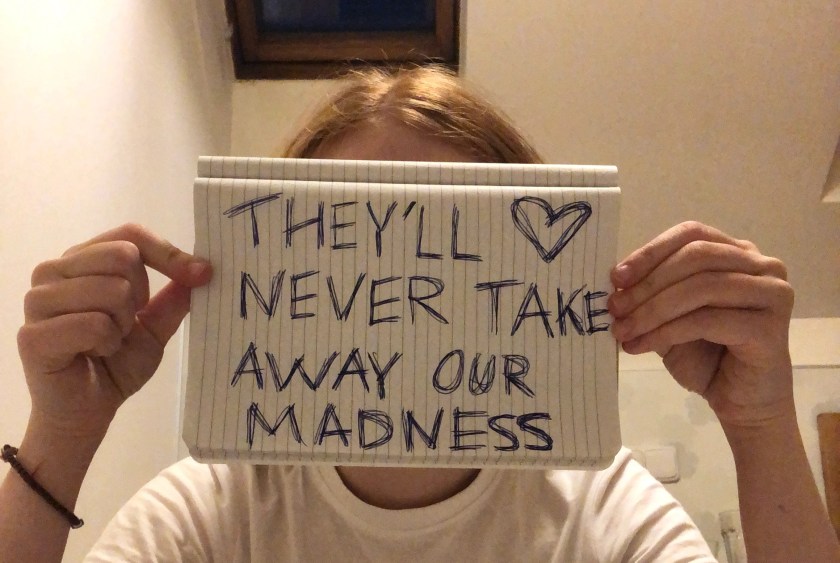
Posted in Advocacy, Mental Health

Write to MP About Mental Health System

Writing letters to our MPs about important issues can feel like hitting our heads against a brick wall. I get it. Our government is failing us in about every way possible at the moment while continuing to introduce increasingly more constricting and draconian laws that limit our freedoms and right to democracy. Nonetheless, I still maintain that there may be hope to be found in raising our voices. The more people that stand up against issues the harder it becomes to ignore – and it could even be argued that it’s up to us to believe in hope even when they aren’t giving us much reason to. One of the easiest ways to raise your voice is by writing to your MP. They may not be able to do anything directly or immediately, but they are our representatives and can bring our concerns to the table. Imagine if every person in your district wrote in about the same issue – it would be pretty hard to ignore. Anyone of any age can write to their MP, and you can even email them. 

Our mental health system is in crisis; it’s built on harm and it is perpetuating that harm. And it cannot be fixed just by increasing its funding – you can’t fund a broken system and expect it to fix itself. So we need to raise the alarm and raise our voices. Below I have written a very short template for writing to your MP about the mental health system. To use simply:

  1. Use this website to find out who your MP is and what their email address is: https://www.writetothem.com/
  2. Copy and paste the template below into an email 
  3. Replace the generic details in italics with your MP’s name and your own information 
  4. Add in your own message or questions 
  5. Hit send 

It’s that simple. And it may seem small, but you never know if the small individual actions we take will add together as a collective. It’s worth a try if nothing else. And remember, if they don’t reply or give a satisfactory reply, you can keep writing to them! Don’t let this be an issue that goes unheard. So here’s the template (just a general content warning for topics relating to mental health here such as suicide):

Dear [insert MP’s name],

I am writing to you today because I am incredibly concerned about the state of our mental health system. It is clear to me that the mental health system continues to fail all of us, especially the most vulnerable in our society. As I’m sure you’ll understand this is an incredibly serious issue, with people’s lives at risk. 

The suicide rate in England and Wales was 6.9% higher in 2021 than in 2020, a trend that has been continuing over many years despite supposed attempts by the government to address mental health issues. For example – the rollout and continued expansion of IAPT that is meant to provide early and easy access to psychological therapies but has since been found to be skewing their own data by several studies. The University of Chester found their actual recovery rate to be just 23% by their own measures (which can include clinically insignificant improvements) as opposed to their claimed 46%. However a large meta-analysis found that 23% of patients with depression spontaneously overcome their symptoms in three months anyway which would render IAPT irrelevant. Despite this it continues to be heralded as a success with no one speaking up about the failures and the people it leaves to the wayside. 

That is the most basic level of treatment and doesn’t even begin to reveal the long waiting times, criminalization of mental illness and failures of the Mental health act, abuse within inpatient treatment, how risk of suicide actually increases after inpatient treatment, lack of appropriate and individualised care, lack of any support for young people, or obsession with productivity instead of personal happiness in recovery. Even within the last six months we have heard about the cases of more young people who have died while in inpatient care –  Christie Harnett, Nadia Sharif, Emily Moore, Charlie Millers, Beth Matthews, and Lauren Bridges. People are falling through the cracks, and being actively harmed by the system. People are dying. It is unacceptable and it cannot be allowed to go on. 

[Insert any personal experience or thoughts here]

Therefore I implore you to research more into the truth of the mental health system and the harm it has caused to so many. And I ask you – what will you do, as representative of this community, to raise the voice of our concern about the mental health system? What will you do to push for change? What will you do to support the mental health of young people in this community? What will you do mitigate the compounding and intersectional issues with mental health (ie. racism, food insecurity, transphobia, poverty)? 

Thank you for taking the time to read this letter and I look forward to hearing your response, 

Kind Regards, 

[Insert your name, address, and contact information here – remember, without an address you will not receive a response!]