Posted in Advocacy

Palestinian Solidarity as a Mental Health Advocate

As a mental health advocate, and a sensitive human being, I have wanted to do more to help the Palestinian people, but I’ve found myself feeling inadequate and powerless – beating myself up over not doing more already and letting that push me into further inaction. The problems in the world can feel overwhelming; it is in those moments I believe we need to find more power to lean into love and lean into hope. We’re all just one person; it’s together that we make a difference, cliche as that may be. So I decided to do what I can and write something here, because this is my little space. If we all do what we can I have a sneaking suspicion we might make a whole lot of difference, even if waiting to see that materialise can be heartbreaking.

Why do I care about Palestine? Because I care about people. We are watching horrific crimes against humanity, what the International Court of Justice has plausibly called a genocide, live streamed to us in real time following what the United Nations has recognised as a 76 year apartheid campaign in Palestine. That’s not normal. And it should never be normal or acceptable. I know personally I have become emotionally numbed to the every day experience of the images and reports streaming in. If that is you too, I implore you not to let that numb, crisis-responding brain to stop you from caring and taking action. It is more than understandable that we are having intense and varied reactions to the violence, but that doesn’t strip our humanity, in fact it shows it.

I believe all of our struggles are interconnected, and that this interconnectedness impacts us in ways we are often unaware of. From the viewpoint of a mental health advocate, my heart breaks for the grief weaving between the Palestinian people. Losing homes, family, children, their dreams, their land… the list goes on and on. How can anyone process that grief and that pain? How can we allow people to go on living in such unimaginable fear and suffering, constantly? Not only their lives and legacies are being attacked, but also their joy.

Yet I have seen such incredible displays of resilience and joy and community from Gaza. Using music, dance, art, magic shows and an ongoing commitment to educating their children in the most horrific circumstances. This is what inspires me to keep hoping and pushing for them, because it gives a glimpse of the resilience of the human spirit and the possibility for future world building.

As a mental health advocate I think often too of the neurodiverse adults and children in Gaza. How the constant uncertainty, unexpected changes, loss of familiarity, and noise from bombings and the 24/7 drones must be affecting them. I can’t deal with a humming fan for a few minutes before I start to become distressed – how is this mental torture going to affect them long term? How much more likely are they to die?

As Maysoon Zayid said, what’s happening in Palestine is a ‘mass disabling event’. We do not currently have the infrastructural setup pretty much anywhere to comprehend or deal with disability on such a scale. The genocide in Palestine highlights many issues with how we conceptualise mental illness, distress, and disability. In the west we use a highly individualised model that tends to view the mentally ill or disabled person as the problem without true consideration of what makes the person disabled, the structural problems, or how we decide distress is illness. As a mental health advocate, I hope what we see in Palestine can inspire us also to reconsider how we decide someone is ill, and how we provide support. Maybe it’s inconsequential to bring up while people are still actively being killed – but the possibility to find multiple avenues of change in these horrors keeps me energised to carry on trying.

As Dr Samah Jabr, Palestine’s head of mental health services said in 2019, ‘I question the methodology. I think they’re measuring social psychological pain and social suffering, and they’re saying this is depression. What is sick, the context or the person? In Palestine, we see many people whose symptoms – unusual emotional reaction or behaviours – are a normal reaction to a pathogenic context. There are many people in Palestine who are suffering. But Western-developed tools for measuring depression, such as the Beck inventory, do not tend to distinguish between justified misery and clinical depression’. She raises important questions around the way we conceptualise trauma and mental health for Palestinians, and indeed the world. We only grow by continuing to reconsider what we know.

All this to say, we need to do something. I am first and foremost a creative and a mental health advocate. So I can raise my unique voice by writing things like this, that take a look at the situation through the lens of a mental health advocate. How can you use your unique voice? I encourage you to ask that question. And remember, it’s never ever too late to do something to help someone else in this world – never let anyone shame you for not doing what you didn’t yet know you could. We only have today, so let’s make it count.

Below are some ideas I’ve gathered on how to help the Palestinian people, and a few resources, because education is the most powerful tool we have. I don’t have a grip on the whole situation or the history, and frankly I have no idea what the best solution would be in the intricacies of international law and politics. Bottom line, what I do know is: anti-zionism is NOT anti-semitism, and the killing has to stop. We have to fight for peace.

How you can help & resources:

  • BDS (Boycott, Divestment, & Sanctions) – A Palestinian-led movement that helps you know what to boycott to make an impact with what money you do/don’t spend. They have different catagories for the type of boycotts and links to other organisations supporting Palestine in your country. You can find their website here
  • Protests – Protests supporting Palestine have been taking place across the world, and they have done a huge amount to raise moral, momentum, awareness, and make change. In the UK the next National Demonstration calling for a ceasefire is taking place in London at 12 noon on the 18th. You can find more information about this and other events in the UK here. I have been to the protests in London and they are incredibly inspiring and joyful – people of all ages, faiths and nationalities have been in attendance. If you can go I would really encourage you to show your face!
  • Read! – It’s so important we take time to educate ourselves properly on this issue and learn more about the world around us. There are many ways to do this and if reading feels like an impossible task right now, don’t worry! It’s all about doing what you can. Watching some videos, like Bisan’s online series, or some articles are a great way to start. But reading is powerful; from books we get an almost unrivalled depth of knowledge and undertsanding. Here is a list of books to start your search, it is split into several categories
  • Podcasts – Podcasts can also be a great way to learn about Palestine as you go through your day. If you have been trying to make sense of the media portrayal of the Palestinian solidarity, and specifically the student encampments that are popping up currently, I would really recommend this episode of queer, Jewish creator Matt Bernstein’s ‘A Bit Fruity’. It’s a good listen for people with in depth and less knowledge of the pro-Palestinian movement alike
  • Follow Palestinian journalists, artists, and organisations – I love Bisan (@bisan_wizard1 on Instagram) in particular, and the Palestinian Solidarity Campaign in the UK is a great way to find out about events and other people to follow
  • Petition your government – Attend events lobbying MPs in person, write to your representatives regularly, and sign petitions like this one (and google others lobbying your government!)
  • Donate to UNRWA – Let’s be completely clear that the work UNRWA does to support and feed the Palestinian people is vital. As more aid agencies have pulled out of Gaza due to unprecedented danger for their workers, the support UNRWA provides has become even more crucial. Israel made false allegations that UNRWA workers aided in the October 7th attack – there is no evidence for this. Without their aid, even more Palestinian people will die from starvation. You can donate to help their life saving work here
  • Donate directly to Gazan families – Many families in Gaza have started Gofundme pages to raise enough money to help them flee, pay for crossing the border, and setting up new lives elsewhere. Here are just a few you can donate to if you have some spare cash: Ghabayen family, family with 3 disabled children from Gaza (this one has very few donations so needs a lot of help!
  • Look after yourself – find ways to connect with yourself in this troubling time; to lean into love and its regenerative power. When was the last time you danced, connected with your body? Have you ever felt a connection to nature, and how can you foster that connection to the earth? Can you reach out and build community (the solidarity movement is so open and a great place to find kind souls to connect with)? What has helped you before? If you are troubled, maybe this can be part of our collective world building and joy growing. I dunno, just an idea
  • Keep questioning and learning and discovering for yourself
  • Be creative – art is powerful and creative thinking is powerful. Use your voice and dream up new ways and remix old ways and be creative in how you can make a difference!

I thought I’d end the post with a poem by Refaat Alareer, who lost his life in this onslaught:

If I Must Die

If I must die, 

you must live 

to tell my story 

to sell my things 

to buy a piece of cloth 

and some strings, 

(make it white with a long tail) 

so that a child, somewhere in Gaza 

while looking heaven in the eye 

awaiting his dad who left in a blaze— 

and bid no one farewell 

not even to his flesh 

not even to himself— 

sees the kite, my kite you made, flying up above 

and thinks for a moment an angel is there 

bringing back love 

If I must die 

let it bring hope 

let it be a tale

فال بد أن تعيش أنت 

رفعت العرعير

إذا كان لا بد أن أموت 

فال بد أن تعيش أنت 

لتروي حكايتي

لتبيع أشيائي

وتشتري قطعة قماش 

وخيوطا

(فلتكن بيضاء وبذيل طويل) 

كي يبصر طفل في مكان ما من ّغّزة 

وهو يح ّّدق في السماء 

منتظرًاً أباه الذي رحل فجأة 

دون أن يودع أحدًاً 

وال حتى لحمه 

أو ذاته

يبصر الطائرة الورقّية 

طائرتي الورقية التي صنعَتها أنت

تحّلق في الأعالي 

ويظ ّّن للحظة أن هناك مالكًاً 

يعيد الحب

إذا كان لا بد أن أموت 

فليأ ِِت موتي باألمل 

فليصبح حكاية

ترجمة سنان أنطون 

Translation by Sinan Antoon

Sending all of my love and support to you today xx
Posted in Advocacy, Mental Health

Mad Liberation: The Missing Piece of The Puzzle

There are a lot of social movements now that are gaining awareness and support in new ways thanks to the global communication the internet has made possible. For example, feminism, Black Lives Matter, climate activism etc. And it’s very encouraging to see that more people are becoming aware of how these all link together too. There’s still a very very long way to go, that’s for sure, and in some ways the enormity can seem overwhelming. But there’s certainly movement happening in these movements, and a lot of passion. But what about mental health? 

When we think of the mental health movement we think of mental health awareness. And for the vast majority of people what they come in contact with under ‘mental health awareness’ is hotline numbers, slogans telling people to reach out, self care tips, and really very repetitive, surface level approaches. The general public does not seem to be aware of the deep issues and abuses in psychiatry, how we view mental health, and how it really impacts all of our lives. In all the fighting for a better future, mad liberation is overlooked, underestimated, misunderstood, or ignored. And that’s damaging for all of us. We cannot be fighting for racial justice, trans rights, and human rights without mad liberation. And yet so few people seem to be aware of it – in fact many people seem scared to approach the topic, which just shows how deeply the stigma and ignorance runs. Maybe, just maybe, mad liberation is the missing piece in the social justice fight. 

Take for example the language we use to describe other social movements – you are a climate activist, a civil rights activist, a human rights activist, but you are a mental health advocate. That’s not to say advocate is a bad word, it is absolutely not, and it’s a badge I’m proud to wear. But to call myself a mental health ‘activist’ sounds wrong. Why? Is it because advocacy feels more acceptable? Perhaps it connotes simply raising awareness within the status quo, continuing to adhere to systems already in place rather than radically opposing them and fighting for change. Maybe not, but I certainly think there’s something in the language.

 Furthermore, why is it always mental health advocate, and rarely mental illness advocate, or madness advocate? For me that sums up the major narrative surrounding the mental health movement, because it focuses on the palatable part that challenges less assumptions and less people, that appeals to everyone. Everyone has mental health, so everyone should care about mental health! Yeah – that’s not wrong. But a lot of people are deemed mentally ill. A lot of people deal with the consequences of madness in this society their entire lives. And the narrative focusing on the easily digestible, easily implemented parts of mental health awareness leaves them behind yet again. It silences and harms them. 

Psychiatry uses mental illness to uphold societal values. Always has. That’s why drapetomania was a proposed mental illness to explain why slaves wanted to escape slavery. That’s why being gay was classified as a mental illness until 1990, and being trans was classified a mental illness until 2019. And that is why one of the major diagnostic criteria for mental illness nowadays is disruption to a person’s ability to work – productivity and fitting into expectations of normality are societal values. 

But people are very rarely encouraged to consider this. They are encouraged to be aware of the signs of common mental illness in the context of deriving from the expectations placed upon us, and recovery in the context of making people be productive citizens again. The common mental health awareness narrative traps us. It does not allow us to redefine healing, to discover the socioeconomic factors in wellbeing, to find community, or to change the pace at which we live. It does not allow us to think about the deeper questions of why, and how can this really be better. 

But what would happen if we questioned? We would hear the voices of psychiatric survivors shouting about the abuse they have endured in the mental health system. We would discover how mental illness and criminalisation are deeply intertwined, and perhaps discover how to create true justice by supporting and liberating people in new ways. We would start to ask, what would happen if we didn’t sedate people into the same reality, but rather found ways to help people incorporate their own reality into their world? We would find new ways of sharing resources, kindness, connection, and changing the pace at which we live. We would find new language to define our human experience. We would free all of us to actually consider what happiness entails. Finally, we would find the link to all the other socioeconomic problems we are facing today, and in doing so find new solutions and progress towards all of them. 

We need to be kind and we need to be supportive, but we don’t need to be afraid to really ask questions about mental health, its presentation, and the treatment of madness as it is. Mental health activism is needed. Mad liberation is needed. But a deep held belief that mad people need protecting – or being protected from – has too often tried to stifle the missing piece in social justice movements. Mad people deserve to be heard, believed, and treated with respect and dignity in social action spaces just like anyone else. 

So I ask the question – is mad liberation the missing piece? 

Maybe. I don’t know for sure. But I think it might be. I certainly think solidarity between oppressed, hurting, and caring people is necessary for progress. We won’t fix everything; we will get things wrong. But as long as we keep questioning, and keep learning, we can make a difference. It’s worth a try at the very least.

Posted in Advocacy, autism, Mental Health, neurodiversity, Personal Growth, sobriety, therapy

Hurt by Psychiatry

Content warning: ED, psychiatric abuse, suicidal ideation, any mental health topic really

I want to write a really strong and defiant letter. I want to write some crazy, proud, creative theatre piece. I want to write something truly hopeful. And while I do have hope, and I do have gratitude – because it is essential to my survival – I also have a lot of pain. And anger. I can talk openly about so many traumas and just general shitty things that have happened in my life. But the one I’ve never been able to write about, never even been able to get through a conversation about without screaming and crying, is the pain endured under the psychiatric complex. Because they were meant to help me. Time and time and time again I have gone looking for help and time and time and time again I have been turned away with only more hurt. I know help is a brave word. I’m not afraid to say it. But I am afraid that when I say it no one will listen. This is my story of a journey through the mental health system. 

Just a disclaimer, because as a writer on mental health I feel it is my responsibility – if you are in a bad place and looking for professional help, please do not use this as your excuse not to. I do know some people have been greatly helped by the mental health system, and you could be too. This is not intended to invalidate anyone’s good experiences, but rather to say that all of us deserve to have those good experiences. This is simply my story as someone who feels they have slipped through the cracks. If you feel this may affect you negatively I implore you to take the decision not to read any further. 

I first asked for help from the mental health system when I was 12 years old. I was experiencing mood swings and distress that were really bothering me – maybe just normal teenage things, maybe not, but the point is it doesn’t matter. They were bothering me. Anyone who wants help, even just to navigate daily life, should be given it. I was assigned a counsellor from the early intervention team. I didn’t like them, so I asked to change. I was discharged from the service – I took that as a message that if I had an opinion on my care, my care would be withdrawn from me. 

My first contact with CAHMS (child and adolescent mental health services) was due to an eating disorder at 14. My life was being ruled by it – I had complete meltdowns when I couldn’t exercise, was hyper fixated on food all the time, was weak and angry and alone; I was really hurting. They weighed me. They told me I wasn’t a low enough weight. I took that to mean I wasn’t sick enough. Without any regard for how I felt, or how food was ruling my life; without anyone trying to find out anything about my experience they denied me the help I so desperately needed. Suggested possibly a meal plan – with no support to implement it or formulate it. If a teacher hadn’t sat with me at lunch every single day for a year and coached me through it because she’d been there too, I don’t know how I would’ve gotten through it. 

I severely relapsed with my eating behaviours twice more, and I still struggle with some thought patterns and triggers to this day (though I am in a much better place, largely due to recovery in other areas giving me the tools to transfer). But I never felt like I really recovered from it, or had the support I needed. Even 9 months ago that teacher would still notice when my old behaviours around food crept in – even before I did – and help me to recognise and head them off. I am immensely grateful for that… but it wasn’t her job. It was never her job to be the main guidance and support in eating disorder recovery. 

CAHMS did offer me six sessions of group therapy. This was to deal with my overwhelming anxiety – much of it around socialising – and deep depression. They didn’t see it as deep depression. It was. It was really, really dark. I stopped going to any lessons and lost all sense of self and hope. But yeah, six sessions would be enough apparently (obviously not). I freaked out at the thought of group therapy, it was entirely unsuitable for me. Once again I received the message in response that if I had an opinion on my care, I wouldn’t get any care. They wanted to discharge me right then, but my wonderful mum stuck up for me so they offered me three – I repeat THREE – CBT sessions. They were not useful. I was put on a years long waiting list for an autism assessment. I was offered no more support. I continued to struggle. 

My mum’s determination to get me the help I deserved was incredible, and probably the only reason I got any support at all. (My mum is probably reading this, so thanks mum). She found a charity that was amazing in supporting us through my teen years, and funded me to see a private psychiatrist – this would not have been possible without them. However I wouldn’t say that was particularly helpful either. That psychiatrist did diagnose me with autism (side note – the assessment for autism really needs to be changed), anxiety and depression. I am eternally grateful for my autism diagnosis – it truly did change my life knowing I was autistic. But it changed my life because I went away and learnt about it, as did my family. The psychiatrist did not formulate a treatment plan for any of this, or provide any further support. Some medication that didn’t work was all she offered. 

In this time I also saw a few therapists – I didn’t like them, one of them didn’t like me and kinda dumped me. All of them were privately paid for. The subpar care I received was paid for privately – can you imagine how much worse it would have been if we hadn’t been able to afford it?

I know this is all a lot of information, but stick with me here. This journey is important to understand because it is something so so many people face. I slipped through the cracks of this system – even with the privilege of being a white, cisgendered woman. I had it reasonably easy. 

In February 2020 I had what I now recognise to be my first (and most intense) mixed episode. I cannot even put this experience into words but essentially it was all the darkness of depression with all the heightened energy and irritability of mania at the same time. I felt reality slipping away from me and I have never been in such intense distress. Two teachers stayed with me at school hours after school ended to try and keep me safe. They eventually helped me calm down, but I later found out they were so concerned they were about to call an ambulance or the police, as the crisis line wasn’t helping. I went to the GP during this episode begging for help. She prescribed me valium to calm me down, but when I begged her for more support I remember her chastising me for being so emotional because she had other patients waiting. I took that as a message that I still wasn’t sick enough; still wasn’t important enough. 

In March 2020 the private psychiatrist diagnosed me with cyclothymia. We had to pay extra for an emergency appointment. She decided I was now too complicated to be under her care and needed more support so referred me back into the NHS. They did not follow up on her recommendation for more support. By the time they saw me I was a bit calmer so apparently that meant I didn’t need help. In her eyes I was too bad, in their eyes I wasn’t bad enough. So I was left with nothing. This was the trend that would continue for the next three years. 

In September 2020 I wound up in A&E. I was broken and desperate. When the CAHMS crisis person finally arrived she acted annoyed about me being there, annoyed she had to be there, uncaring. She essentially asked ‘if things are so bad then why haven’t you killed yourself yet?’ and sent me home with no support. They didn’t follow up on any support because I calmed down a bit after, so I was no longer considered in crisis when they finally did get in contact (even though they hadn’t helped me when I was in crisis) and because I was drinking at the time. Just so we are all clear – if a young person is drinking as heavily as I was, that is exactly the time they need support. I went to my first AA meeting after I left the hospital that day. And excuse my french but thank fuck I did. I have no idea if I would still be alive otherwise. And having connected with others who have been subjected to inpatient treatment, I am incredibly grateful I did not have to bear that extra trauma. This is how bad the surface level service is – it’s even worse inside. 

After I got sober in July 2021 I was still struggling. I finally got to see a psychiatrist on the NHS in October 2021 because of my mum’s insistent fighting for me. When he asked me what I wanted from the meeting, he chastised my response. He was unclear. He shouted at me, and revoked what I thought I had been diagnosed with in a letter. I was meant to see him again in 10 weeks and he cancelled. I got discharged from CAHMS without them ever asking to talk with me about how I was doing. 

The one professional who has been a saving grace is my therapist. She is autistic herself and very flexible. But again – if I wasn’t able to fund that privately I don’t know where I would be. After my charity funding stopped when I turned 18 I had to take the sessions down to every 2 weeks, even with her sliding scale, which is significantly less helpful. Luckily I’ve also found amazing peer support, especially through AA, and spent a lot of time reflecting and doing my own work, so I’ve managed to build myself a much brighter life. But it’s been hard. And sometimes I really do need some more help – no one should have to do this alone.

I Went back to the NHS this October and had my first ever good meeting with anyone, just someone in my GP clinic. Why? He was honest. He genuinely seemed to care, but there was nothing they could offer me. He explained that as far as the system saw it, I had already been helped.

In late 2022 my mental health really started to decline again. I went back to the NHS this October and had my first ever good meeting with anyone, just someone in my GP clinic. Why? He was honest. He genuinely seemed to care, but there was nothing they could offer me. He explained that as far as the system saw it, I had already been helped. So from October I was searching for a psychiatrist who would see me. 

I was turned down by over 10 private psychiatrists for being too complex, having comorbidities, or my favourite way of putting it: ‘them not being able to offer the support I need at that time’. So I was again too bad for private and not bad enough for the NHS. One of the only people who would see me charged just under £1000 a session. Others said they would consider seeing me, but were booked up until 2024.

Finally in March 2023 – 5 months later – I got to meet with a private psychiatrist. And wow, he was amazing. We had three meetings so we could cover everything. He was kind, listened to me – really listened – and didn’t patronise. He treated me like an adult, and made it clear I would have a say in my care plan and the final report that would be sent to my doctor. I would have a say? I almost thought that wasn’t allowed. I’m still sceptical, it still doesn’t feel real. 

He diagnosed me with Bipolar type 1. Just think about that for a minute – an 18 year old has been dealing with undiagnosed bipolar 1, unsupported, emerging from 12 years old. I have no idea where I would be without the angels placed in my life along the way; without the undying support of my family and friends; without the flexibility of my school. I knew something more was going on, I knew how much pain I was in, and no one in the mental health industry was listening. I was screaming into a void and not even hearing the echoes of my own screams. (A separate issue is that we shouldn’t need labels to validate that level of human distress, which is what it is at its core, but diagnosis can be so validating. Read more about that here). 

I am not in any way saying this one experience erases all the rest. It does not. It absolutely does not. And it doesn’t not mean that psychiatry isn’t built on an oppressive, harmful foundation whose history has been hidden. It is. But it was a little hope given back to me. A relief at the very least. Before I went into that meeting I said ‘I’ll take them just not being actively mean to me’. How sad is that? What a desperately low bar. 

I’m still scared. He has instructed my GP to refer me back to secondary care teams in the NHS, which I still – like always – hope might offer some help. But the main thing offered seems to be medication, which I have some serious and valid concerns about. But I am terrified of raising these concerns or asking about alternatives for fear that a) I will be labelled as disordered and my new diagnosis weaponised against me or b) I will be labelled as non-compliant/ not wanting help enough, and sent away again. I wish I didn’t want help from them, and maybe one day I’ll be able to find a path that avoids dealing with the mental health system altogether. But I’m not there yet. Nor should I have to avoid it. It should be an inclusive, varied, accessible service. It should have community and individualised care. It should have alternative treatments and input from patients. It should see the human condition as a spectrum. But it doesn’t. And being mentally ill makes me scared that if I voice any of this, I will not be taken seriously. How can anyone ever prove that they are sane?

I deserve better. Everyone deserves better; we deserve to know that no matter what we’re going through there will be appropriate support for us. But it’s not there. And this broken system is quite literally killing people. We can’t just say fund the system either, the system needs to change. I need it to change, we all need it to change. 

I think I’m sharing this because the younger version of me wanted desperately to read it from someone else. So the core message is that you are not alone. You are not alone in the hurt psychiatry has caused you. You are allowed to be angry about it, and distrusting of it. You are allowed to choose your own care and your own path – even if others don’t understand it! (And that applies to all paths – mental illness should not be policed). Your pain is valid, completely valid, and I see you. I see you.

Sending love and support to you all today xx

Posted in Advocacy, Mental Health

I Want Change.

This was originally written as a post for Mental Health Awareness week on Instagram. It serves as an introduction to my Mental Health advocacy here at Our Happy Notes:

I’m an advocate for mental health awareness, but sometimes I feel as though I don’t know what to say or do. But I know what I want and I will build from there through myself, my community, and reaching out. 

Positivity and compassion are important, but so is speaking up for change and against the romanticism of mental illness. 

I’m fed up with all these ‘the true side of mental illness’ posts – no, it’s not the ‘truth’, it’s your experience; it’s just as damaging to say it is the only one. Fed up with toxic positivity telling us mental health can be fixed by self care. It will never be ‘fixed’. It will always be a part of us. All of us. Self care is not a singular solution, and we are not failures when it doesn’t take it all away or we can’t commit because brushing our teeth is hard enough. 

Speaking about our experiences is valuable, because there needs to be a tolerance and dialogue, but more than anything there needs to be a system change. I want change. I would never choose to take my illnesses away because they shaped me, and they give me creativity and kindness, but I shouldn’t have had to arrive at that conclusion on my own. 

It shouldn’t be down to a teacher to hand out all the real advice I’m getting – and only then because she’d experienced what I was going through herself. It shouldn’t be a system where we come away from each meeting feeling worse than when we went in, a three month check in from a psychiatrist you had to pay for with charity money otherwise it was an eighteen month wait and quite simply you would be dead by then, but all they did was make sure that you weren’t dead already anyway. Mothers shouldn’t be burdened with such worry when this is something that happens and can be supported. There should be research to prevent the endless trial and error of medications that messes around with yet another patient’s brain. For the kids who need understanding there should be explanations. 

There should be staff for CAMHS and inpatient. When the teachers are so worried, you’re wondering what it might be like to fly, they’re talking about phone calls to parents and police – you shouldn’t be more afraid of hospitals than you are of dying. It shouldn’t have gotten to that point where you weren’t light enough, bad enough, clear enough, strong enough – teenagers shouldn’t have to be strong and blamed for their reluctance when all they’ve known is that they’re not enough. There shouldn’t be so many inequalities – any inequalities – in the system; so much lack of understanding of the challenges that Black people, LGBTQ+ people, disabled people face. 

I want staff. I want research. I want money for the service and societal change led by a government that actually gives a sh*t and we need that now more than ever. I don’t want to see another friend grappling with a mental illness all alone. I don’t want the statistics for suicide and self harm to climb. I don’t want another overdose that could’ve been prevented if only they’d learnt how to cope. I don’t want them to be blamed anymore. I don’t want anyone to feel alone when they are not. To feel unsupported simply because of their identity. 

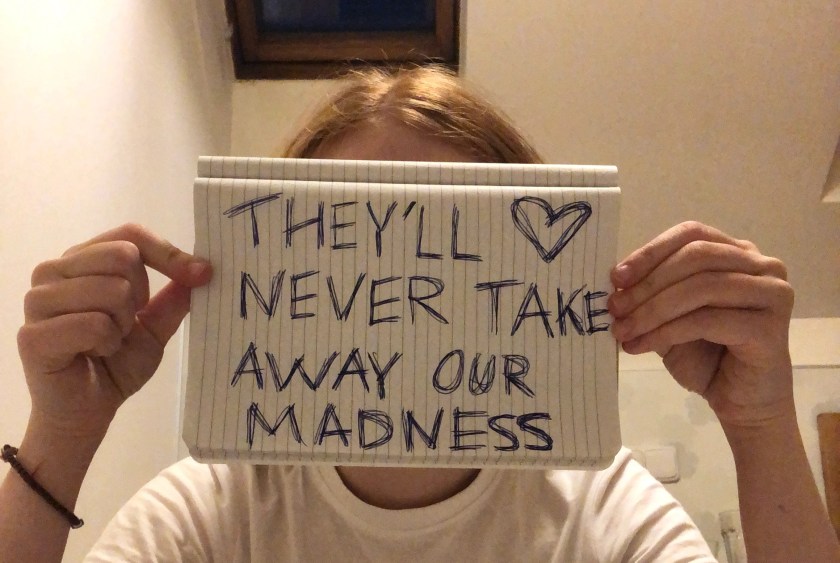
I want change, and it starts with us. With our dialogue – led by love and compassion and a willingness to learn. I want us to be validated without labels, and yet unafraid if a diagnosis is present. I want the criteria for diagnosis to reflect the diversity of the people who might be diagnosed. I want understanding and support of mental health built into every facet of our lives, including where we are fighting for justice elsewhere, because these are not stand alone issues. The ‘mad’ people are getting mad, and they don’t want that. I want change.

– Millie